Arm Wheels, Helm and Back Massager: Upper-Body Stations for Outdoor Trails
Sur un parcours santé, les volants font tourner deux disques indépendants (un par bras), le gouvernail impose une roue symétrique à deux mains, et le masseur détend le dos avec un rouleau vertical et un rouleau horizontal. Comptez 1 110 à 2 166 EUR excl. VAT pour les volants et gouvernails, 1 080 à 2 368,80 € pour les masseurs. Volants et gouvernail existent en version accessible en fauteuil roulant, pas le masseur.
On an outdoor fitness trail, three stations address the upper body without any added load: the arm wheels and the helm for shoulder and arm mobility, and the back massager for muscular release. These are mobility and recovery stations, and in practice they are among the most used pieces on any trail, particularly by older users and by walkers. This guide sets out what each one contributes and which versions are available.
Arm wheels and helm: two shoulder movements
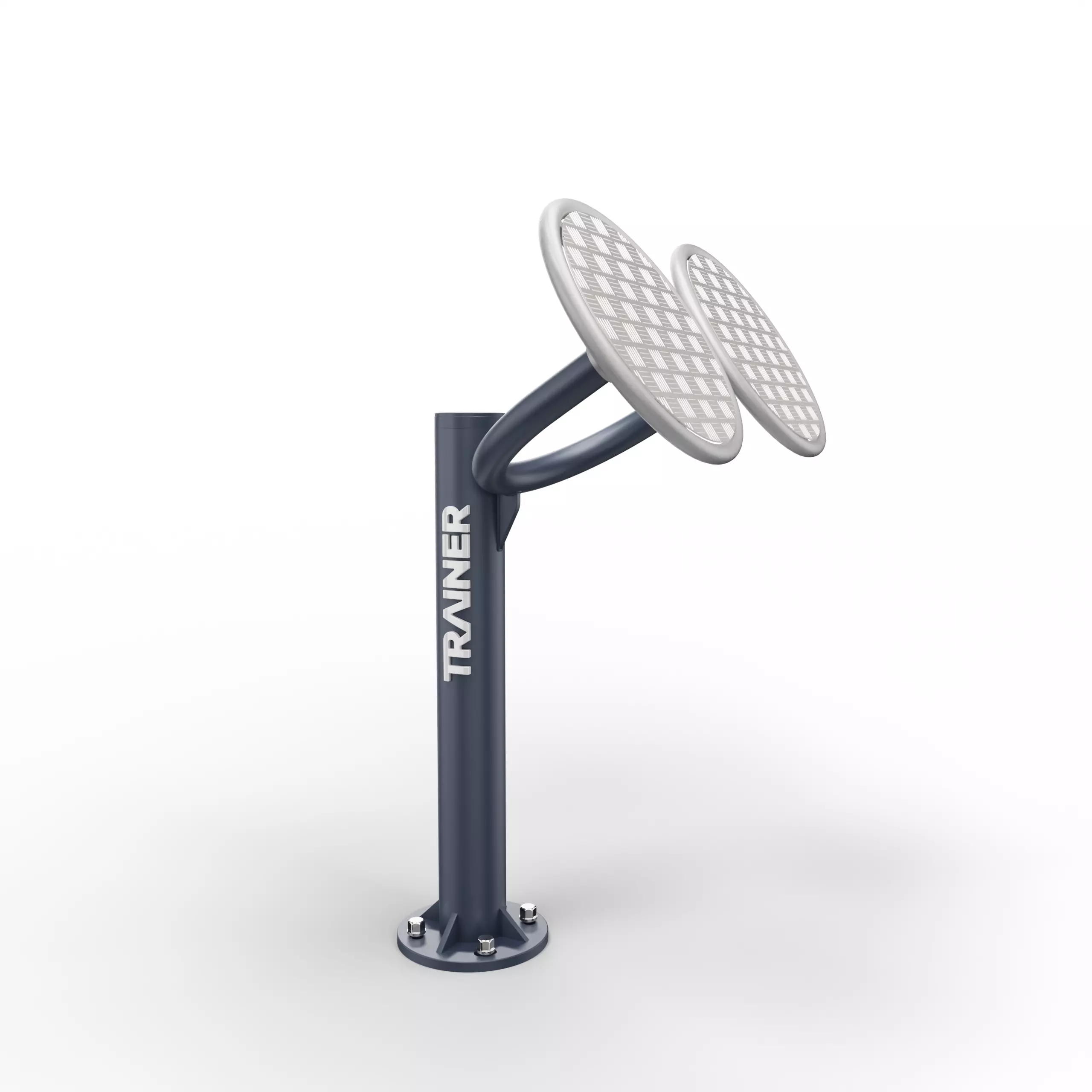
The arm wheels present two independent discs, one per arm: each shoulder turns at its own pace and through its own range, which allows a restricted side to be worked without being constrained by the other. The helm, by contrast, uses a single wheel gripped with both hands, producing a symmetrical, guided movement closer to a functional action. Both are rated easy in difficulty and weigh between 25 and 35 kg depending on the version.
| Reference | Movement | Range | Price ex VAT |
|---|---|---|---|
| Arm wheels, pylon mounted | Two independent discs | OutdoorFit | 1,110.00 EUR excluding VAT |
| Helm, pylon mounted | Two-handed wheel | OutdoorFit | 1,124.40 EUR excluding VAT |
| Single arm wheels | Two discs, one station | OutdoorStart | 1,236.00 EUR excluding VAT |
| Helm | Wheel, one station | OutdoorStart | 1,290.00 EUR excluding VAT |
| Steel4Fit arm wheels | Two reinforced discs | Steel4Fit | 1,392.00 EUR excluding VAT |
| Steel4Fit helm | Reinforced wheel | Steel4Fit | 1,418.40 EUR excluding VAT |
| Double arm wheels and double helm | Two stations | OutdoorStart | 1,596.00 EUR excluding VAT |
| Combined arm wheels and helm | Both movements | OutdoorStart | 1,638.00 EUR excluding VAT |
| Steel4Fit arm wheels and helm | Both, reinforced | Steel4Fit | 2,166.00 EUR excluding VAT |
The back massager, a recovery station
The back massager combines a vertical roller and a horizontal roller against which the user rolls their back while standing. It releases the muscles of the back and complements general muscular condition, and its logical place is at the end of the trail, after the strength stations. The combined version measures 1350 x 800 x 1600 mm for 60 kg, with a safety zone of 4350 x 3800 mm, and its difficulty is rated medium.
| Reference | Rollers | Price ex VAT |
|---|---|---|
| Vertical massager, pylon mounted | Vertical | 1,080.00 EUR excluding VAT |
| Horizontal massager, pylon mounted | Horizontal | 1,320.00 EUR excluding VAT |
| Steel4Fit vertical massager | Vertical, reinforced | 1,368.00 EUR excluding VAT |
| Steel4Fit horizontal massager | Horizontal, reinforced | 1,644.00 EUR excluding VAT |
| Vertical and horizontal massager | Both | 1,870.80 EUR excluding VAT |
| Steel4Fit vertical and horizontal massager | Both, reinforced | 2,368.80 EUR excluding VAT |
Wheelchair-accessible versions
The arm wheels and the helm are available in wheelchair-accessible versions: the E18 accessible arm wheels (740 x 1000 x 1920 mm, 35 kg, 1,195.20 EUR excluding VAT), the accessible helm (1,188.00 EUR excluding VAT) and the combined accessible arm wheels and helm (885 x 1000 x 1700 mm, 1,676.40 EUR excluding VAT). These stations make a trail usable by wheelchair users without creating a separate area for them, which is both better practice and cheaper than building two circuits. See the wheelchair-accessible stations category.
Composing the upper-body section of a trail
A common configuration pairs one shoulder mobility station (arm wheels or helm), one upper-body strength station and the massager at the end of the circuit. On a constrained site, the combined arm wheels and helm unit groups two movements on a single foundation, which saves both surface area and civil works. For an inclusive trail, allow at least one accessible station per movement family.
Outdoor fitness equipment for adults is covered by EN 16630, which governs the equipment itself and the safety zone around it. Whatever national procurement rules apply to your project, that standard is the technical reference to specify, and the safety zone is the figure most often left out of a site plan. The full ranges are in the OutdoorStart and Steel4Fit categories.
If a reference is unavailable
The helm substitutes for the arm wheels on shoulder mobility where dissociating the arms is not a requirement, and the reverse holds as well. Across ranges, the Steel4Fit version delivers the same movement in a reinforced construction. The two single massagers together replace the combined version, at the cost of two foundations instead of one.
Frequently asked questions
What is the difference between the arm wheels and the helm?
The arm wheels turn two independent discs, one per arm, which allows the shoulders to be dissociated and each side worked through its own range. The helm imposes a two-handed rotation on a single wheel, a symmetrical and guided movement. On a trail the two complement each other.
What is the back massager for?
It combines a vertical and a horizontal roller against which the user rolls their back. It releases the muscles of the back and improves general muscular condition, and it is the recovery station at the end of a trail.
Are these stations wheelchair accessible?
The arm wheels and the helm exist in accessible versions, with a raised working area and clear frontal approach for a wheelchair: the E18 accessible arm wheels, the accessible helm and the combined unit. The massager, which is used standing with the back to the equipment, has no wheelchair version.
Why do these stations suit older users?
They are mobility stations with no added load, rated easy in difficulty for both the arm wheels and the helm. They maintain shoulder joint range, which is often the first to become restricted with age, and that makes them well suited to retirement residences and urban trails.
Can the arm wheels and helm share one foundation?
Yes. The combined arm wheels and helm unit groups both movements on a single structure, available in the standard, Steel4Fit and accessible versions. It is the most economical option in both surface area and civil works.
Planning your trail
These three stations are inexpensive relative to what they add to a trail, and they are the ones that keep the users who are least likely to use a strength station coming back. Get the safety zones onto the site plan early and decide the accessible provision at the same time rather than adding it later.
Send us your site plan and we will lay out the circuit and price it. Request a quote to start.