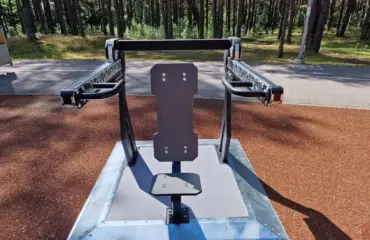
Outdoor Sports Park: The Complete Specification Guide
Un parc sportif de plein air combine agrès de fitness, parcours santé et zones de jeu sur un même site, en accès libre et sans encadrement. Les équipements relèvent de la norme EN 16630 pour le fitness et de l'EN 1176 pour les structures de jeu. L'implantation, le sol de réception et le plan de maintenance conditionnent la conformité de l'ensemble.
An outdoor sports park brings fitness apparatus, a fitness trail and children’s play zones together on a single open-access site that is used without supervision. The adult fitness equipment is governed by EN 16630, the play structures by EN 1176-1 and their impact-attenuating surfacing by EN 1177. Layout, surfacing and the maintenance plan are what decide whether the finished site is compliant, not the catalogue the equipment came from.
What an outdoor sports park actually is
An outdoor sports park is a permanently installed, publicly accessible training area. Nobody hands out a briefing at the entrance, nobody supervises the sets, and users arrive with every level of fitness and every body size. That single characteristic – unsupervised free access – drives every technical decision that follows. Equipment has to be self-explanatory, mechanically forgiving, resistant to misuse, and safe when three people use one station at once.
In practice a park is a combination of complementary zones rather than a row of machines: bodyweight and calisthenics structures, guided-resistance stations that use the user’s own weight, a fitness trail connecting the site, and frequently a separate area for children. Each zone answers a different brief and, importantly, a different standard.
Why public and private operators build them
For a municipality, a housing association, a campsite or a hotel group, the appeal is straightforward. The equipment runs without staff, without a booking system and without an energy bill. It is available at any hour, it serves residents who would never enter a commercial gym, and it stays useful in the shoulder seasons when indoor capacity is under pressure.
The operational reality is more demanding than the sales pitch. An open-access site is a piece of public infrastructure: it needs a documented inspection routine, an owner for that routine, and a budget line for spare parts. Sites that fail do not usually fail because the equipment was weak – they fail because nobody was named as responsible for checking it.
The zones of a park and the standard that governs each
| Zone | Typical content | Governing standard |
|---|---|---|
| Adult outdoor fitness | Guided-resistance stations, cardio-style apparatus, stretching posts | EN 16630 |
| Fitness trail | Sequenced stations linked by a running or walking route | EN 16630 |
| Calisthenics and street workout | Bars, rigs, wall bars, dip stations | EN 16630 |
| Children’s play area | Play structures, climbing units, swings | EN 1176-1 |
| Surfacing under play equipment | Rubber tiles, wet-pour, loose fill | EN 1177 |
Two mistakes account for most of the non-conformities found on delivered sites. The first is specifying EN 16630 apparatus inside a children’s area: EN 16630 covers permanently installed outdoor fitness equipment for adult use and does not apply to children’s play equipment, which belongs under EN 1176-1. The second is treating EN 1176-1 and EN 1177 as one requirement. They are separate: EN 1176-1 qualifies the structure, EN 1177 qualifies the ground that catches a fall from it. A perfectly compliant play unit installed over an unsuitable surface is a non-compliant installation.
Surfacing: the decision that carries the most risk
Surfacing is where budgets are cut and where inspections bite. The rule is that the critical fall height of each item of equipment determines the performance the surface has to deliver under EN 1177, and that performance has to hold across the whole impact area, not only directly beneath the structure.
Loose-fill materials are inexpensive to install and expensive to keep compliant, because they migrate and compact – they need topping up on a schedule, not on complaint. Bonded rubber surfaces cost more up front and hold their tested performance with far less intervention. Between the two, the deciding factor is usually not the purchase price but who will be maintaining the site in five years and how often they can realistically visit. Our range of playground surfacing is specified against the fall height of the equipment it serves.
In the adult fitness zone the surfacing brief is different again: the priority is drainage, slip resistance and durability under repeated footfall rather than impact attenuation, unless the apparatus itself creates a fall height that has to be treated.
Designing the layout
A good layout is mostly about the space between equipment, not the equipment. Every station needs its free space respected, and free spaces must not overlap in ways that let a user swinging on one unit reach a user on another. Circulation between zones should be readable without signage. Sight lines matter: open, overlooked sites are used more and vandalised less than sites screened by planting.
Separate the children’s zone physically from the adult zone. Mixing them is the single most common design fault – it invites children onto outdoor gym equipment that was never dimensioned for them, and it discourages the adults the park was built for. Add shade, seating and a water point if the budget allows; they extend dwell time more effectively than an extra station would.
Materials and lifespan
Outdoor equipment is judged over a decade, not over a delivery. The variables that decide how it ages are the steel treatment, the fastening system, the bearing design and the coating. Coastal and de-icing-salt environments are the hardest test: where the atmosphere is aggressive, stainless steel is the specification that survives, and the maintenance saving over the life of the site usually outweighs the higher purchase price.
Anti-vandalism detailing is worth specifying explicitly: tamper-proof fixings, no removable small parts, closed tube ends, and cabling or moving parts that cannot be reached without tools.
Maintenance and inspection
Compliance is not a delivery event, it is a routine. The workable model is three tiers: a frequent visual check for obvious damage and litter, a periodic operational check on wear, fixings and stability, and an annual principal inspection of the structural condition of the whole site, documented in writing. Keep the records: they are what an operator relies on if an incident is ever investigated.
Budget for consumables from day one – fixings, bearings, grips and surfacing top-ups. A park with a maintenance budget stays open; a park without one closes station by station.
Frequently asked questions
Can EN 16630 equipment be installed in a children’s playground?
No. EN 16630 applies to permanently installed outdoor fitness equipment intended for adult use. Children’s play equipment is covered by EN 1176-1 and its surfacing by EN 1177. The two families are specified, installed and inspected separately.
Does an outdoor sports park need impact-attenuating surfacing everywhere?
No. The requirement is driven by fall height. Areas under play equipment need surfacing qualified to EN 1177 for the relevant fall height; adult fitness zones need a durable, well-drained and slip-resistant surface, with impact attenuation only where the apparatus creates a fall height that requires it.
How long does an outdoor sports park last?
That depends on the material specification, the exposure of the site and the inspection routine far more than on the intensity of use. Galvanised and coated steel performs well inland; aggressive coastal or salt-exposed sites justify stainless steel.
Who is responsible for the site once it is open?
The operator of the land. Supplying compliant equipment does not transfer that duty, which is why the inspection routine has to be named, resourced and recorded before the site opens rather than after.
Specifying your project
An outdoor sports park is a design exercise before it is a purchase: define the zones, apply the right standard to each, size the surfacing against fall heights, and set the maintenance routine while the layout is still on paper. Send us the plan, the user profile and the exposure of the site and we will return a zoned layout with the matching equipment and surfacing specification. Request a quote and our team will work through the brief with you.
Réalisations documentées
- Cage street workout ultime, Carcassonne – armée française
- Cage street workout ultime, Tahiti – armée française, Polynésie
- Cage SP Max, centre EPIDE de Combrée – établissement public d’insertion
- Cage SP Max, lycée Saint-Bénigne de Dijon – établissement scolaire
Sources et références
- NF EN 16630 – modules fixes d’entraînement physique de plein air : exigences de sécurité et méthodes d’essai (AFNOR)
- Code du sport, article L322-2 – garanties d’hygiène et de sécurité des établissements d’activités physiques et sportives (Légifrance)