Obstacle course racing in modern pentathlon: the equipment brief
La course d'obstacles remplace l'équitation dans le pentathlon moderne à partir des Jeux de Los Angeles 2028. Ce changement modifie la préparation des athlètes et crée un besoin d'équipements de parcours d'obstacles dans les clubs et les pôles. Les structures concernées relèvent de la norme EN 16899 pour le parkour et les parcours sportifs.
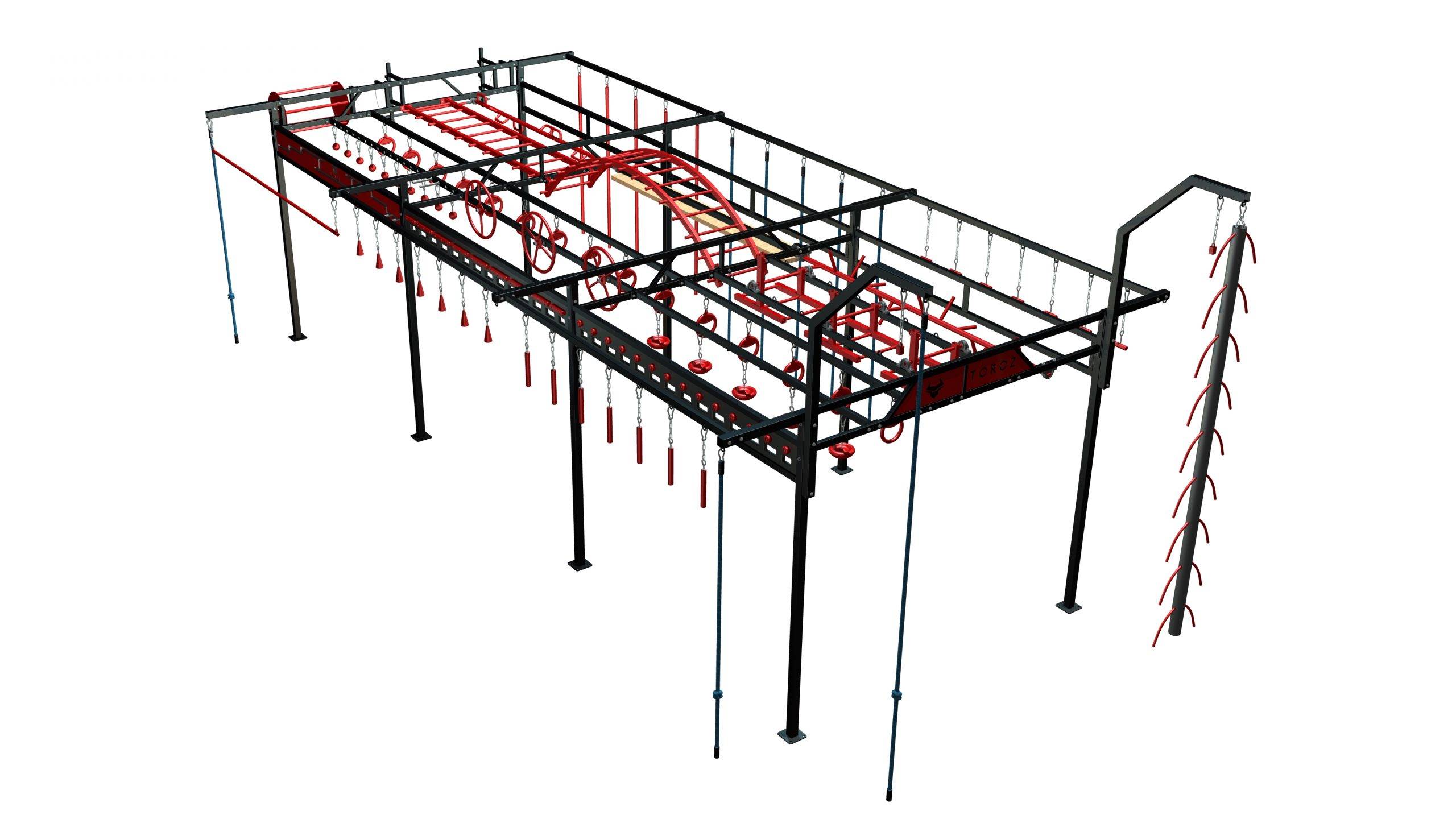
From the Los Angeles 2028 Games, obstacle course racing replaces riding as the fifth event of modern pentathlon. The decision taken by the Union Internationale de Pentathlon Moderne changes how pentathletes are prepared, and it opens a new equipment line for clubs, national training centres and event organisers: a permanent or demountable obstacle rig, specified against EN 16899, the European standard covering parkour and obstacle equipment.
Modern pentathlon: five sports, one athlete, a new fifth event
Modern pentathlon asks a single athlete to be competitive in disciplines that share almost nothing. Swimming rewards aerobic endurance and technique in the water. Fencing rewards precision, timing and the ability to read an opponent. The laser run combines running with target shooting under a rising heart rate, which is a control problem as much as a fitness one. The fifth event was riding an unfamiliar horse. It becomes an obstacle course.
For the athlete, that is a different physical profile: upper body pulling strength, grip endurance, body control in the air and the ability to repeat maximal efforts with very short recovery. For the buyer, it is a different capital item: instead of an equestrian venue, a stable and a warm-up arena, the discipline now needs a structure that can be installed in a sports hall, on a training ground or in a city centre for a competition weekend.
Why the governing body changed the fifth event
Three arguments carry the decision, and each one has a direct consequence for equipment procurement.
Cost. Riding is the most expensive event to stage and the hardest to reproduce in training. Removing horses removes the equestrian venue, the animal welfare obligations and a large share of the organising budget. An obstacle rig is bought once and amortised over years of training and events.
Accessibility. A club that could never offer riding can install an obstacle course. That lowers the barrier to entry for the discipline and widens the base of athletes a federation can recruit from, including athletes already competing in obstacle course racing and ninja disciplines.
Spectacle. An obstacle course is legible on screen. A viewer with no knowledge of the sport understands immediately who is winning, which is not true of fencing rankings or riding penalties. Broadcasters buy that, and venues fill.
The obstacles retained and what they demand of a structure
The obstacle set announced for the discipline is built around ascending steps, rope swings, climbing walls and monkey bars. Each one loads the frame differently, and that is what drives the specification of the rig underneath.
| Obstacle | Physical quality tested | Structural consequence |
|---|---|---|
| Ascending steps | Explosive leg drive, landing control | Static load and impact on the step frame, anti slip surface, no sharp edges on the landing side |
| Rope swing | Grip endurance, timing, body control in flight | Dynamic load at the anchor point, swept volume kept clear, fall zone treated over the whole trajectory |
| Climbing wall | Upper body pulling strength, transition over the top edge | Overturning moment on the frame, ballast or ground anchoring, rounded top edge |
| Monkey bars | Grip, shoulder stability, rhythm | Bar deflection under load, bar diameter matched to grip, fall height governing the surfacing below |
Two points matter more than the obstacle list itself. The first is the anchoring: a swing and a wall generate dynamic and overturning forces that a rig sized only for static load will not absorb. The second is the fall zone, which is not the footprint of the obstacle but the volume an athlete can actually travel through after losing a grip. Both are decided at the design stage, not on the day of installation.
Which standard applies to an obstacle rig
This is the question that most often goes wrong in a tender, because four different European standards circulate in the same conversation and they are not interchangeable.
- EN 16899 covers parkour equipment and is the reference for obstacle structures of this type. It is the standard to name in a specification for a pentathlon or obstacle course training rig.
- EN 16630 covers permanently installed outdoor fitness equipment for adults. It applies to an outdoor fitness trail, not to a competition obstacle rig.
- EN 1176-1 covers playground equipment and EN 1177 covers impact attenuating playground surfacing. They belong to children’s play areas. They are never applied to an adult obstacle course, and the two must not be confused with each other: EN 1176-1 is the equipment, EN 1177 is the surface.
- EN ISO 20957-1 class S covers stationary training equipment for professional use, which is what a pentathlon squad trains on indoors between obstacle sessions.
Our parkour equipment and obstacle trail modules are specified for professional installations, and complete OCR obstacle courses can be configured as a fixed training installation or as a demountable competition set.
Who needs to equip, and for which athletes
The change concerns every competition category: under 19, junior and senior pentathletes, and athletes already experienced in obstacle disciplines who now have a route into pentathlon. In practice, that puts four types of buyer in front of the same question.
National federations and training centres need a permanent installation that matches the competition obstacle set, because the transfer of skill from a generic rig to a competition course is poor above a certain level.
Clubs need a scalable structure: a first configuration that covers the fundamental movement patterns, with the ability to add modules as the section grows.
Local authorities and school sport can use the same equipment outside the competition season for physical education and open access training, which is usually what makes the investment defensible.
Event organisers need a demountable set that can be transported, built and taken down inside the window a host venue gives them.
What organisers have to plan for
Staging an obstacle event is a logistics exercise before it is a sporting one. The venue has to take the anchoring loads and offer a clear volume above and around the course. Build and dismantle time has to be costed into the event schedule, because each configuration changes with the obstacles selected. The safety brief has to be delivered to competitors before they run, and the fall zones have to be treated with a surface appropriate to the fall height of each obstacle.
None of this is unusual for an organiser who has staged an obstacle race before. It is new for an organisation that has spent decades staging an equestrian event, and it is where most of the first year of transition cost sits.
Frequently asked questions
Can an obstacle rig be installed indoors?
Yes, provided the hall offers the clear height the obstacles require and the floor or structure can take the anchoring. Freestanding ballasted configurations exist for venues where drilling into the slab is not permitted.
Can the same structure serve pentathlon training and general club use?
It can, and that is usually how the investment is justified. The obstacle set stays the same; what changes is the progression offered to non competitive users, through lower entry variants of the same movement patterns.
Fixed installation or demountable set?
A training centre buys fixed. An organiser who moves between host cities buys demountable, and accepts a longer build time in exchange. Some federations run both: a fixed course at the training base and a transportable set for events.
Specifying your installation
An obstacle course is a structural project, not a catalogue purchase: the anchoring, the fall zones and the clear volume are decided before the module list. Send us your site plan, your clear height and the categories of athlete who will use it, and we will return a configuration and a costed proposal. Request a quote and our technical team will come back to you with a layout.
Réalisations documentées
- Parcours ninja sur mesure, Rennes – îlot des Hautes-Ourmes
- Double mur ninja extérieur, Sallanches – Haute-Savoie