What Is the Right Surfacing for a Safe Street Workout Park?
Laying out a safe street workout park turns on one decision that is easy to underestimate: the surfacing. It is the only component every user touches on every repetition, it takes every dropped body weight, and it is the element that a local authority, a housing association or a campus facilities team will be asked about first if something goes wrong. Resistance, durability and safety all have to be satisfied at once, because the people using the installation will be doing varied and sometimes intense activities that place very specific demands on the floor.
Slip resistance comes first
A surface for a street workout park cannot afford to be slippery, and least of all in wet conditions. That rules out a large part of the catalogue immediately and points to two families.
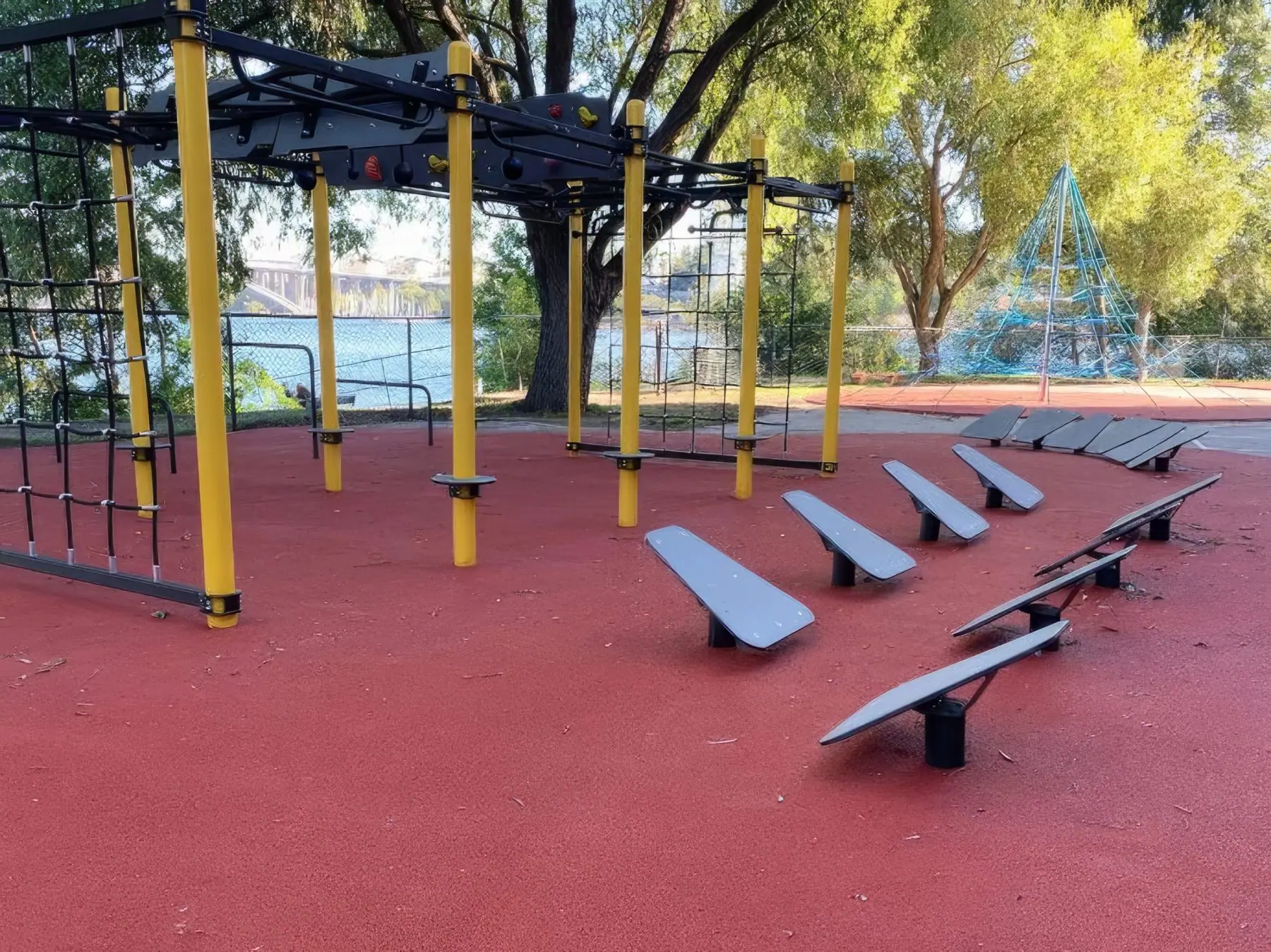
Rubber and resin surfaces are the reference answer, because they combine a genuinely non-slip surface with the ability to absorb impact. Rubber in particular is available as tiles, as rolls or as pavers, offers high resistance to wear and abrasion, and provides acoustic damping that reduces the noise generated by impacts, which matters a great deal when the park sits close to housing.
Synthetic surfaces such as vinyl or PVC sports flooring are a valid option too. They are easy to clean, durable, straightforward to install through bonded or clip-together systems, and available in a wide range of colours and finishes, which gives the designer something to work with visually.
Our outdoor sports flooring range covers both families, and our rubber flooring rolls answer the large continuous areas where joints are best avoided.
Thickness and zoning
Thickness is the next decision, and it is not uniform across the site. The rule is to specify tiles or rolls with a minimum thickness that guarantees adequate protection against shocks and impacts under each structure, and rubber is supplied in a range of thicknesses precisely so that resistance can be matched to the most heavily used zones.
In practice a park splits into three zones: the impact zone under and around the bars and rigs, where the surfacing does the safety work; the circulation zone between structures, where wear resistance and drainage matter more than absorption; and any fixed-installation zone, where a rigid surface can be appropriate. Concrete areas can be considered for those fixed installations. They are harder underfoot, but their durability and weather resistance are real advantages, and they should be kept away from the fall zones rather than used across the whole site.
Which standards apply
Outdoor fitness and street workout equipment for adults falls under EN 16630. Where impact-attenuating surfacing is required, its performance is assessed to EN 1177. Those two references are separate from the children’s playground framework: EN 1176-1 covers playground equipment and must never be applied to adult street workout structures, just as EN 16630 must never be applied to children’s play equipment. Ask your supplier which standard each element of the installation was tested against, and expect a documented answer rather than a reassurance.
Joints, heat and surface regularity
Safety is not only about absorption. A good surface should offer thermal insulation, which becomes a live issue on a site fully exposed to the sun, where a dark surface can become uncomfortable to touch during a summer afternoon.
The joints between tiles deserve careful attention. Poorly executed joints create exactly the two defects a training surface cannot tolerate: a slip risk, and an irregularity in the surface that becomes a trip hazard the moment a user steps off a bar without looking down. Where the layout allows, continuous rolls remove the question entirely.
Environmental profile
The environmental dimension has become a decision criterion in its own right, particularly for public procurement. Many manufacturers now offer surfaces made from recycled materials, including certain polyethylene and composite floor coverings, and ranges built on recycled granulate. Choosing products that do not harm the environment is worth doing on its own merits, and in a tender it is frequently worth points.
Maintenance
Finally, maintenance decides what the park looks like in year five. Resin and rubber surfaces are among the easiest options to maintain, which is the main reason they dominate this application. Surfaces that need regular specialist care, with wax or epoxy treatments to preserve their appearance and durability, belong to a different building type altogether and should not be brought onto an outdoor training site.
Comparison at a glance
| Surface | Strengths | Best used for |
|---|---|---|
| Rubber tiles | Non-slip, impact absorbing, acoustic damping, wear resistant | Impact zones under rigs and bars |
| Rubber rolls | Same properties, far fewer joints | Large continuous training areas |
| Rubber pavers | Robust, modular, easy to replace locally | High-traffic and repair-prone areas |
| Resin | Seamless, non-slip, easy to maintain | Whole-surface treatments |
| Vinyl and PVC | Easy upkeep, bonded or clip systems, wide colour range | Design-led and covered areas |
| Concrete | Durability, weather resistance | Fixed installation zones only, away from fall zones |
Frequently asked questions
What is the best surface for a street workout park?
Rubber or resin. Both combine resilience and safety, and concrete zones can be added for fixed installations where no fall protection is required.
How thick should the surfacing be?
Thick enough to give adequate protection against shocks and impacts in the zone concerned. Rubber comes in several thicknesses so that the specification can follow the loading of each area rather than applying one figure everywhere.
Do joints matter?
Yes. Badly executed joints create slip and trip hazards. Where the geometry allows it, continuous rolls avoid the problem; where tiles are used, the jointing detail should be specified, not left to the installer.
Can recycled materials be used?
Yes. Ranges based on recycled granulate, polyethylene and composites are widely available and perform to the same requirements.
In summary
For a safe street workout park, the right answer is a rubber or resin surface combining resilience and safety, with concrete zones where fixed installations call for them. Priority always goes to materials that absorb impact, are non-slip, are easy to maintain, respect the environment and still look good in five years.
Light In Fitness supplies both the street workout rigs and the surfacing that goes under them, which means one specification, one set of fall zones and one delivery. Send us the site plan and the intended user profile: request a quote.
Réalisations documentées
- Cage street workout ultime, Carcassonne – armée française
- Cage street workout ultime, Tahiti – armée française, Polynésie
- Cage SP Max, centre EPIDE de Combrée – établissement public d’insertion
- Cage SP Max, lycée Saint-Bénigne de Dijon – établissement scolaire
Sources et références
- NF EN 16630 – modules fixes d’entraînement physique de plein air : exigences de sécurité et méthodes d’essai (AFNOR)
- Code du sport, article L322-2 – garanties d’hygiène et de sécurité des établissements d’activités physiques et sportives (Légifrance)