What Is Calisthenics and Which Equipment Should You Buy?
Le calisthénics, ou street workout, utilise le poids du corps comme unique résistance, entre gymnastique et musculation. La pratique demande peu de matériel : barre de traction, barres parallèles, espalier et anneaux couvrent l'essentiel des mouvements. En équipement collectif extérieur, ces agrès relèvent de la norme EN 16630.
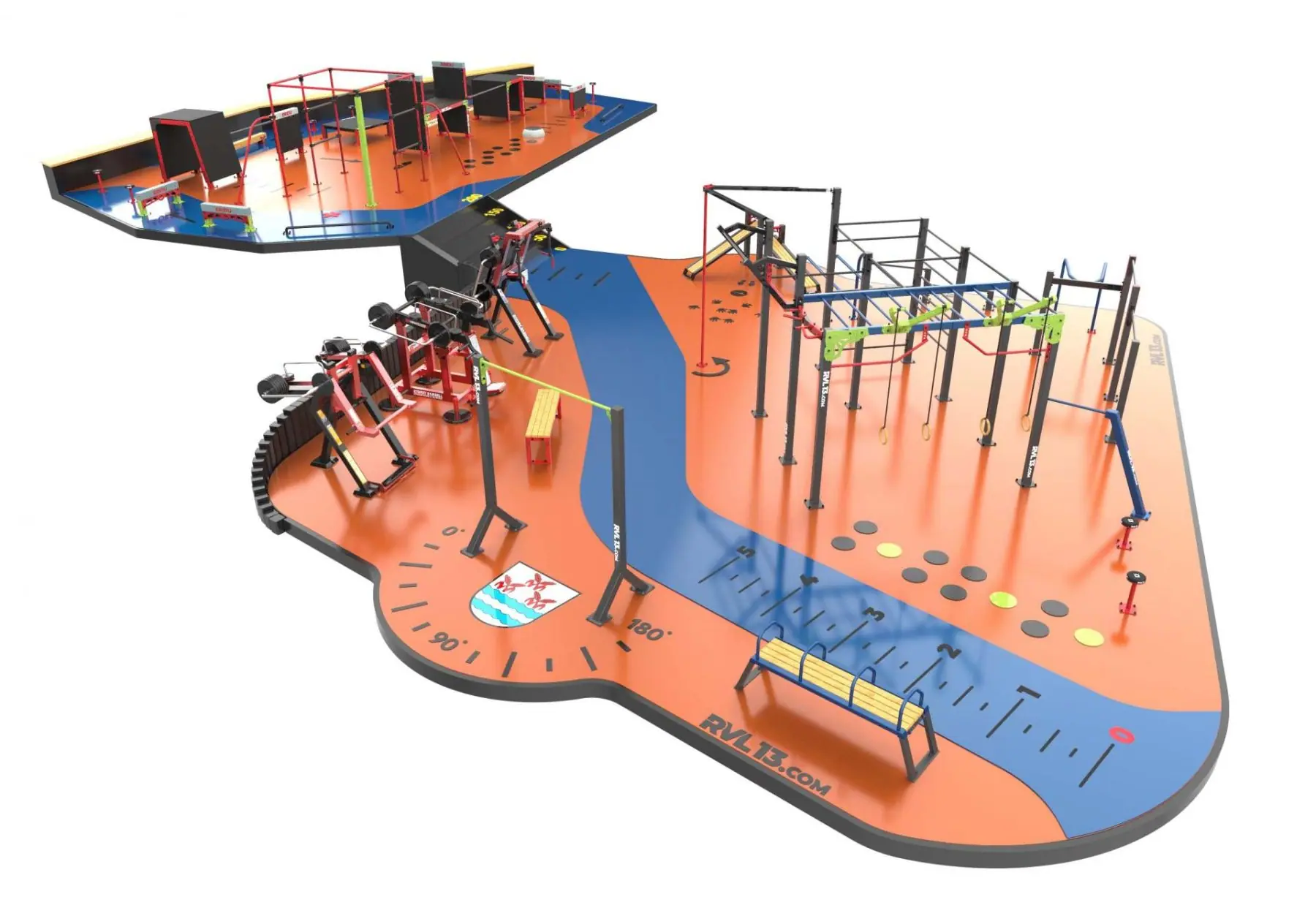
Calisthenics, also known as street workout, has moved from park culture to a discipline that clubs, municipalities, schools and armed forces now build facilities for. It sits between gymnastics and strength training and rests on one principle: the body is the resistance. It is accessible, spectacular to watch and extremely effective, and it works outdoors as well as indoors. This guide covers what the discipline is, what it trains, what equipment it needs, and how to specify that equipment when the installation has to serve the public rather than one athlete.
What calisthenics is
Definition and origins
The word comes from ancient Greek, kallos meaning beauty and sthenos meaning strength. It originally described the art of developing strength, flexibility and body control through natural movement. Popularised in the 2000s through street workout in urban parks, calisthenics is now recognised as a complete discipline combining raw strength, endurance, explosiveness and body control.
Core principles
Unlike training with free weights or machines, calisthenics is built on three things: bodyweight movements (pull-ups, push-ups, squats, dips, planks), a mix of dynamic and static skills (muscle-up, front lever, human flag), and gradual progression, since every movement has an easier and a harder variation. That last point is what makes it viable for a public installation: the same bar serves a first-time user and an advanced athlete.
What it delivers
Physical benefits
Balanced development of functional strength, better coordination, mobility and flexibility, an athletic and proportionate physique, and joint reinforcement through movements that load the body in the positions it actually uses.
Mental and social benefits
Visible progression produces a strong sense of achievement, the discipline rewards consistency, and it has an unusually strong community dimension: training groups form spontaneously around a rig, and outdoor challenges bring people back. For a municipality, that community effect is often the real return on the installation.
The equipment calisthenics needs
The discipline can be practised with nothing at all, but equipment is what allows progression and prevents injury.
Basic apparatus
- Pull-up bars, the foundation: pull-ups, muscle-ups, hangs and leg raises.
- Parallel bars, dip bars and parallettes, for dips, L-sits and handstand work.
- Gymnastic rings, which add instability and open up the full range of gymnastic progressions.
- Resistance bands, used both to assist pull-ups for beginners and to add load for advanced users.
- Mats or rubber tiles, for comfort and for safe landings.
Professional structures
For clubs and public installations, the practical answer is a cage or a rig rather than a collection of separate items. A structure carries multi-position fixed bars, integrated dip stations, monkey bars and modular elements that can be extended later, and it concentrates a full training circuit into a defined footprint. Our range is grouped under calisthenics and street workout cages, with larger configurations under street workout rigs.
Surfacing
Surfacing is not an accessory on a calisthenics installation, it is part of the safety case. Where the free height of fall requires it, impact-attenuating surfacing is mandatory and its performance is verified by the EN 1177 test method. Outdoors this normally means bonded rubber or rubber tiles rather than grass, which turns to mud under a busy rig. Indoors, rubber tiles protect both the users and the floor slab. See outdoor sports flooring for the usual specifications.
Choosing the right equipment
Structural quality. Reinforced steel sections, welded rather than bolted where the load path demands it, and a genuine anticorrosion treatment for outdoor use: hot-dip galvanising plus powder coating as standard, stainless steel on coastal or salted sites.
Compliance. This is where a purchase is won or lost. Permanently installed, freely accessible outdoor training equipment for adults must meet EN 16630, which governs structural strength, entrapment prevention, fall protection, corrosion resistance and the free space around each station. Indoor equipment for shared professional use is covered by EN ISO 20957-1 class S. Equipment intended for children is a different regime again, under EN 1176-1 with surfacing under EN 1177, and the two must never be mixed as if they were interchangeable.
Modularity. A structure that can be extended lets an installation grow with its user group instead of being replaced.
Ergonomics. Bar diameter, grip finish and the spacing between stations decide whether the rig is actually usable by people of different heights and levels.
Durability over headline price. On a public installation the purchase price is a small part of the total cost. Foundations, surfacing, inspection and repair make up the rest, and cheap steel multiplies all of them.
Where the equipment goes
Three contexts dominate. Outdoor public parks, where the municipality owns the land, remains the operator of the installation and carries the inspection duty. Clubs and gyms, where a rig adds a functional training zone in a footprint that a machine circuit could not match. Schools, campsites, hotels and armed forces sites, where a compact structure covers an entire training programme with no moving parts to maintain.
Frequently asked questions
Is calisthenics suitable for beginners?
Yes. Every movement has a regression, and resistance bands make pull-ups accessible from the first session. That is precisely why it works in public spaces with mixed ability levels.
What is the minimum equipment to start?
A pull-up bar, a mat and a set of bands cover the essential movements. Parallel bars and rings widen the range considerably.
Can a calisthenics station be installed outdoors?
Yes, provided the equipment is designed for it: anticorrosion treatment, permanent anchoring into foundations specified by the manufacturer, and compliance with EN 16630. Indoor equipment bolted outside meets none of those conditions.
Is rubber surfacing really necessary?
Where the free height of fall requires impact attenuation, it is not optional. Beyond the regulatory case, it also protects the equipment, controls noise and keeps the area usable in wet weather.
How does calisthenics differ from conventional strength training?
Conventional training adds external load through dumbbells and machines; calisthenics changes leverage and body position instead. The two are complementary, and most complete facilities offer both.
Does calisthenics build muscle?
Yes. Progressive overload comes from harder variations rather than heavier plates, and the result is lean, athletic and functional musculature.
Specifying your installation
Whether the project is a public street workout park, a functional zone inside a club or a compact structure for a school or hotel, the process is the same: surface area, exposure, user profile and budget frame, then a layout, an EN 16630 or class S specification as appropriate, and the foundation and surfacing detail. Send us those elements and we will come back with a costed proposal: request a quote.
Réalisations documentées
- Cage street workout ultime, Carcassonne – armée française
- Cage street workout ultime, Tahiti – armée française, Polynésie
- Cage SP Max, centre EPIDE de Combrée – établissement public d’insertion
- Cage SP Max, lycée Saint-Bénigne de Dijon – établissement scolaire
Sources et références
- NF EN 16630 – modules fixes d’entraînement physique de plein air : exigences de sécurité et méthodes d’essai (AFNOR)
- Code du sport, article L322-2 – garanties d’hygiène et de sécurité des établissements d’activités physiques et sportives (Légifrance)
À lire aussi sur le même thème
- Découvrez la station d’entraînement urbain: votre module de calisthénics en plein air
- Street Workout Cages and Calisthenics Structures: How to Choose and Why Buyers Choose Light In Fitness
- Outdoor Fitness Areas for Hotels and Holiday Parks
- Buying a galvanised steel playground: documents, impact areas and real costs