Buying a galvanised steel playground: documents, impact areas and real costs
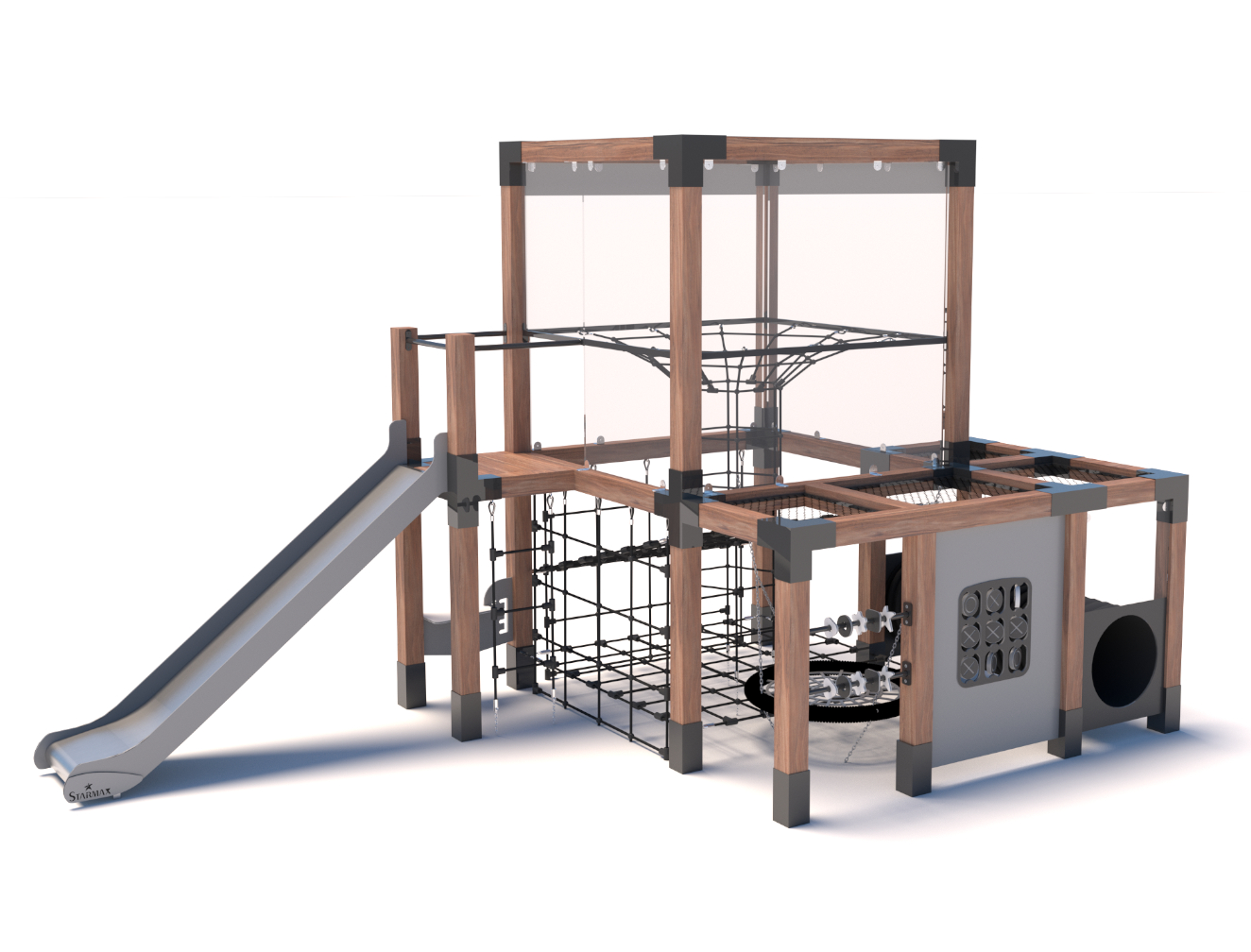
A playground is not a furniture purchase, it is a regulated installation for which the operator stays liable for its whole service life. Hot dip galvanised steel has become the reference material for local authority and commercial sites, but the material is only half the subject. The other half is the paperwork you demand from the supplier, and the budget lines that sit outside the structure itself. This guide covers material choice, the documents to request one by one, impact areas and surfacing, selection by age group, realistic catalogue prices and how public buyers finance the project.
Why hot dip galvanised steel became the standard
Hot dip galvanising deposits a metallurgically bonded zinc layer on the steel that protects in two ways: as a barrier, and sacrificially when the coating is scratched. Combined with powder coating it gives the best compromise available for outdoor sports and play structures inland. Stainless steel takes over in coastal locations, where chloride laden air attacks ordinary coatings, and the grade must be specified explicitly rather than assumed.
| Material | What it gives | What it demands | Where to use it |
|---|---|---|---|
| Hot dip galvanised and powder coated steel | High mechanical strength, good corrosion resistance, wide colour range, low maintenance | Touch up after deep impacts and scratches, periodic anchor checks | The standard, everywhere inland |
| Stainless steel | Superior performance in chloride atmospheres | Higher cost, grade to be stated in the specification | Coastal sites exposed to sea spray |
| Timber | Landscape integration, visual warmth | Wear and splinter monitoring, evidence of permitted treatments | Natural settings, design led projects |
| HPL and HDPE panels | Through coloured, UV stable, easy to clean, graffiti resistant | Check panel thickness and fixings on large spans | Decks, walls, platforms on most structures |
A word on service life claims. You will often read that galvanised structures last more than 20 years according to standards body studies. Standards bodies write standards, they do not publish product durability studies, so we do not repeat that attribution. What actually determines longevity is zinc coating thickness, site exposure, anchor quality and maintenance discipline. Ask instead for the contractual warranty in writing and in years. Ours runs to 20 years on steel structures, which is an enforceable commitment rather than a marketing claim.
The documents to demand, and the CE marking myth
Tender documents frequently ask for CE marking on playground equipment to guarantee lawful placing on the market. That is incorrect. Playground equipment is not covered by a CE marking directive. In France the framework is decree 94-699 of 10 August 1994, which sets the safety requirements and provides for type examination by an approved body. Asking for the wrong document leaves you with a file that is useless at inspection.
Request each of the following, item by item: a declaration of conformity to the applicable national safety decree, reference by reference; the type examination report from an approved body where applicable; the declaration of conformity to the EN 1176 series, stating which parts apply to the modules selected, whether swings, slides or rope structures; the surfacing test report to EN 1177 with the measured critical fall height; assembly and maintenance instructions in your language with inspection intervals; a spare parts list with a stated availability commitment in years; and the as built drawings and handover report after installation.
Two duties, not one. The manufacturer is bound on the equipment. The operator is separately bound on the playground as a whole, in France by decree 96-1136 of 18 December 1996: siting, display of age ranges and rules, maintenance, periodic inspections and a dated register. Buying compliant equipment does not by itself make you compliant.
Impact areas and surfacing: the two numbers that matter
Another widely repeated rule is to allow 2 metres of clearance around every item. The actual reference is different: the impact area measures at least 1.50 m around the equipment for a free height of fall between 0.60 and 1.50 m, then follows the formula of two thirds of the fall height plus 0.50 m above 1.50 m. A single flat figure either undersizes a tall structure, which is dangerous, or overpays on a low one.
| Free height of fall | Surfacing required | Impact area |
|---|---|---|
| Up to 0.60 m | Impact attenuating surface, no formal certification required. Concrete and asphalt excluded in every case | 1.50 m |
| 0.60 m to 1.50 m | Surface with a critical fall height at least equal to the free height of fall | 1.50 m |
| Above 1.50 m | Same, with critical fall height evidenced by test report | Two thirds of the height plus 0.50 m |
Choose between rubber safety tiles, graded wood chips or poured EPDM according to budget and accessibility requirements. On the question of whether surfacing is compulsory: the operator decree requires appropriate impact attenuating materials in landing zones without making any standard mandatory in itself. EN 1177 is the recognised way to demonstrate that the surface meets that requirement, by measuring critical fall height, and it is that demonstration your inspection body and your insurer will ask for. An assertion of compliance without a test report is worth very little.
Choosing by age group
| Age group | Relevant modules | Watch points |
|---|---|---|
| 2 to 6 years | Low slides, cradle swings, spring riders, activity panels, raised sand trays | Low fall heights, head and neck entrapment, physical separation from older children |
| 6 to 12 years | Multi activity structures, climbing walls, rope nets, suspended bridges, tube slides | Extended impact areas, circulation and collisions, higher fall heights |
| All ages, inclusive use | Cradle swings, shared play at several difficulty levels, sensory activities, trafficable paths | Inclusion is designed into the overall layout, not bolted on as one module at the end |
| 12 years and over | Ninja courses, children’s fitness trails | Governed by other reference standards than EN 1176, so treat as a separate zone |
What a playground really costs
The bands below come from references actually in our catalogue, at list price excluding VAT for the structure alone.
| Project level | Typical references | Price excluding VAT |
|---|---|---|
| Entry module, small footprint, school or residential | Children’s sports course sets | 2,055 to 5,350 EUR |
| Timber multi activity structure, nursery, campsite, neighbourhood park | Timber cube with slide, net and deck, and the Maxi version with climbing and tunnel | 20,500 to 28,500 EUR |
| Modular playground, municipal park, family campsite | Modular HPL structures with slides | 36,000 to 80,000 EUR |
| Tower structure, urban park, high capacity | HPL tower structures with slide | 67,000 to 84,000 EUR |
| Flagship playground, leisure park | XXL modular structures and large towers | 107,000 to 375,000 EUR |
What those figures exclude matters more than what they include. Budget separately for impact attenuating surfacing across the whole impact area, earthworks and drainage, foundations and concrete blocks, transport and lifting, assembly, signage giving age ranges, rules and the operator’s contact details, and the handover inspection. The gap between the first quotation and the final invoice always opens on those lines, never on the structure.
Frequently asked questions
Should we require CE marking on playground equipment?
No. Playground equipment falls outside CE marking directives. Ask for the declaration of conformity reference by reference, the type examination report where applicable, and the EN 1176 declaration stating the applicable parts.
How much space does a playground actually need?
Size it on the sum of the impact areas plus circulation, never on the footprint of the structures. That is why a compact looking layout can still fail at design review.
Is impact attenuating surfacing mandatory?
Concrete and asphalt are excluded under any equipment. Certified surfacing with an evidenced critical fall height becomes necessary as soon as the free height of fall exceeds 0.60 m.
How do public buyers fund a playground?
Through national rural and local investment grants and regional schemes. Application windows are strict, typically between October and December of the preceding year, and a late file simply is not programmed.
Do you manufacture everything you sell?
We manufacture our steel and stainless steel structures in our own workshops and distribute ranges from European partners alongside them. We prefer to say so plainly: what matters to you is the listed price, documented compliance and parts availability.
Get a compliant playground specification
Light In Fitness has equipped more than 2,500 customers since 2013 from Tours, France, and supplies a 3D layout drawing that verifies impact areas and circulation before you order, plus the full compliance pack at handover. Public buyers receive the unit price schedule, price breakdown and technical specification annexes their procedure requires. Send us your site plan and you will have a costed proposal within 24 working hours. Delivery covers France, Belgium, Switzerland and Luxembourg, with export quoted per project. See playground equipment and playground surfacing, or request a quote.
Réalisations documentées
- Parcours ninja sur mesure, Rennes – îlot des Hautes-Ourmes
- Double mur ninja extérieur, Sallanches – Haute-Savoie
- Dalles et sols sportifs : livraisons documentées – plusieurs chantiers
- Sol sportif extérieur, square Georges-Vallerey – Taverny (95)
Sources et références
- Décret n° 96-1136 du 18 décembre 1996 – prescriptions de sécurité relatives aux aires collectives de jeux (Légifrance)
- NF EN 1176-1 – Équipements et sols d’aires de jeux, partie 1 : exigences de sécurité et méthodes d’essai générales (AFNOR)
- NF EN 1177 – revêtements de surface amortissants : détermination de la hauteur de chute critique (AFNOR)
- Code de la commande publique – texte intégral en vigueur (Légifrance)