Playgrounds and Outdoor Sports Equipment for Campsites and Hotels
In brief: equipping a campsite or a hotel with play areas and outdoor sports equipment means meeting the safety standards that apply to publicly accessible installations, in particular free space around each unit and impact-attenuating surfacing. Material choice follows exposure: 316L stainless steel is the material for coastal sites. Light In Fitness manufactures its own structures.
Why play areas and sports equipment pay for themselves
Hotels and campsites no longer compete on accommodation alone. Guests look for a stay that combines rest, entertainment and physical activity, and two facilities do most of that work: a play area for children, and outdoor sports equipment for teenagers, adults and older guests.
For campsites
- Attract families with children, who book longer stays.
- Provide daily activity without adding staff.
- Support the site classification, where sports facilities are part of the criteria.
- Extend the average stay and bring guests back the following season.
For hotels
- City hotels gain a genuine reason for families to choose them.
- Seaside hotels and resorts gain an alternative to the beach and the pool, which matters on a wet day.
- Upscale properties gain an active, contemporary image that photographs well.
What we manufacture
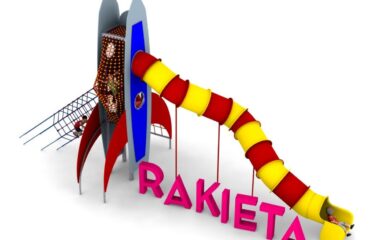
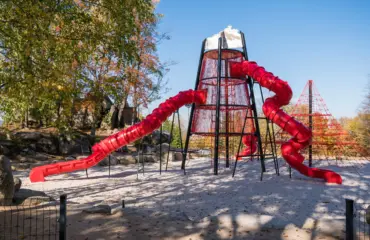
- Children’s play areas: slides, swings, walkways and multi-activity structures.
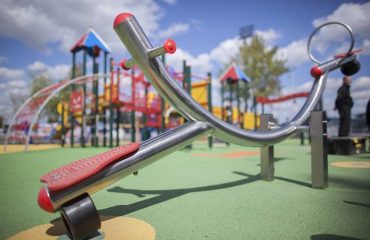
- Outdoor fitness equipment: bikes, cross-trainers, presses and plate-loaded outdoor benches.
- Multi-sport areas: street workout rigs, cross-training cages and outdoor fitness zones.
- Galvanised steel and stainless steel construction for maximum service life and corrosion resistance.
The standards that apply
Two separate regimes cover the two halves of the project, and they are not interchangeable.
- EN 1176-1 covers playground equipment and its installation, including free space and free height of fall.
- EN 1177 covers impact-attenuating playground surfacing, and the surfacing required follows directly from the free height of fall of the equipment above it.
- EN 16630 covers permanently installed outdoor fitness equipment for adults. It must never be applied to equipment intended for children, and EN 1176-1 must never be used to justify an adult fitness station.
Ask any supplier for the test reports and the declaration of conformity for the exact reference you are buying, not for the range. Then keep them: they are the first documents an insurer or an inspector will ask to see.
Our playground equipment and its impact-attenuating surfacing are specified together for this reason, because ordering one without the other is the most common way a compliant playground becomes a non-compliant one.
Choosing a play area
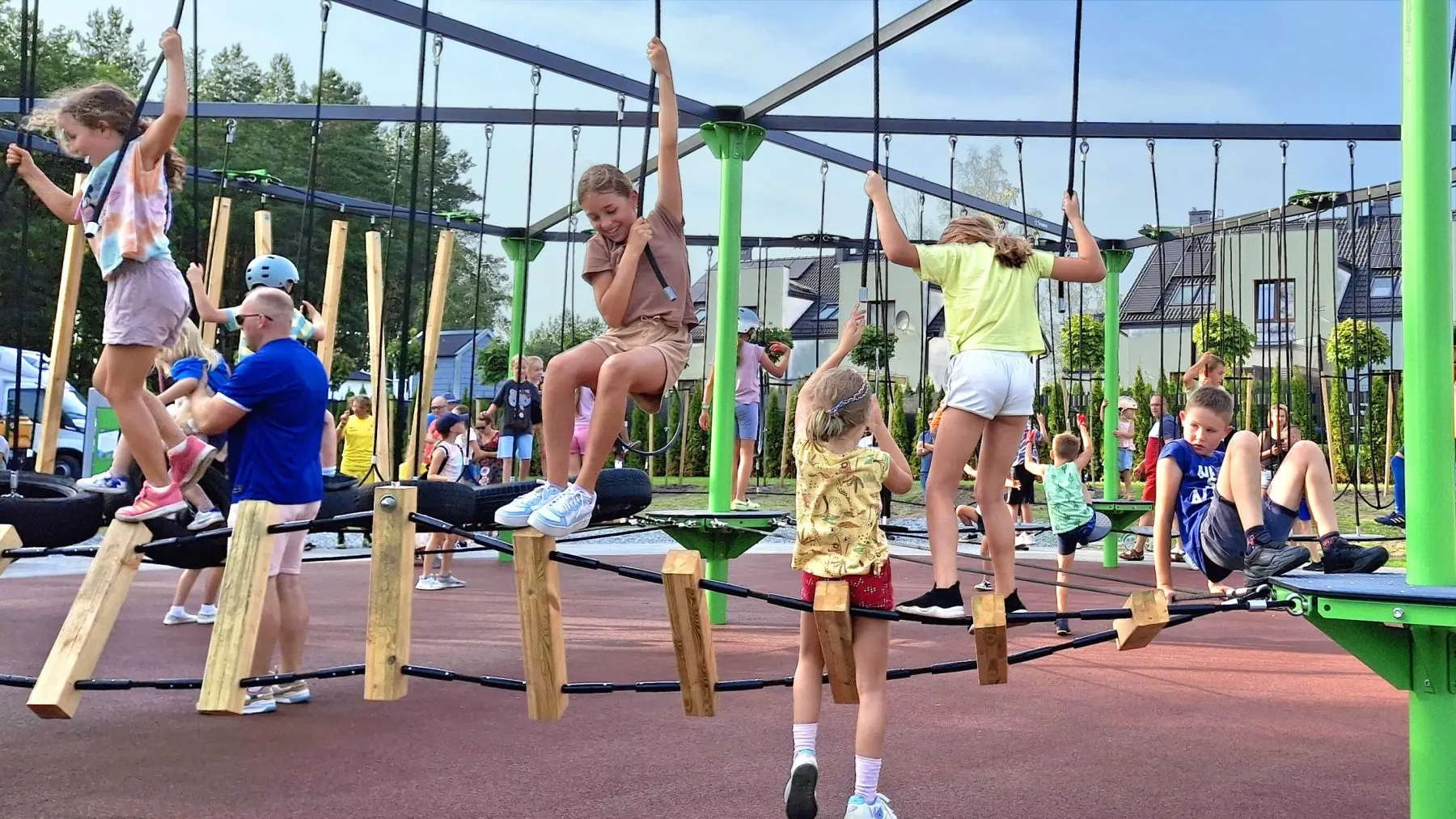
- Target age. Ages 2 to 6 need low structures and enclosed slides; ages 6 to 12 take larger modules, climbing elements and suspended bridges. A single area can serve both if the zones are distinct.
- Available area. Allow at least 2 metres of clearance around each item as a working minimum, then confirm the actual free space against the equipment’s free height of fall, which is what the standard requires.
- Budget. A simple play area starts from 3,000.00 EUR excluding VAT; a complete multi-module area runs up to 50,000.00 EUR excluding VAT.
- Conformity. Always request the EN 1176 and EN 1177 test documentation before ordering.
Choosing an outdoor fitness area
- Type of equipment. Low-impact stations such as outdoor rowers and bikes, or strength equipment such as benches, racks and cages. Most sites need some of both.
- Target guests. Families, experienced trainers and older guests use an outdoor area very differently, and the mix decides the station list.
- Materials. Galvanised steel is the versatile, durable default. Stainless steel is the material for coastal sites.
- Budget. A single station starts from 1,500.00 EUR excluding VAT; a complete outdoor fitness park runs from 20,000.00 EUR to 40,000.00 EUR excluding VAT.
See the outdoor gym equipment range for the station-by-station options.
Indicative configurations
| Configuration | Suited to | Area required | Indicative price | Strengths |
|---|---|---|---|---|
| Compact play area | Small hotel | 20 m2 | 6,500.00 EUR excluding VAT | Compact, colourful, safe |
| Six-station fitness area | Family campsite | 60 m2 | 18,800.00 EUR excluding VAT | Versatile, several users at once |
| Mixed play and fitness park | Resort | 120 m2 | 50,000.00 EUR excluding VAT | Children’s play plus adult fitness |
| Stainless steel outdoor station | Seaside hotels | 50 m2 | On request | Highly resistant to salt and chlorine |
Prices are indicative, exclude VAT and cover the equipment. Groundworks, surfacing, delivery and installation are quoted separately once the site has been assessed.
Galvanised steel or stainless steel?
This is the single decision that most affects how the installation looks in year ten, and it is decided by the site, not by the budget.
- Galvanised steel. Highly corrosion resistant and the sensible default for inland sites, campsites away from the coast and city hotels.
- 316L stainless steel. The material for salt-laden air and for equipment near pools, where chlorine attacks standard coatings. On a seafront site it is not an upgrade, it is the specification.
The stainless steel outdoor fitness range exists precisely for coastal and poolside installations.
Maintenance and operator responsibility
Once the equipment is installed on your site, its condition is your responsibility as the operator. The routine is straightforward and the record-keeping is what matters:
- Regular visual checks of fixings, landing areas and the condition of materials.
- Deeper periodic inspections carried out by a competent person.
- A written log of every inspection and every repair, kept for the life of the installation.
- Any item found unsafe taken out of use until it is repaired, not merely noted.
Specify colours, logos and inclusive-access modules at the design stage rather than afterwards; retrofitting a ramp or an accessible station to a finished layout is always more expensive than planning it in.
Frequently asked questions
What standards apply to a publicly accessible play area?
Play areas open to the public are governed by requirements covering free space, free height of fall and impact-attenuating surfacing. Those requirements shape the layout as much as they shape the choice of modules.
What is the budget for a campsite play area?
From 3,000.00 EUR to 50,000.00 EUR excluding VAT, depending on the size of the area and the modules chosen.
Can children’s play and adult fitness share one area?
Yes, and mixed zones are among our most requested layouts. The two parts remain separate in standards terms, with their own equipment, their own surfacing and their own safety zones.
Which material for a seaside campsite?
Salt-laden air attacks standard coatings quickly. 316L stainless steel is the material for these installations; galvanised steel is appropriate for sites away from the coast.
What maintenance should we plan for?
Regular visual checks of fixings, landing areas and material condition, backed by deeper periodic inspections. Keeping the record of those checks is the operator’s responsibility.
Can the equipment be customised?
Yes. Colours, logos and inclusive-access provision can all be specified, and custom modules can be manufactured.
Get a layout for your site
Send us your site plan, the guest profile and your budget envelope, and we will return a proposed layout with safety zones, surfacing requirements and the material specification for your exposure. Request a quote.
Réalisations documentées
- Cage street workout ultime, Carcassonne – armée française
- Cage street workout ultime, Tahiti – armée française, Polynésie
- Cage SP Max, centre EPIDE de Combrée – établissement public d’insertion
- Cage SP Max, lycée Saint-Bénigne de Dijon – établissement scolaire
Sources et références
- Décret n° 96-1136 du 18 décembre 1996 – prescriptions de sécurité relatives aux aires collectives de jeux (Légifrance)
- NF EN 1176-1 – Équipements et sols d’aires de jeux, partie 1 : exigences de sécurité et méthodes d’essai générales (AFNOR)
- NF EN 1177 – revêtements de surface amortissants : détermination de la hauteur de chute critique (AFNOR)
- NF EN 16630 – modules fixes d’entraînement physique de plein air : exigences de sécurité et méthodes d’essai (AFNOR)