Inclusive play area design: standards, routes, surfacing and equipment
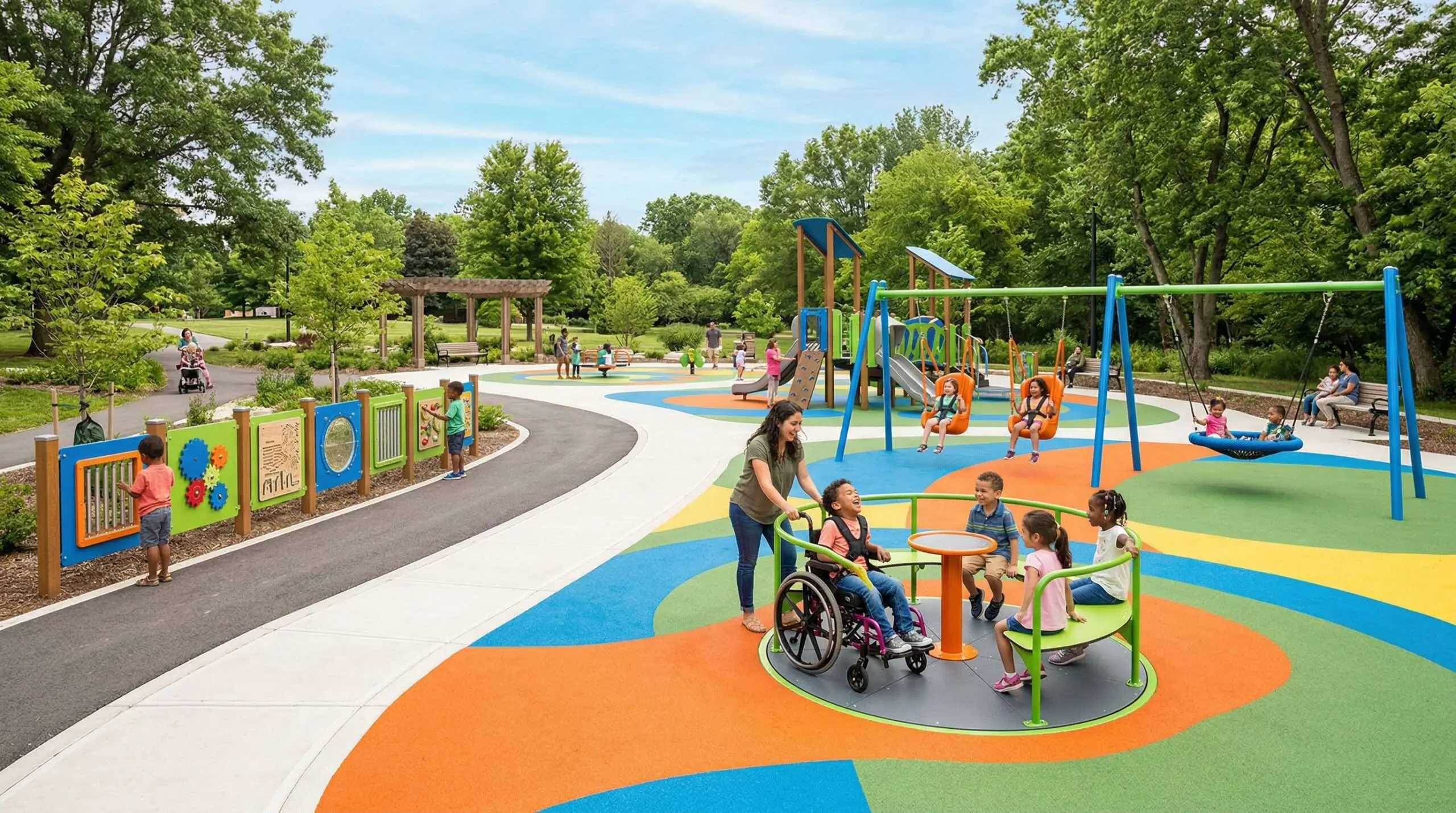
An inclusive play area is not a standard play area with two special items added to it. It is a site designed from the outset so that a child using a wheelchair, a child with a visual impairment and a fully mobile child can play in the same space at the same time. This guide sets out the design principles, the standards that apply, the surfacing decision that most projects get wrong, and the equipment families that actually deliver shared play rather than parallel play.
Short answer. Three things decide whether a play area is genuinely inclusive: an accessible route that reaches the equipment, a surfacing system that a wheelchair can cross and that still meets the impact attenuation requirement, and equipment that children of different abilities use together. Surfacing is where budgets fail, because loose fill is cheap and is not traversable, while a bound or tiled system costs more and is the only thing that makes the rest of the design work.
The regulatory frame
Two families of requirement apply, and they are frequently confused.
Safety of the equipment and the surfacing is covered by EN 1176 for playground equipment and EN 1177 for impact attenuating surfacing. EN 1176 sets out general design requirements, entrapment, structural strength and edge treatment, with parts dedicated to slides, swings, roundabouts and rocking equipment, and a part covering installation, inspection, maintenance and operation. EN 1177 covers the determination of critical fall height by impact testing.
Accessibility is set by national legislation rather than by a European standard. In France, the law of 11 February 2005 and decree 2006-555 make public play areas, as installations open to the public, subject to accessibility requirements, with a decree of 1996 making compliance with EN 1176 and EN 1177 mandatory and requiring a documented maintenance plan. Penalties for non compliance in France run to 45,000 EUR, and to 75,000 EUR with a custodial element on repeat offences by those responsible for the works. Equivalent regimes exist across the European Union, so check the national rule before you fix the brief.
One term to get right in the specification. Critical fall height is expressed in metres and is determined by impact test to EN 1177. HIC, the Head Injury Criterion, is a dimensionless index with an acceptance threshold of 1000. Writing HIC 3 metres in a specification is meaningless. Write: surfacing whose critical fall height, determined to EN 1177, is at least equal to the free height of fall of the equipment served.
The accessible route comes before the equipment
A wheelchair cannot reach a play item across loose sand, deep bark or a kerb upstand, so the route decides the design. Working figures used in French practice, and broadly consistent across Europe:
| Element | Requirement |
|---|---|
| Clear width of the main route | 1.40 m minimum |
| Longitudinal gradient | Under 5 per cent, up to 8 per cent where unavoidable with a level rest every 10 m |
| Surface | Firm, non loose, slip resistant: bound rubber, permeable resin or impact attenuating tiles |
| Upstands | None above 20 mm, chamfered at 1 in 3 where unavoidable |
| Manoeuvring space at each accessible item | 1.50 m turning circle |
| Wayfinding | Tactile guidance at the entrance and at route junctions for visually impaired users |
Concrete and bitumen are excluded under any equipment with a free height of fall, so the accessible route and the impact area have to be resolved as one system rather than as two separate contracts. Rubber safety tiles do both jobs: our 60 mm safety tile tested to EN 1177 is 78.00 EUR per square metre excluding VAT, and thinner tiles are available where the fall height is lower. Ask for the test report with the critical fall height stated, not a marketing figure.
Equipment that produces shared play
The design test is simple: can a child in a wheelchair and a child not in a wheelchair use this item at the same time? Items that pass are worth their cost; items that only one group can use create a segregated corner.
| Family | What to specify | Why it works |
|---|---|---|
| Swings | Cradle or moulded seats with a harness, extra large nest swings, and platform swings with lateral access | Nest swings carry several children of mixed abilities at once, and swinging motion has a documented calming effect for children with sensory processing differences |
| Roundabouts | Ground level platform, flush or ramped access, grab rails and side protection | A wheelchair rolls straight on, with no transfer required |
| Sensory panels | Manipulative panels, giant abacus, gears and mazes mounted between 0.40 m and 1.10 m from ground level | That mounting band is reachable from a seated position and from standing, so no separate item is needed |
| Sound and music | Outdoor xylophones, drums and chimes approached from the front | Frontal approach is what makes an item usable from a wheelchair; side approach usually is not |
| Sand and water | Raised tables with knee clearance underneath | Turns the single most popular play activity into a shared one |
| Multi level structures | Ramp access at 10 per cent or less, 1.20 m clear width, guarding to both sides | Gives access to the elevated deck, which is where the social play happens |
Universal design is the governing principle: design the space so that it works for everyone from the start, rather than adding adapted items to a standard layout. In practice that means multiple entrances, generous manoeuvring space, a range of sensory stimulation, and seating and shade for accompanying adults who may themselves have reduced mobility.
Inspection and record keeping
EN 1176 part 7 sets out the inspection regime, and it is the part that operators are actually judged on after an incident: routine visual inspection, operational inspection at one to three month intervals, and an annual main inspection. Record every inspection, every repair and every part replacement, with dates and names. In France a documented maintenance plan is a regulatory requirement rather than good practice, and an independent conformity check before opening to the public is expected. Loose fill surfacing needs the deepest attention in this regime, because depth reduces with use and the critical fall height falls with it, whereas bound and tiled systems hold their performance.
Frequently asked questions
Is bark or sand ever acceptable in an inclusive play area?
It can be used away from the accessible route and away from any item that has to be reachable, but it cannot form the route or the approach to an accessible item, and it needs depth monitoring throughout its life. Most projects end up with a bound or tiled route and impact zone, and loose fill only in secondary areas.
How do we set the surfacing thickness?
From the free height of fall of each item, not from a single figure for the whole site. Establish the highest free height of fall in each impact area, then specify a surfacing whose tested critical fall height meets or exceeds it. Ask for the EN 1177 test report for the exact product and build up you are buying, including any underlay.
Does inclusive equipment cost more?
The equipment premium is modest. The real cost difference is the surfacing and the routes, which is why they belong in the first budget rather than in a later phase. A project that installs inclusive equipment onto loose fill has spent the money and not delivered the outcome.
What should we ask a supplier to provide?
Declaration of conformity to EN 1176 for each item with its free height of fall, the EN 1177 test report for the surfacing build up with its critical fall height, installation drawings with impact areas set out, a maintenance schedule, and a written commitment on spare parts availability.
Designing an inclusive play area
Light In Fitness has manufactured and distributed play and outdoor sports equipment from Tours, France, since 2013, and has equipped more than 2,500 customers for local authorities, schools and property developers. We produce the layout with impact areas and accessible routes set out, supply the conformity documentation your file needs, and issue quotations within 24 working hours.
Réalisations documentées
- Parcours ninja sur mesure, Rennes – îlot des Hautes-Ourmes
- Double mur ninja extérieur, Sallanches – Haute-Savoie
- Dalles et sols sportifs : livraisons documentées – plusieurs chantiers
- Sol sportif extérieur, square Georges-Vallerey – Taverny (95)
Sources et références
- Décret n° 96-1136 du 18 décembre 1996 – prescriptions de sécurité relatives aux aires collectives de jeux (Légifrance)
- NF EN 1176-1 – Équipements et sols d’aires de jeux, partie 1 : exigences de sécurité et méthodes d’essai générales (AFNOR)
- NF EN 1177 – revêtements de surface amortissants : détermination de la hauteur de chute critique (AFNOR)
- Code du sport, articles R322-4 à R322-43 – garanties d’hygiène et de sécurité applicables aux établissements d’activités physiques et sportives (Légifrance)