Playground Swings: Which Model to Choose
Les balançoires sont la seule famille d'aire de jeux à couvrir 0 à 14 ans, là où les structures en corde commencent à 5 ans. Le critère décisif n'est pas le prix de l'agrès mais la hauteur de chute libre, de 1,0 à 2,8 m selon les 15 modèles : elle commande l'étendue du sol amortissant, souvent plus coûteux que la balançoire elle-même. Deux modèles, Kordelia et Bianka, sont dédiés aux enfants à mobilité réduite.
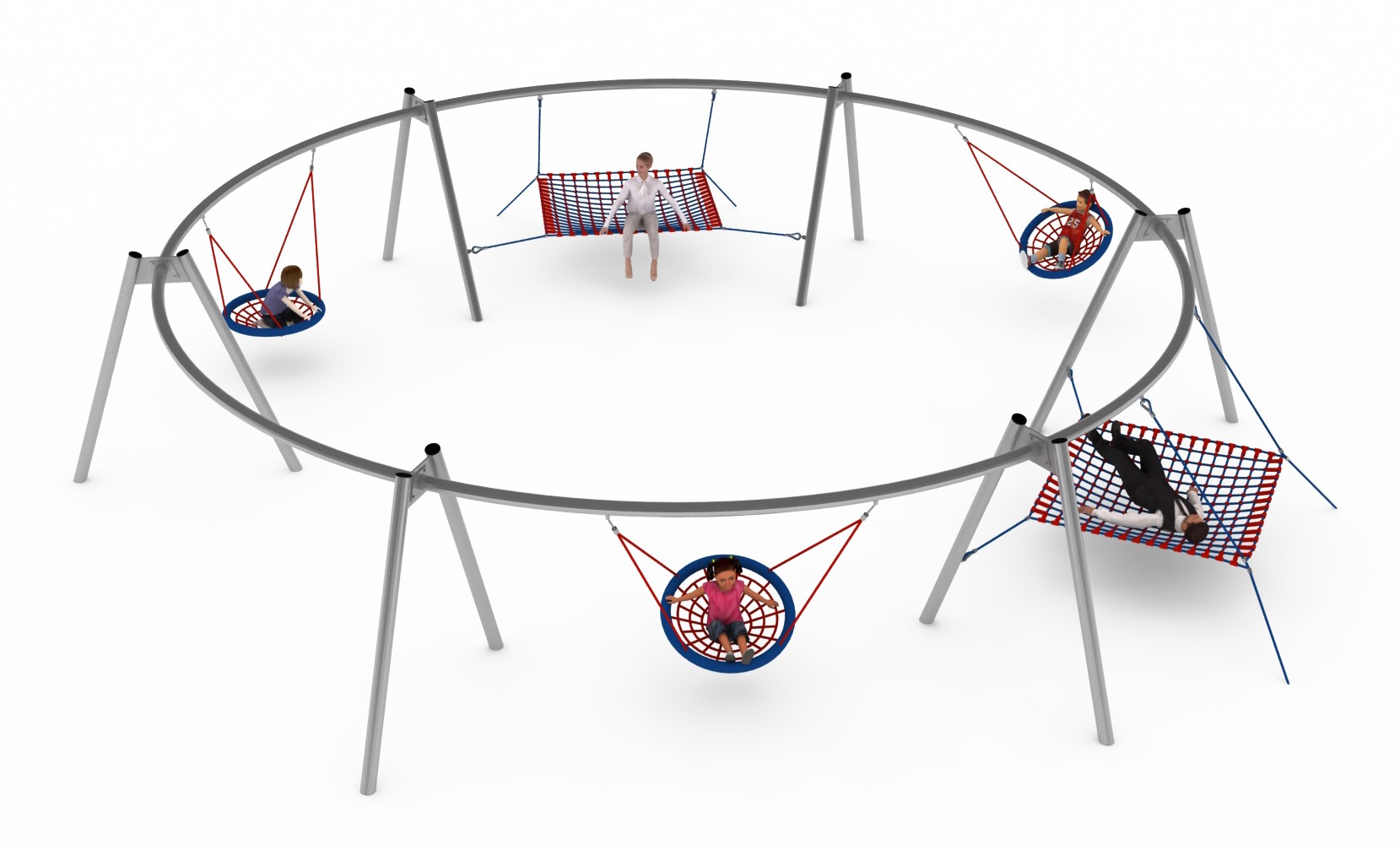
Swings are the only family of playground equipment that covers the widest age band: most of the 15 models in the catalogue are declared for ages 0 to 14, cradle seats included. They are what makes a playground usable by the very youngest children, where rope structures only start at age 5. This guide compares the models and explains what actually drives the budget of a swing project.
What changes from one model to the next
| Parameter | Range across the 15 models | Consequence |
|---|---|---|
| Main age range | 0 to 14 years | The only family covering toddlers |
| Free fall height | 1.0 to 2.8 m | The impact-absorbing surface is sized on the model chosen |
| Foundation depth | 0.5 to 1.0 m | Varies with the height of the frame |
| Standard | EN 1176-1 | Sets the inspection regime for the playground |
Free fall height is the figure to hold on to. Between a model at 1.3 m and one at 2.3 m, it is not the price of the swing that changes most, but the thickness and the area of the impact-absorbing surface to lay around it.
The models and what they are for
For toddlers and families
The Portia parent and child swing seats an adult and a young child facing each other, for shared use from the earliest age, with a free fall height of 1.8 m. It is the model that brings in families whose children are still too young for the rest of the playground.
For an inclusive playground
Two models are designed for children who cannot use a conventional swing: the Kordelia inclusive swing, whose wrap-around polyethylene seat provides reinforced support, and Bianka, with its woven seat on a steel core. In a local authority tender, these are what make a playground genuinely accessible rather than nominally open to all.
For playing together
The Puk large nest swing combines a central woven seat with rope standing platforms, while Hamster offers two platforms topped with a net and perimeter guard rails. These formats take several children at once, which cuts queuing at busy times.
For covering every age on a single frame
Mab brings three swings together on one beam, suspended at different heights; it is also the model with the highest free fall height in this selection, at 2.3 m. Namaka crosses two swings at a right angle for a compact footprint. Where a playground is meant to grow over time, the modular swing configuration lets several modules be combined to suit the plot.
What drives the budget
Three items are costed together: the equipment itself, the foundations (0.5 to 1.0 m deep depending on the frame) and the impact-absorbing surface certified to EN 1177, whose extent depends on the free fall height and on the swept area of the swing. On a swing, the area to treat is elongated along the axis of the movement: this is the equipment family where the surfacing often costs more than the item itself. See the playground surfacing range before fixing the budget.
Building a complete playground
Swings cover ages 0 to 14; rope climbing pyramids take over from around ages 3 to 5 for climbing activity. For an intergenerational park where parents train while children play, an adult outdoor fitness zone can be laid out alongside the playground, with each area kept under its own standard: EN 1176-1 for the play equipment, EN 16630 for adult outdoor fitness. The two are never interchangeable, and equipment for children is never specified to EN 16630.
Browse the full playground swing sets range. All these models are supplied on quotation.
FAQ
From what age can a child use a swing?
Most of the 15 models are declared for ages 0 to 14, cradle seats included. It is the only family in the catalogue that covers toddlers, where rope structures start at age 5.
What free fall height should be planned for?
The models range from 1.0 to 2.8 m. That value determines the thickness and the extent of the impact-absorbing surface certified to EN 1177: choosing a lower model directly reduces the cost of the surfacing.
Which swings suit an inclusive playground?
Kordelia, with its wrap-around polyethylene seat, and Bianka, with its woven seat on a steel core, are designed for children with reduced mobility or who need reinforced support.
What foundation depth is required?
From 0.5 to 1.0 m depending on the height of the frame. The exact figure appears on the installation drawing supplied with the quotation.
Do these swings comply with the standards?
Yes, with EN 1176-1, which applies to playground equipment and also sets the regime of periodic inspection once the playground is installed. The impact-absorbing surface is covered separately by EN 1177.
Planning your swing area
A swing project is decided on three figures: the age range you need to serve, the free fall height of the model, and the surface area of impact-absorbing flooring that follows from it. Light In Fitness supplies playground equipment to local authorities, campsites, hotels, schools, housing providers and property developers, and prepares the installation drawing with the model, the foundations and the surfacing shown together.
Request a quote with the plan of your site and we will come back with a layout study and a costed configuration.
Réalisations documentées
- Dalles et sols sportifs : livraisons documentées – plusieurs chantiers
- Sol sportif extérieur, square Georges-Vallerey – Taverny (95)
Sources et références
- Décret n° 96-1136 du 18 décembre 1996 – prescriptions de sécurité relatives aux aires collectives de jeux (Légifrance)
- NF EN 1176-1 – Équipements et sols d’aires de jeux, partie 1 : exigences de sécurité et méthodes d’essai générales (AFNOR)
- NF EN 1177 – revêtements de surface amortissants : détermination de la hauteur de chute critique (AFNOR)