Commercial Weight Benches: Which Type to Choose for a Gym Floor
Les bancs se répartissent en quatre familles : plat, inclinable, déclinable et multiposition réglable. Le banc plat offre la meilleure stabilité sous charge lourde, le multiposition la plus grande polyvalence par mètre carré. Le choix se fait sur le nombre d'exercices à couvrir et sur la place disponible.
Benches are the least glamorous line on a gym equipment order and one of the most consequential. They carry the free-weight area, they are used continuously at peak hours, and a bench that flexes under load is both a safety problem and a complaint magnet. Benches fall into four families — flat, incline, decline and adjustable multi-position — and the choice comes down to how many exercises you need to cover and how much floor area you can give them.
Why the bench decides how your free-weight area works
Every dumbbell and barbell movement on the floor is organised around benches: presses, rows, hip thrusts, step-ups, supported curls and core work. Their number and their type set the throughput of the area. Too few benches and the rack queue backs up; too many fixed flat benches and you lose the angles that make the area useful for a mixed membership. A well-planned free-weight zone mixes stable flat benches for heavy pressing with adjustable benches for variety and for members training around a limitation.
Adjustable models let a coach isolate a specific muscle group by changing the back angle, which matters in supervised programming and in rehabilitation settings. Flat benches keep the advantage where it counts most: under heavy load, a fixed frame with a wide footprint is the most stable platform you can put a member on.
The four bench families
Flat bench
A rigid frame with a fixed horizontal pad. No angle adjustment, nothing to loosen, nothing to misuse. It is the reference platform for bench pressing, hip thrusts, dumbbell flyes and supported rows, and it is the family that ages best in a busy facility because it has no moving parts.
Incline bench
The back pad is set above the horizontal, which shifts the emphasis of pressing movements towards the upper chest and shoulders. Fixed-angle incline benches are simple and stable; adjustable ones cover several angles from the same footprint.
Decline and abdominal bench
The pad sits below the horizontal, with a leg brace or foot rollers to secure the user. It is used for decline pressing and for abdominal work. In a commercial room the leg brace must itself be adjustable, because it is the part that has to fit users of very different heights.
Adjustable multi-position bench
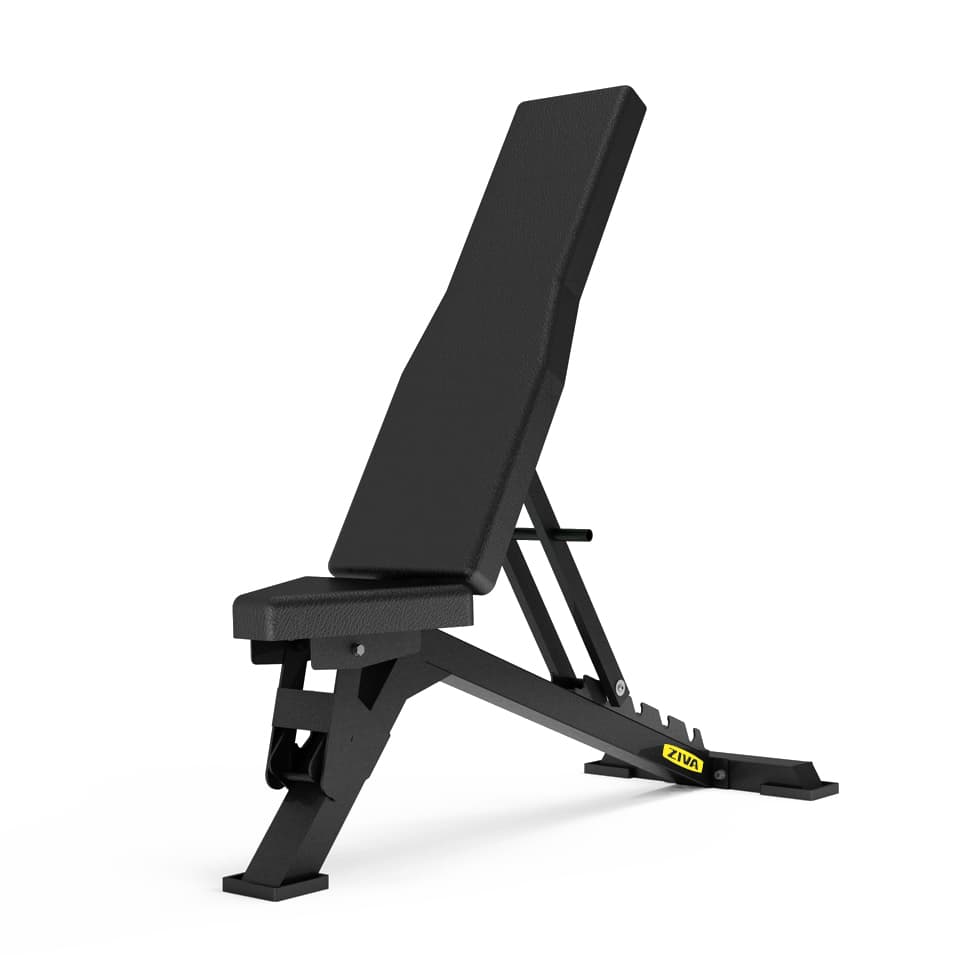
Back pad and seat both articulate, from decline through flat to near-vertical. This is the highest number of exercises per square metre, which is why it is usually the largest share of a commercial bench order. The trade-off is mechanical: the locking system and the hinges are what you are really buying.
Bench with barbell supports
A bench combined with uprights for the barbell. It gives a self-contained pressing station without tying up a rack, and the useful criteria are the adjustment range of the supports and the spacing between the uprights.
Specification checklist for a commercial order
- Stability under load. A rigid frame, solid fixings, no perceptible sway during dynamic sets, and non-slip feet that do not travel on the floor covering.
- Rated load. The manufacturer rating covers the user plus the load they handle — barbell, dumbbells, kettlebells. In a supervised facility, specify the highest rating you can, because you cannot control who uses the bench or with what.
- Frame and finish. Thick steel profiles with a corrosion-resistant finish such as powder coating; this is what survives sweat, cleaning products and daily knocks.
- Upholstery. Dense padding under an abrasion-resistant cover, high-quality PU being the usual commercial choice, with seams positioned away from the contact zones.
- Pad geometry. Check back pad width and bench length against your membership: a pad that is too narrow makes shoulder retraction impossible and a bench that is too short leaves the head unsupported.
- Adjustment range. The more varied the programming, the more back and seat positions you need, and the faster the locking mechanism has to be to operate between sets.
- Attachments. Confirm what the bench accepts: a preacher curl pad for biceps work, band anchors for shoulder and arm work, a leg developer attachment for leg extensions and curls.
- Handling. Transport wheels and a handle turn a two-person move into a one-person move, which matters every time the floor is reconfigured for a class.
Standards: what to ask your supplier for
Equipment installed in a supervised, professional facility is covered by EN ISO 20957-1, which sets the general safety requirements for stationary training equipment, with class S designating professional use. Ask for documentation naming that reference and the class, not a generic conformity statement. Class I is the professional class for inclusive access, a different intended use rather than a higher level of intensity.
Two practical consequences: keep the certification file for the equipment on site because insurers and inspectors ask for it, and check that a bench used with a rack is rated for the loads that rack can hold.
Space and layout
Plan the clearance around a bench, not just the bench itself: room to load and unload a bar, room to walk behind a spotter, and room for a dumbbell rack within reach. Folding benches are a real option for multi-purpose rooms and studios that reconfigure between classes, provided the folding mechanism is rated for the same load as the frame.
Our commercial weight benches are specified for this kind of use, and they are usually ordered alongside racks and power cages and a set of professional dumbbells so the whole free-weight zone lands in one delivery.
FAQ
How many benches does a gym floor need?
It depends on peak occupancy and programming rather than on total membership, which is why the count is set during the layout study. The usual mistake is ordering flat benches only and discovering that the incline and adjustable positions are the ones members queue for.
Flat or adjustable?
Both. Flat benches give the most stable heavy-pressing platform; adjustable benches give the most exercises per square metre. A commercial free-weight area is normally built from a mix of the two.
What makes a bench a professional bench?
The frame section, the fixings, the rated load and the locking mechanism, plus documented conformity with EN ISO 20957-1 class S. Pad thickness and cover quality decide how it looks after two years of daily use.
Specify your free-weight area with us
Tell us the surface available, the expected number of users at peak hour and the programming you run, and we will propose a bench mix and a layout to match. Start with our quotation request form.