Bench press: a complete guide to effective and safe training
Bench press: a complete guide to effective and safe training
In brief: the bench press loads the pectorals, the anterior deltoids and the triceps. Its safety rests on three points: shoulder blades held in retraction, a controlled bar path, and safety supports set at the right height. On a shared gym floor, adjustable safety supports are not an option.
In the fitness world the bench press holds a special place. It is one of the fundamental pillars for anyone looking to build strength and muscle mass, testing above all the pectorals, the anterior deltoids and the triceps. To get results that are both effective and safe, however, the movement has to be approached with the right technique and the right awareness. This article looks in detail at how to perform this fundamental exercise, from the benefits to the equipment required, taking in correct technique and the advice that prevents injury. The aim is to give you everything you need to bring the bench press into a training programme effectively and safely, maximising results and minimising the risk of injury.
Chapter 1: What the bench press is
The bench press is one of the fundamental exercises of strength training and powerlifting, known for its effectiveness in developing the upper body. But what is it exactly? Let us look at it together.
Description of the exercise
The bench press is performed lying on a horizontal bench, feet flat on the floor and the back in a neutral position. The exercise consists of lifting a loaded barbell from a resting position on a support to a position above the chest, then lowering it again. The bench press is a compound exercise, which means it involves several muscle groups, principally the pectoralis major, the triceps brachii and the anterior deltoid.
Muscles involved
- Pectoralis major: the main muscle trained by the bench press. It is responsible for flexion, adduction and internal rotation of the arm.
- Triceps brachii: involved in extending the forearm, which is what pushes the bar upwards.
- Anterior deltoid: contributes to the push and stabilises the shoulder during the movement.
It is worth noting that although these are the main muscles involved, the bench press is a complete exercise that also works other secondary muscles, improving overall upper body strength and stability.
Types of bench press
There are several variations of the bench press that allow you to concentrate on specific muscle groups or aspects of strength:
- Flat bench with a barbell: the classic version, effective for building strength and mass.
- Flat bench with dumbbells: allows a greater range of motion and recruits the stabilising muscles more.
- Incline bench press: concentrates the work more on the clavicular fibres of the pectoral and on the anterior deltoid.
- Decline bench press: targets the lower pectoral muscles more.
In the end the bench press is a versatile and powerful exercise for developing upper body muscle mass and strength. Correct execution and a conscious approach are essential to draw the maximum benefit from it and to prevent possible injury.
Chapter 2: The benefits of bench press training
Bench press training is not only a way to build a big chest and powerful triceps; it offers a range of other benefits that can contribute significantly to general wellbeing and sporting performance. Below are the main benefits of including the bench press in a training programme.
Improved strength
The bench press is one of the key exercises for developing upper body strength. It improves not only the strength of the pectoral muscles, but also that of the triceps, the anterior deltoids and the stabilising muscles.
Increased muscle mass
Regular bench press training stimulates muscle growth, particularly in the pectorals, the triceps and the anterior deltoids. It is an essential exercise for anyone seeking to increase upper body muscle mass.
Improved athletic performance
The strength and power developed through the bench press can translate into improvements in athletic performance across many sports, for instance by contributing to more powerful throwing in baseball or harder punching in boxing.
Stronger stabilising muscles
The bench press also works the stabilising muscles of the trunk, the shoulders and the back, improving overall body stability and reducing the risk of injury during other physical activities.
Versatility of training
The versatility of the bench allows the training to be varied, using different types of bench (flat, incline, decline) and different tools – the barbell and dumbbells – for complete and balanced training.
Psychological benefits
The confidence and discipline gained by improving bench press performance can also have positive effects on mental health, encouraging a positive attitude and the determination to pursue goals.
In conclusion, bench press training is a fundamental part of a complete fitness programme, bringing benefits not only in strength and muscle mass, but also for general health, sporting performance and psychological wellbeing.
Chapter 3: The equipment required
Effective bench press training requires specific equipment, which not only allows the exercise to be performed correctly but also ensures safety during training. Here is the equipment needed for the bench press.
The bench
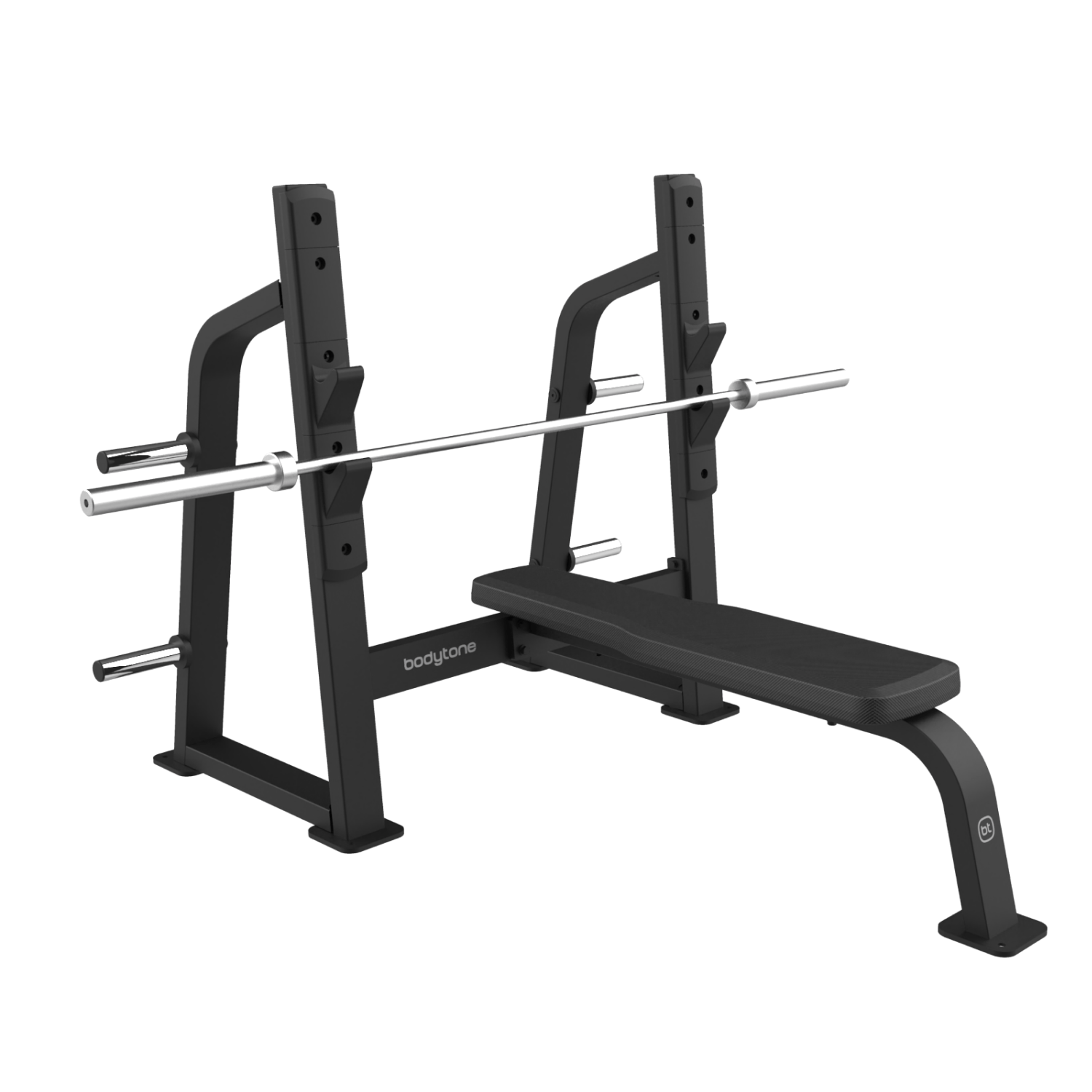
- Horizontal bench: fundamental for performing the standard flat bench exercise. It must be stable and robust, capable of supporting the user’s weight and that of the loads used.
- Adjustable bench: allows incline or decline work, varying the angle of the bench to load the pectoral muscles differently.
The bar
- Olympic barbell: ideal for the bench press thanks to its robustness and its length, which allow a stable and secure grip.
The weights
- Weight plates: available in different sizes and materials, they allow the working load to be adjusted to capacity and progression.
Safety
- Bar supports: fundamental for positioning the bar before and after the set, guaranteeing safety and avoiding unnecessary strain.
- Safety bars or spotter arms: useful for training safely, particularly when lifting heavy loads, since they remove the risk of being trapped under the bar if the lift fails.
Optional accessories
- Dumbbells: for variations of the exercise or accessory work.
- Belt: can offer lumbar support during the set, particularly with heavy loads.
- Gloves or wrist wraps: offer protection and support to the hands and wrists during training.
Using the right equipment is essential not only for the effectiveness of the training but also for safety and injury prevention. For a commercial floor, the equipment should conform to EN ISO 20957-1, class S, the classification for professional indoor use. Browse our professional weight benches, the squat racks and power racks that carry the safety supports, and the Olympic barbells.
Chapter 4: Correct technique
Correct technique is essential when performing the bench press, both to maximise the effectiveness of the exercise and to minimise the risk of injury. Here are the stages and the points to watch.
Starting position
- Position on the bench: lie down on the bench making sure the head, the back and the glutes are properly supported and that the feet are firmly planted on the floor.
- Grip on the bar: take hold of the bar with both hands, keeping a firm grip and placing the hands wider than the shoulders.
- Position of the bar: the bar should be above the chest with the arms fully extended.
Eccentric phase (lowering)
- Control: lower the bar slowly towards the chest, controlling the movement throughout.
- Depth: the bar should touch the chest lightly at its centre, below the line of the sternum.
Concentric phase (pressing)
- Push: press the bar upwards by extending the arms fully, without locking the elbows out.
- Bar path: the bar should follow a slightly arced path, travelling from the lower chest towards the upper chest.
General advice
- Do not throw the head back: keep the head firmly on the bench throughout the exercise.
- Maintain tension: keep tension in the pectorals, the shoulders and the triceps throughout the set.
- Avoid excessive arching: a slight lumbar curve is normal, but avoid arching the back excessively.
- Use a spotter: especially when lifting heavy loads, having someone assisting is essential for safety.
By following this advice and paying attention to correct technique, you can take full advantage of the bench press, encouraging optimal muscle growth and considerably reducing the risk of injury.
Chapter 5: Safety advice
Safety is fundamental when performing the bench press. Following safety advice is essential to avoid injuries and problems that can arise in the short and the long term. Here are the points to observe.
1. Use a spotter
Having a spotter, someone who assists during the exercise, is essential, especially when heavy loads are involved. The spotter can step in if the lift becomes difficult, preventing possible injury.
2. Correct position
Maintain the correct position throughout the exercise: feet flat on the floor, back and glutes in contact with the bench, and head resting on it.
3. Do not overdo the weight
Do not lift more weight than your strength level allows. Increase the load progressively and make sure every repetition can be performed with correct technique.
4. Warm up properly
Do not neglect the warm-up before starting training. A good warm-up prepares the muscles and the joints for the effort, reducing the risk of injury.
5. Use appropriate equipment
Always use appropriate equipment in good condition. Check the stability of the bench and the integrity of the bar and the weights.
6. Listen to your body
Always listen to your body. If you feel pain or discomfort, stop the exercise immediately and, if necessary, consult a doctor or a physiotherapist.
7. Rest periods
Include rest periods in the programme so that the muscles can recover and overtraining, which increases the risk of injury, is avoided.
By following this safety advice, bench press training can be carried out effectively and safely, protecting the body from unnecessary and dangerous injury.
Chapter 6: A training programme
A well structured training programme is essential to see steady and safe progress in the bench press. Here is an example programme that can be followed or adapted.
Phase 1: Warm-up (10 to 15 minutes)
- Carry out a general warm-up to raise body temperature (light jogging or skipping, for example).
- Continue with a specific warm-up, performing light sets on the flat bench and increasing the weight progressively.
Phase 2: Main exercise, the bench press (4 sets)
- Set 1: 12 repetitions with a weight representing around 50 per cent of your maximum.
- Set 2: 10 repetitions with a weight representing around 70 per cent of your maximum.
- Sets 3 and 4: 6 to 8 repetitions with a weight representing around 80 per cent of your maximum.
Phase 3: Accessory exercises (3 sets per exercise)
- Dumbbell bench press: an exercise that isolates the pectoral muscles.
- Dumbbell flyes: encourage the stretch and the contraction of the pectoral muscles.
- Dips: strengthen the triceps and the pectorals.
Phase 4: Recovery and stretching (10 minutes)
- Carry out recovery and stretching exercises for the muscles worked, to aid recovery and prevent stiffness and soreness.
Notes on the programme
- Perform every exercise with correct technique and adapt the programme to your level of fitness.
- Use a spotter or safety bars for extra safety, particularly on the heavier sets.
- Rest 1 to 2 minutes between sets and 2 to 3 minutes between exercises.
- Run this programme 1 to 2 times a week, allowing at least 48 hours of rest between two bench press sessions.
This programme is a baseline example for anyone wanting to improve their bench press. Listening to your body and, where necessary, adapting the programme to your specific needs matters, as does taking the advice and supervision of a fitness professional.
Chapter 7: Getting the most out of it
Maximising the results of bench press training does not depend only on the weight lifted, but also on how and when it is lifted. Here are practical points for optimising sessions.
1. Periodisation
Organise training in cycles, varying intensity, volume and exercise selection to avoid stalling and to encourage continuous muscle growth.
2. Adequate nutrition
Make sure nutrition supports recovery and muscle growth. Take in protein, carbohydrates and good fats in balanced proportions.
3. Recovery
Take the time to recover between sessions. Rest is essential for muscle growth and for injury prevention.
4. Complementary training
Complement bench press training with accessory exercises for the shoulders, the triceps and the back, to improve performance and stability.
5. Consistency
Be consistent in training, keeping a regular frequency and giving your best in every session.
6. Reviewing results
Assess progress periodically and make the necessary adjustments to the programme in light of the results obtained.
Frequently asked questions about the bench press
Which muscles does the bench press work?
Mainly the pectorals, the anterior deltoids and the triceps. The angle of the bench changes the distribution: the incline emphasises the upper part of the pectorals, the decline the lower part.
Which safety equipment should a gym provide?
Safety supports adjustable to the height of the user, a stable rack, and a bench whose rated load covers the user and the loaded bar. In unsupervised open access, adjustable supports are not an option.
Which technical mistakes are the most common?
Letting the shoulder blades release, an uncontrolled bar path and lifting the points of contact. All three increase the load on the shoulder. Initial coaching remains the most reliable way to correct them.
Conclusion
The bench press is a fundamental exercise for building base strength and muscle mass. Never forget the importance of correct execution, a safety-first approach and a well planned strategy, in order to maximise results and minimise the risk of injury. By adapting the advice set out in this article to your own needs, you will be able to get the most out of bench press training and progress steadily towards your goals.
Equipping a bench press area for a club? Send us the available area and the number of stations you need: we come back with a priced proposal covering benches, racks, safety supports, bars and plates. Browse the weight benches, or request a quote.