Lat Pulldown with a Triangle Handle: Technique and Programming
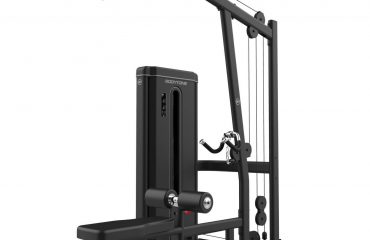
The lat pulldown is one of the busiest stations in any commercial gym, and the triangle handle, also called a V handle, is the accessory that changes the most about how it is used. It brings the hands into a neutral, closer grip, keeps the shoulders in a comfortable position and moves the work towards the mid-back. For a facility manager or a coach, getting this station set up and taught properly is what turns a machine that members avoid into one that is occupied all evening.
This guide covers what the triangle handle actually changes, how the machine is built, how to set it up for a member, how the movement should be executed, a nine-week progression you can hand to a coaching team, and what to look for when you specify the station for a facility open to the public.
Where the lat pulldown and the triangle handle fit
The pulldown has been a fixture of commercial strength floors for decades, because it gives supervised, guided access to a vertical pulling pattern that most members cannot yet load with a pull-up. The frame carries the load, the cable governs the path, and the member only has to manage the movement itself.
The name triangle comes from the shape of the handle used in the exercise. The neutral, close grip it imposes is more comfortable for most shoulders than a wide straight bar, it distributes load evenly between the two hands, and it lets a coach change the emphasis simply by changing the handle rather than changing the station.
The primary target is the latissimus dorsi, with the trapezius, the rhomboids and part of the deltoids contributing. Because of the closed grip, the biceps and the forearms take a real share of the work, and the trunk is engaged to keep the torso stable against the pull.
The other reason this station belongs in a supervised facility is safety. Used correctly, the guided path of a pulldown limits the loading on the spine and the joints compared with an equivalent free-weight pattern, which makes it usable by members who could not safely be given a barbell row.
How the station is built
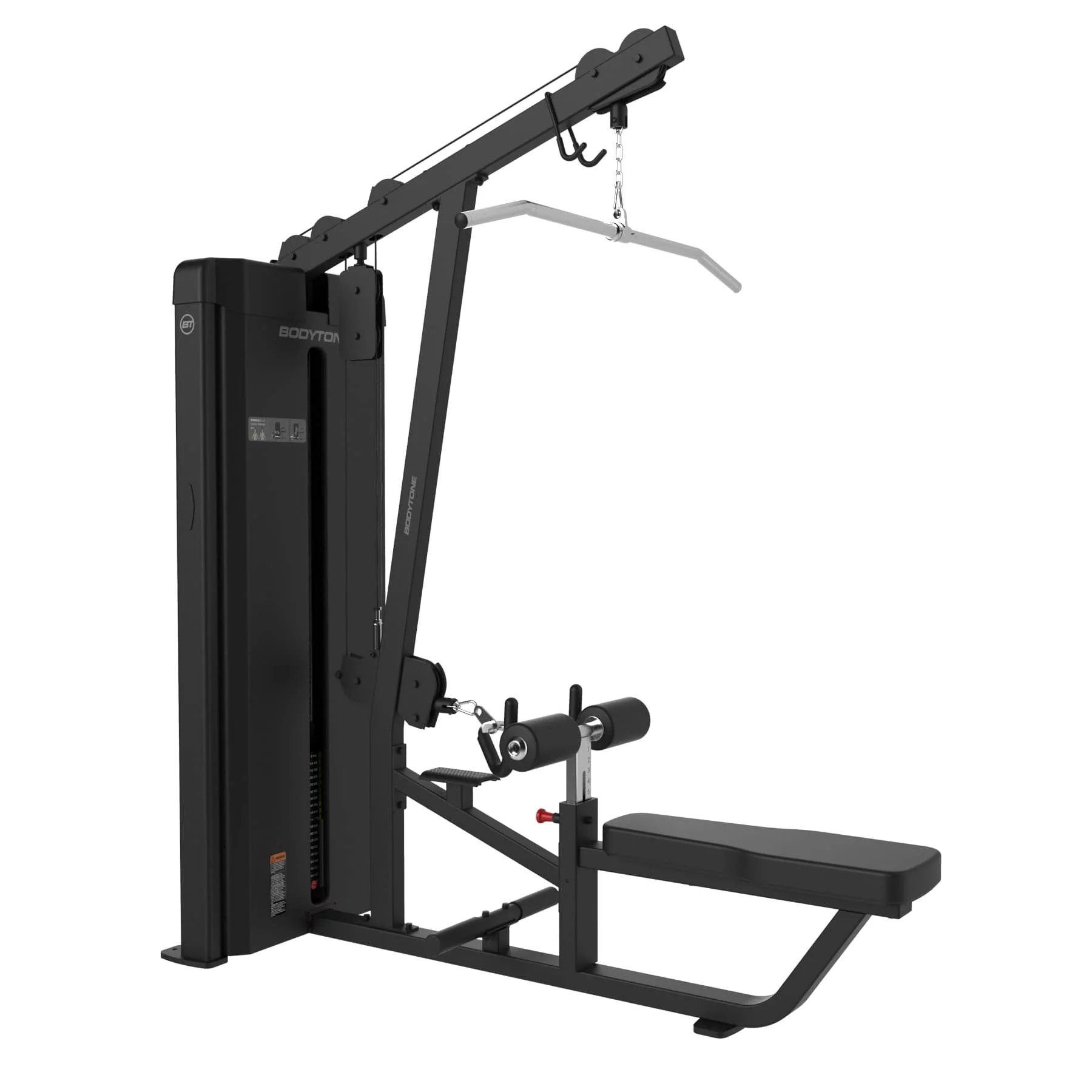
- Weight stack. The column that houses the plates. Most commercial machines use a selectorised stack with a pin, so the load can be changed in seconds between two members. Plate-loaded versions exist and are common in performance and cross-training settings.
- Cable and pulley. The cable links the stack to the handle through one or more pulleys. This is what delivers a smooth, constant resistance without jerks, and it is also the part that wears: cable condition is the single most important maintenance check on this station.
- Triangle handle. The defining accessory. A durable metal handle with a neutral grip that adapts to different hand positions and gives the movement its versatility.
- Seat and thigh pad. An adjustable seat and a padded restraint over the thighs stop the member being lifted out of the seat by the load. Correct adjustment here is what protects the lower back.
- Footplate or base. Positioned at the bottom, it stabilises the user during the pull and prevents the body rising with the weight.
- Adjustment points. Seat height, thigh pad position and, on some models, pulley height, so that members of different sizes get the same movement path.
The construction of the station is what determines whether it survives a commercial duty cycle: material thickness, quality of the welds and the finish, and the number of adjustment points that will be operated dozens of times a day.
Setting up before the set
- Warm up. Spend at least 10 to 15 minutes on a general cardio warm-up followed by dynamic mobility work for the back and shoulders before loading a vertical pull.
- Choose the load. Always start with a weight that allows the movement to be performed with correct technique. A member new to the station should begin light to learn the path, then progress the load once the movement is consistent.
- Adjust the machine. Set the seat so that the feet are flat on the floor and the knees are at roughly a 90 degree angle, then set the thigh pad firmly against the legs. Adjust the backrest and any other moving part to the member size.
- Kit. Comfortable, breathable clothing and trainers with real grip. Many members use training gloves for grip and hand protection on a knurled handle.
- Intent. Before the first repetition, the member should know which muscles the set is meant to work and what the movement should feel like. That single instruction does more for technique than any amount of correction mid-set.
Correct execution
- Grip. Take the triangle handle with both hands, thumbs facing you. A neutral grip with the hands about shoulder width apart is the reference starting point.
- Slow, controlled tempo. Every repetition is controlled. Avoid fast, thrown repetitions at the start of the set. Breathe in as the handle returns and out as it is pulled down.
- Full range. Let the arms extend completely as the handle returns, so that the back muscles are stretched and then activated over the full range.
- Targeted contraction. At the strongest point of the movement, with the handle at chest level, squeeze the back hard. The cue is to draw the shoulder blades towards each other. This is where activation is won or lost.
- Posture. No arching of the back, no lifting out of the seat. The torso stays upright and stable throughout. Excess body movement reduces the effect of the exercise and raises the risk of injury.
- Sets and repetitions. For muscle mass, 3 to 4 sets of 8 to 12 repetitions with a load that becomes demanding on the last repetition. For muscular endurance, raise the repetitions to 15 to 20 with a slightly lighter load.
- Rest. Allow at least 1 to 2 minutes between sets. Light stretching or controlled breathing during that time prepares the next set.
A nine-week progression
Phase 1: learning the movement, weeks 1 to 2
Objective: familiarise the member with the station and establish the movement pattern. Main exercise: triangle handle pulldown. Volume: 3 sets of 10 to 12 repetitions with a moderate load.
Phase 2: intensification, weeks 3 to 5
Objective: raise the intensity to drive muscle growth. Main exercise: triangle handle pulldown with grip variations, for example a wider or a narrower hand position. Volume: 4 sets of 8 to 10 repetitions with a heavier load than the previous phase.
Phase 3: specialisation, weeks 6 to 8
Objective: work on detail and muscular definition. Main exercise: triangle handle pulldown with an isometric contraction, holding the bottom position for 2 to 3 seconds. Volume: 3 sets of 10 to 12 repetitions with a moderate to heavy load.
Phase 4: deload and recovery, week 9
Objective: give the muscles time to recover and prepare for the next block. Main exercise: triangle handle pulldown. Volume: 2 sets of 12 to 15 repetitions with a light load.
This progression builds strength and muscle while keeping recovery built in. The key is consistency, and adjusting intensity according to how the member is actually responding.
Advanced coaching cues
- Vary the grip. Changing the grip changes the recruitment. Experiment with wider and narrower hand positions to bias different areas of the lats.
- Continuous tension. Do not let the stack rest at the end of each repetition. Keeping constant tension on the muscle raises both the difficulty and the effect of the set.
- Supersets. Pair the triangle handle pulldown with another back exercise, such as a seated row, with no rest between the two. This raises intensity and muscular endurance.
- Extended holds. Hold the peak contraction for around 5 seconds after the last repetition. This isometric work can help develop strength and definition.
- Periodisation. Rather than repeating the same routine indefinitely, vary repetitions, sets and load every few weeks. This avoids plateaus and stale adaptation.
- Active recovery. Instead of resting completely between sets, use the time for stretching or foam rolling of the back, which supports flexibility and recovery.
Specifying the station for a facility open to the public
Class and certification. Indoor equipment for a supervised commercial facility should be built and certified to EN ISO 20957-1 class S, the class written for professional installations. Class I is the professional class covering inclusive access, a different scope rather than a level above class S.
Stack, cable and pulleys. Ask about the cable specification, the pulley bearings and the guide rods. On a station used continuously, these determine both service intervals and the perceived smoothness that keeps members coming back to the machine.
Handles are consumables. Budget for spare handles and carabiners from the start. A V row handle is inexpensive next to the station and is the part that gets lost or worn first.
Adjustment and accessibility. Seat and thigh pad adjustment should be operable one-handed by a seated member. This is what makes the station usable across the whole membership rather than only by the confident.
Layout. Allow clearance behind the seat for access and in front for the cable path. A combined lat pulldown and low row station covers vertical and horizontal pulling in a single footprint, which is often the right answer for a hotel gym or a compact club.
Frequently asked questions
What does a triangle handle change compared with a straight bar?
It imposes a neutral, closer grip. Most members find it more comfortable on the shoulders and the wrists, the load is shared evenly between the hands, and the emphasis moves slightly towards the mid-back and the lower lats.
Can the same station serve beginners and experienced members?
Yes, and that is the main reason it belongs on a commercial floor. The guided path and the adjustable stack mean the load can be changed in seconds between two very different members, with no change of setup other than seat height and pin position.
Should we specify a selectorised or a plate-loaded pulldown?
A selectorised stack is faster to change and better suited to a general membership and to circuit use. A plate-loaded version suits performance and cross-training settings where heavier loading and a different feel are wanted. Many facilities install both.
What maintenance does this station need?
Regular inspection of the cable and its terminations, of the pulleys and of the guide rods, plus checking upholstery and the tightness of the adjustment mechanisms. Confirm parts availability with the supplier before purchase, since spares are what determine the real cost of ownership.
In short
The triangle handle turns a standard pulldown into a comfortable, well-tolerated mid-back exercise that works for almost every member. Teach the setup and the contraction, programme it in blocks rather than repeating the same session forever, and specify the station itself to EN ISO 20957-1 class S with spares available. Our selectorised strength machines cover the pulldown and rowing patterns for commercial floors. Request a quote and we will put a configuration together for your facility.