Playground Equipment for Municipalities: Buying Guide for Play Structures and Modules
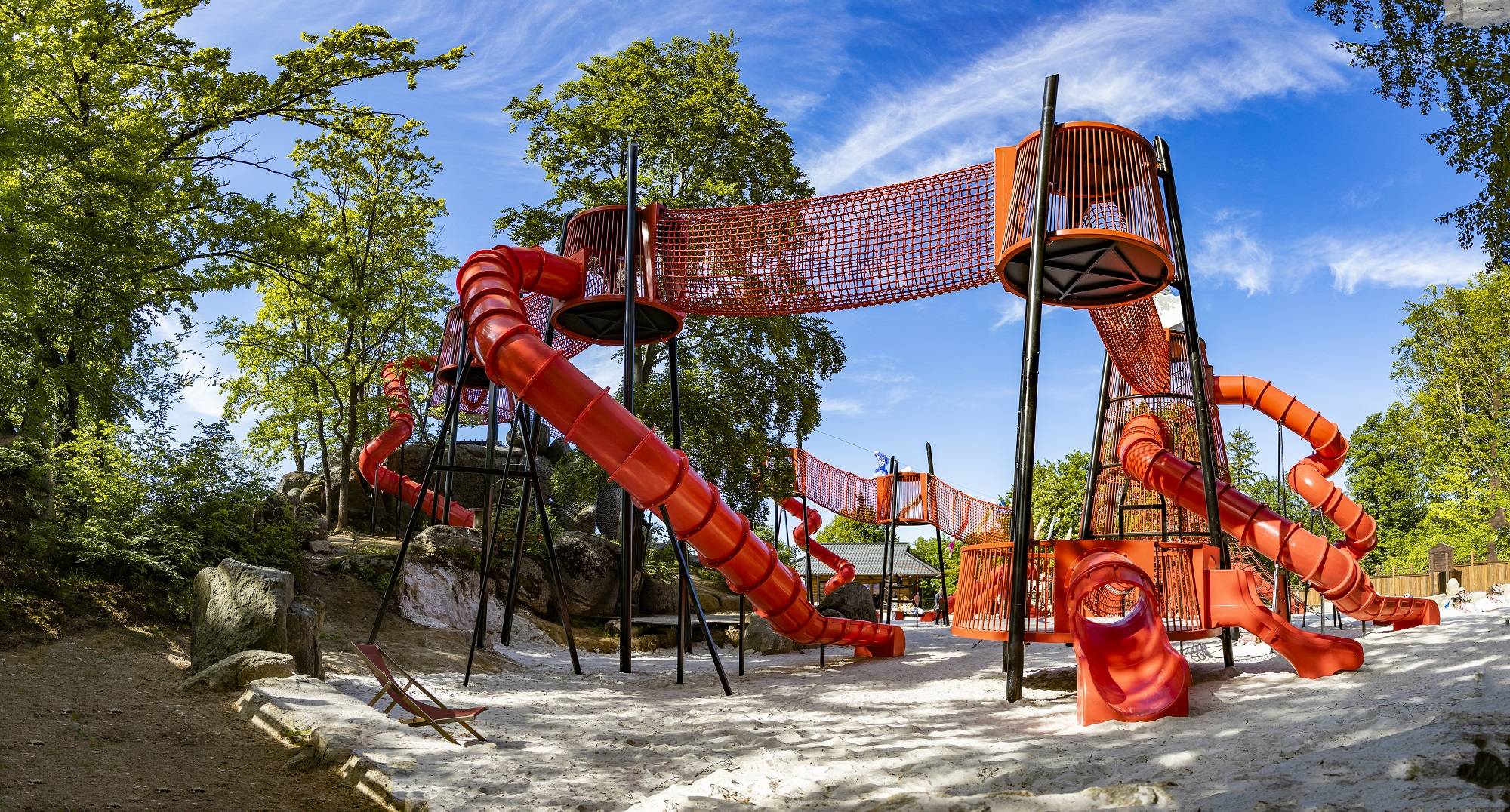
A playground is one of the few pieces of public infrastructure whose success is visible within a week of opening. Either children use it or they do not, and the difference has less to do with budget than with how the scheme was specified. This guide covers what a local authority actually has to decide when buying play structures and modules: the equipment mix, the age zoning, the surfacing, the standards that apply and the duties that begin on the day the site opens.
Start with who is going to use it
The most common specification error is buying a single structure and calling it a playground. Children of different ages need different things, and a scheme that serves only one age band empties out as soon as its users grow past it.
In practice a site is planned around age zones. Toddlers need low platforms, enclosed play, ground-level activities and short falls. School-age children need height, climbing, movement and something that feels slightly risky without being dangerous. Older children need equipment that keeps its interest through repetition, which usually means climbing structures, rotating equipment and open-ended play rather than a single fixed route.
Rope play structures are frequently specified for exactly this reason: a climbing pyramid or a large rope complex holds a wide age range on the same footprint, because each child chooses their own difficulty. The full playground equipment range covers rope structures, towers, swings, roundabouts and spring riders, and the choice between them is a use decision before it is a budget one.
Structures, modules and how they combine
Two approaches dominate. A combined structure gathers several activities into one unit: platforms, a climbing access, a slide, sometimes a sliding pole and a play house. It concentrates play in a small footprint and is usually the better answer on a constrained site.
Individual modules do the opposite. Swings, spring riders, roundabouts and climbing nets are placed separately, each with its own use zone, which spreads children across the site and reduces queuing at the single popular item.
Most successful schemes use both: one anchor structure that gives the site its identity, plus modules around it that absorb the overflow and serve the age groups the main structure does not.
Where the brief is a whole sports and play area rather than a playground alone, children outdoor sports parks extend the same logic to older children.
The two standards that govern the site
This is where specifications most often go wrong, and where a wrong reference in a tender document creates a real problem later.
EN 1176-1 is the standard for playground equipment itself: the general safety requirements and test methods for equipment intended for children.
EN 1177 is a separate standard, and it covers the impact-attenuating surfacing under and around that equipment.
They are not interchangeable and neither replaces the other. Equipment complying with EN 1176-1 installed over a surface that does not meet EN 1177 is an incomplete installation. Equally, EN 16630 is the standard framework for outdoor fitness equipment for adults and must never be cited on children playground equipment.
Surfacing is not the item to economise on
Impact-attenuating surfacing is the least visible line in the budget and the one that does the most work. Its function is to reduce the severity of a fall from the equipment, and the required performance depends on the free height of fall of the equipment above it, which is why the surfacing cannot be chosen before the equipment is chosen.
The practical options split into loose fill and continuous surfaces. Playground wood chips are inexpensive and easy to install, but they displace under swings and slides and need to be topped up and raked as part of the maintenance routine. Continuous playground surfacing costs more at installation, holds its performance without topping up and is the usual answer where accessibility matters, since a wheeled user cannot cross loose fill.
Whichever is chosen, the surfaced area has to extend across the full impact area around the equipment, not only directly underneath it.
Budget: where the money actually goes
A playground budget has four parts, and equipment is only the first. Groundworks and levelling, the surfacing, installation and the fencing or site furniture around the scheme routinely add up to as much as the structures themselves.
The two decisions with the largest effect on total cost are the free height of fall, which drives the surfacing specification, and the ground conditions, which drive the groundworks. Reducing the height of a structure by a small amount can change the surfacing requirement across the whole impact area, which is often a better saving than removing an item of equipment.
Phasing is legitimate and common: a first phase with the anchor structure and its surfacing, a second phase adding modules, provided the layout is drawn for the finished scheme from the outset so the use zones still work.
Installation and what happens afterwards
Play equipment is anchored, and the anchoring is designed for the loads the equipment generates. This is not a task to separate from the supply: a structure installed on foundations that were not designed for it is a liability, not a saving.
Responsibility does not end at handover. A public playground is subject to a routine of visual checks, periodic operational inspections and an annual main inspection, together with a record of what was inspected and what was found. Deciding who does this, how often, and how a member of the public reports a defect belongs in the project before the order is placed, not after the opening.
Frequently asked questions
What area is needed for a playground?
Far more than the footprint of the equipment. Each item has a use zone and an impact area around it that must stay clear, and those zones cannot overlap where the standard does not allow it. The usable area is set by the zones, not by the structures.
Can equipment be installed on grass?
Grass is not an impact-attenuating surface in the sense of EN 1177 and cannot be treated as one for equipment with a significant free height of fall. Low ground-level items are a different case, decided item by item.
How is the playground made accessible?
Accessibility is designed in, through a continuous surface that a wheeled user can cross, ground-level activities that can be reached and used, and at least one item usable by a child who cannot climb. Adding it afterwards is far more expensive.
How long does a playground last?
Service life depends on materials, exposure and use intensity, and on whether the inspection routine is actually followed. The components that wear first are the moving parts and the surfacing, and both are replaceable without rebuilding the scheme.
Planning your scheme
If you are preparing a playground project for a municipality, a school, a housing scheme or a holiday site, send us the plan of the area, the age groups you want to serve and the budget envelope. We will come back with an equipment selection, a layout showing the use zones and a surfacing specification: request a quote.
Réalisations documentées
- Dalles et sols sportifs : livraisons documentées – plusieurs chantiers
- Sol sportif extérieur, square Georges-Vallerey – Taverny (95)
Sources et références
- Décret n° 96-1136 du 18 décembre 1996 – prescriptions de sécurité relatives aux aires collectives de jeux (Légifrance)
- NF EN 1176-1 – Équipements et sols d’aires de jeux, partie 1 : exigences de sécurité et méthodes d’essai générales (AFNOR)
- NF EN 1177 – revêtements de surface amortissants : détermination de la hauteur de chute critique (AFNOR)