Gym Flooring: The Complete 2026 Comparison
Flooring is one of the most structural decisions in a gym fit-out. The wrong surface causes injuries, damages equipment, degrades early and generates maintenance costs nobody budgeted for. The right one improves performance, protects users, makes cleaning straightforward and lasts for decades.
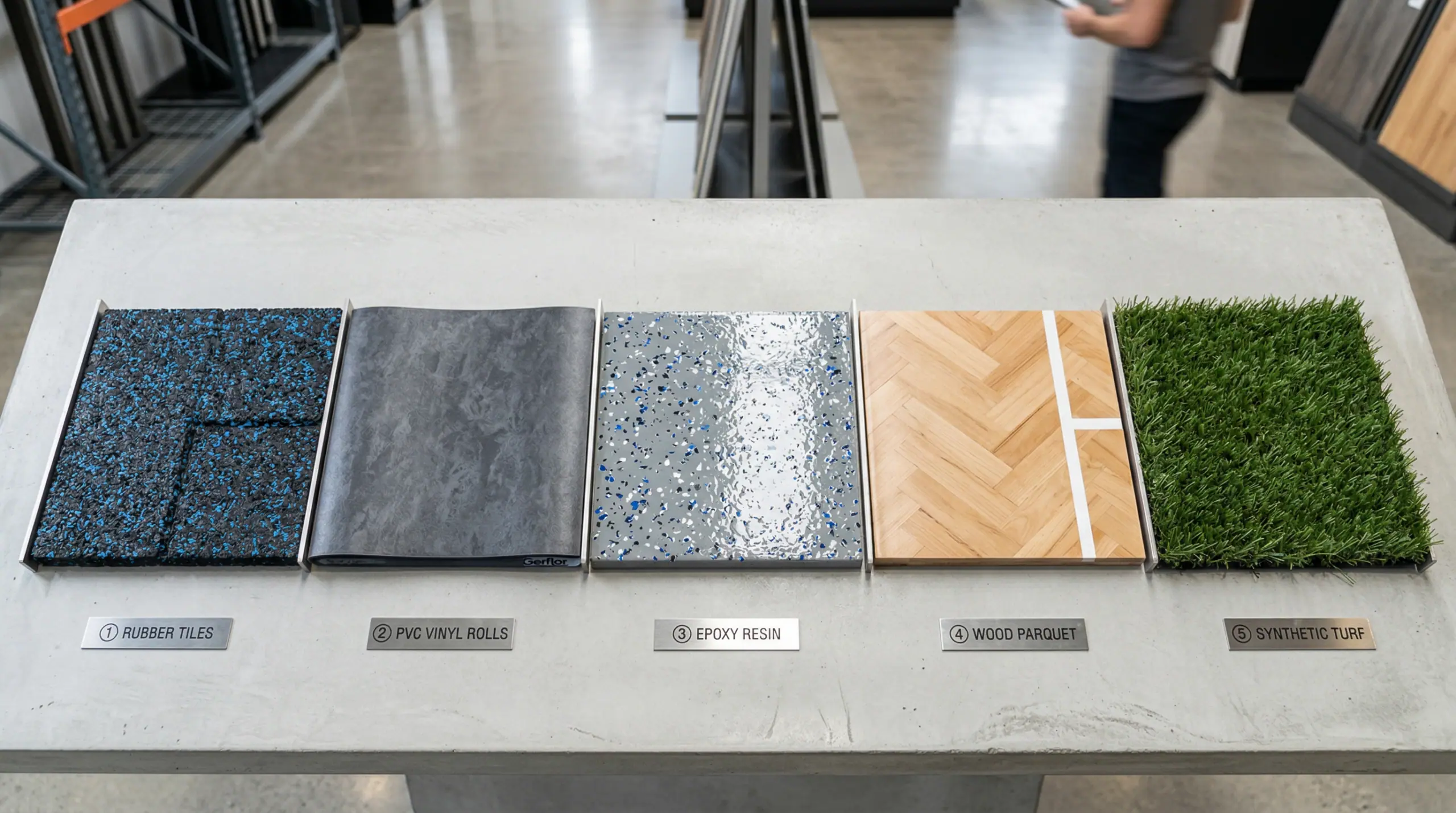
This comparison covers every material available on the professional market: granulated rubber, solid vulcanised rubber, PVC and vinyl, epoxy resin, sports timber and artificial turf. For each one it sets out the technical properties, the uses it suits, its constraints and its cost. It is written for the people specifying a room rather than choosing a surface for themselves: gym operators, box owners, hoteliers, campsite managers, municipalities, clubs, schools and rehabilitation centres.
The six families of sports flooring
1. Granulated rubber (recycled SBR tiles or rolls)
Granulated rubber is the most widespread surface in strength and fitness rooms. It is made from recycled SBR granules, styrene-butadiene rubber, generally shredded car tyres, bound with a polyurethane binder.
Specification
- Available thickness: 10, 15, 20, 25, 30 mm
- Typical density: 400-700 kg/m3
- Appearance: uniform black, or with coloured EPDM granules at the surface
- Format: tiles 50 x 50 cm, 100 x 100 cm, or rolls 1 to 2 m wide
Strengths
- Excellent shock and vibration absorption, which is essential under free-weight areas
- High resistance to point loads and to dropped plates
- Good durability, 10-20 years with normal maintenance
- Replaceable tile by tile where wear is localised
- Affordable, and simple to install, with no adhesive needed for tiles
- Recyclable at end of life
Weaknesses
- A noticeable rubber smell, particularly when newly laid, which fades over 2-4 weeks
- Basic appearance, less suited to premium spaces
- Possible liquid absorption where density is insufficient, from spilled bottles and sweat
Best used for: free-weight areas, heavy strength zones, CrossFit rooms, functional training areas, weight storage rooms.
Typical price: 15 EUR to 45 EUR per m2 excluding VAT, depending on thickness and quality.
2. Solid vulcanised rubber (dense EPDM tiles and rolls)
Unlike granulated rubber, solid vulcanised rubber is made from high-quality EPDM synthetic rubber, ethylene propylene diene monomer, with no recycled granules. Vulcanisation produces a homogeneous, very dense molecular structure.
Specification
- Available thickness: 3, 5, 6, 8, 10, 15 mm
- Density: 1 000-1 200 kg/m3, far denser than SBR
- Smooth or textured surface, including diamond, coin and orange-peel finishes
- Resistant to oils, greases and chemicals
Strengths
- Non-porous surface, hygienic and very easy to clean
- High resistance to abrasion and indentation
- Professional, uniform appearance
- Available in many colours, since EPDM takes pigment
- Suitable for wet areas such as changing rooms and, in the anti-slip version, showers
Weaknesses
- Less absorbent than granulated SBR at equal thickness
- More expensive than SBR
- Not as easy to cut
Best used for: cardio areas, circulation routes, changing rooms, pool surrounds, wet areas, sports hall walkways.
Typical price: 25 EUR to 60 EUR per m2 excluding VAT, depending on thickness.
3. Sports PVC and vinyl
PVC, polyvinyl chloride, and sports vinyl are a family of synthetic multilayer coverings. They combine a transparent wear layer, a printed layer carrying the decor, whether wood, concrete or plain, and a backing layer of foam, felt or glass fibre.
Main types
- Compact vinyl, in planks or tiles, bonded or floating
- LVT, luxury vinyl tile, 5-8 mm thick and highly resistant
- PVC in rolls, homogeneous or heterogeneous, the traditional sports hall surface
Specification
- Total thickness: 2 to 8 mm
- Wear layer: 0.55 mm for light use, 0.7 mm and above for intensive professional use
- Use classification: from class 23 for heavy domestic use up to class 43 or 44 for very intensive industrial and commercial use
- Surface treatment: PU, polyurethane or UV, for scratch resistance
Strengths
- A wide choice of finishes: wood, concrete, tile effect and plain
- Excellent comfort-to-durability ratio in cardio and mobility areas
- Waterproof and easy to maintain, including steam cleaning
- Fast, reversible floating installation
- Moderate to good indentation resistance depending on thickness
Weaknesses
- Insufficient under heavy weight areas, above 100 kg on the floor, without a suitable underlay
- Vulnerable to point impact: dropped dumbbells damage the surface irreversibly
- Contains chlorine, which is an issue for incineration at end of life
Best used for: cardio areas, mobility, yoga and pilates rooms, changing rooms, reception, corridors.
Typical price: 20 EUR to 50 EUR per m2 excluding VAT, installation included.
4. Epoxy and polyurethane resin
Resin floors are poured in situ over an existing concrete slab. They form a continuous, jointless, fully sealed and customisable surface.
Main types
- Epoxy resin: very hard, gloss or matt, suited to military physical preparation facilities and industrial areas
- Polyurethane resin: more flexible, more resistant to UV and to thermal shock
- Two-coat epoxy and quartz system: anti-slip through quartz added to the wear layer
Specification
- Thickness: 2 to 6 mm depending on the system
- Chemical resistance: excellent, against oils, dilute acids and cleaning products
- Continuous jointless surface, for maximum hygiene
- Customisable colours and painted demarcation lines
Strengths
- Exceptional mechanical resistance
- Impermeable and bacteriostatic surface
- Service life of 15-25 years
- Easy to clean with a single-disc machine or scrubber-drier
- Sports markings can be integrated
Weaknesses
- Complex installation, requiring a certified applicator
- The concrete substrate must be perfectly dry, below 4 per cent moisture
- Barely absorbent, and uncomfortably hard for floor exercises
- Slippery when wet, unless a quartz treatment is used
- Difficult to repair locally after an impact
Best used for: military physical preparation areas, indoor street workout spaces, technical workshops, corridors and circulation.
Typical price: 30 EUR to 70 EUR per m2 excluding VAT, installation included, excluding substrate preparation.
5. Sports timber and sports laminate
Timber is the traditional surface of multi-purpose sports halls and dance studios. It exists as solid timber, engineered timber and floating sports timber over a shock-absorbing underlay.
Main types
- Timber on pads: the traditional sports hall build, with timber or elastomer pads, softwood or oak boards and a finish coat
- Floating sports timber: multilayer systems with an integrated absorbing layer
- High-pressure sports laminate: high-density HDF core, resistant top layer, foam underlay
Specification
- High energy return, which is essential for running, dance and jumping
- EN 14904 sets the specifications for indoor sports surfaces, covering shock absorption, vertical deformation and slip resistance
- Classes: P1 for light use up to P5 for high-performance competition
Strengths
- Unmatched comfort and energy return for team sports and dance
- A warm, high-end appearance
- High vertical shock absorption, which protects joints
- Sports markings can be painted or inlaid
Weaknesses
- Unsuitable for free-weight areas: dumbbells and plates damage timber irreversibly
- Sensitive to moisture and to humidity variation
- Requires specific maintenance, including resealing and periodic sanding
- Expensive, particularly timber on pads
- Incompatible with heavy rolling equipment
Best used for: multi-purpose sports halls, dance studios, group exercise rooms, light martial arts, basketball, volleyball.
Typical price: 40 EUR to 120 EUR per m2 excluding VAT, depending on the system.
6. Indoor artificial turf
Indoor artificial turf is increasingly used in CrossFit rooms, indoor football, touch rugby and functional training. It reproduces outdoor pitch conditions inside a building.
Specification
- Polypropylene or polyethylene fibres, 10 to 40 mm high
- With or without infill, in quartz or rubber
- Bonded to the slab or laid over an elastic underlay
Strengths
- An outdoor pitch feel indoors
- Ideal for sled work, sprints, dives and rolls
- Resistant to abrasion and impact
- Minimal maintenance: vacuuming and rinsing
Weaknesses
- Feels warm, because the fibres are synthetic
- Friction burns are possible in a fall
- Hard to deep clean, since bacteria settle in the fibres
- Less suited to bodyweight floor work such as press-ups
- Shorter service life than rubber, 5-10 years under heavy traffic
Best used for: CrossFit and functional fitness zones, indoor football, indoor sprint lanes, sled areas.
Typical price: 20 EUR to 45 EUR per m2 excluding VAT, depending on quality and fibre height.
Comparison at a glance
| Material | Shock absorption | Heavy load resistance | Maintenance | Price per m2 excl. VAT, installed | Service life |
|---|---|---|---|---|---|
| Granulated SBR rubber | 5/5 | 5/5 | 4/5 | 15-45 EUR | 10-20 years |
| Solid EPDM rubber | 4/5 | 4/5 | 5/5 | 25-60 EUR | 15-25 years |
| Sports PVC and vinyl | 3/5 | 2/5 | 5/5 | 20-50 EUR | 10-15 years |
| Epoxy and PU resin | 2/5 | 5/5 | 5/5 | 30-70 EUR | 15-25 years |
| Sports timber | 4/5 | 1/5 | 3/5 | 40-120 EUR | 20-30 years |
| Artificial turf | 3/5 | 3/5 | 3/5 | 20-45 EUR | 5-10 years |
Which surface for which zone
| Room or zone | Recommended surface | Recommended thickness |
|---|---|---|
| Heavy strength zone with barbells and racks | Granulated SBR rubber | 20-25 mm |
| Cardio zone with treadmills, bikes, cross-trainers | PVC and vinyl, or EPDM rubber | 6-10 mm |
| CrossFit and circuit training zone | SBR rubber plus artificial turf | 15-20 mm |
| Group exercise room, yoga, pilates | PVC and vinyl, or sports timber | 5-8 mm |
| Multi-purpose sports hall | Sports timber over an underlay | EN 14904 P3 |
| Martial arts and dojo | PVC tatami or EPDM rubber | 40-50 mm for tatami |
| Wet areas, changing rooms, showers | Anti-slip EPDM rubber | 6 mm |
| Outdoor fitness park | UV-resistant granulated rubber | 30-40 mm |
| Sprint and sled lane | Artificial turf | 20-30 mm |
Standards and fire classification
Reaction to fire: the Euroclass system
Reaction to fire for floor coverings is expressed across Europe in Euroclasses, from A1fl and A2fl-s1 through Bfl-s1, Cfl-s1 and Dfl-s1 down to Efl. The suffix fl identifies a floor covering and the s index states the smoke production. Both parts matter: a Cfl-s1 product and a Cfl product with no stated smoke index are not the same specification, and a certificate that omits the smoke index is incomplete.
Which class your floor has to achieve is set by the fire regulations that apply to your building in your country, and depends on the type of establishment and the number of people it admits. Establish that classification before you shortlist a material, not after, and ask every supplier for a reaction-to-fire certificate issued by an accredited laboratory. Any serious manufacturer will have one.
Technical standards
- EN 14904: specifications for indoor sports surfaces, including sports halls and timber floors, with classes P1 to P5
- EN 13501-1: the classification system behind the Euroclasses above
National rules add to these: sports federations often publish their own requirements for competition venues, and public procurement in most countries references them. Check the federation for the sport concerned before specifying a competition hall.
How Light In Fitness can help
Light In Fitness supplies a complete range of sports flooring for every use: SBR rubber tiles, EPDM rolls and sports vinyl. Our team can guide you through the choice of material for your project and put together a turnkey solution covering both the floor and the equipment on it.
See the range on the rubber gym flooring tiles page, the continuous surfaces under rubber flooring rolls, and the martial arts surfaces under tatami mats.
Frequently asked questions
What rubber thickness is needed under a free-weight area?
The baseline is 20 mm minimum for a free-weight area with plates up to 20 kg reaching the floor. For weightlifting rooms with loads over 100 kg and bumper plates being dropped, allow 25 to 30 mm to protect both the lifter and the concrete slab.
Can rubber be laid over an existing timber floor?
Yes, provided the timber is stable, flat and free of deformation. Rubber tiles laid loose, without adhesive, can go straight over timber to create a temporary or permanent strength area. Adhesive is not necessary in low-circulation zones.
What does a Cfl-s1 fire classification mean for a sports floor?
Cfl-s1 identifies a floor covering that is difficult to ignite, with the s1 index confirming low smoke production. It is a common requirement in larger public-access buildings. Whatever class your building demands, ask the supplier for the certificate from an accredited laboratory rather than taking the specification on trust.
Which floor should a CrossFit room have?
The optimal configuration is a mix of two zones: 20 mm granulated SBR rubber under the barbell and kettlebell stations, and artificial turf or 15 mm SBR rubber in roll form for circuit and running areas. That combination optimises both protection under load and practicality for functional movement.
Is PVC resistant enough for strength equipment?
Standard PVC, with a 0.55 mm wear layer, is not suitable for heavy strength zones: a 20 kg dumbbell dropped on it leaves a permanent mark. Under selectorised machines and static cardio equipment, an LVT vinyl of 5-8 mm with a wear layer of 0.7 mm or more can be used, if necessary with local protection under each machine foot.
How long does an SBR rubber floor last in a commercial gym?
In a commercial facility with 50-100 users a day, a professional-grade SBR rubber floor with a density of 500 kg/m3 or more generally lasts 12 to 18 years before it needs partial replacement. The advantage of the tile format is that only the most worn areas are replaced, rather than the whole floor.
Is public funding available for a municipal sports floor?
In most countries, national and regional programmes exist to co-finance the renovation of public sports facilities, and flooring is normally an eligible cost. The schemes, the eligibility rules and the calls for projects differ from one country to the next, so the reliable route is to ask the national or regional sports authority responsible for your territory what is currently open. We can supply the technical documentation an application needs.
Specifying your floor
No single material wins. A working facility usually needs two or three surfaces, zoned by what happens on them, and the money is best spent where the load is heaviest. Send us your floor plan, the zones you intend to run and the fire classification your building requires, and we will specify the floor zone by zone. Light In Fitness has equipped professional facilities since 2013. Request a quote and our team will come back with a costed proposal covering supply and installation.
Réalisations documentées
- Dalles et sols sportifs : livraisons documentées – plusieurs chantiers
- Sol sportif extérieur, square Georges-Vallerey – Taverny (95)
Sources et références
- Arrêté du 19 avril 2011 – étiquetage des produits de construction ou de revêtement de mur ou de sol sur leurs émissions de polluants volatils (Légifrance)
- Ministère de la Transition écologique – étiquetage des produits de construction : classes d’émission A+ à C
À lire aussi sur le même thème
- Which Street Workout Cage Brand Should You Choose? 2026 Comparison Framework
- Comparing gym flooring suppliers: technology, classifications and real cost
- Leasing or buying professional gym equipment: how to decide
- Synthetic ice rinks: specification, installation and budgets
- Building a professional padel court: budget, dimensions and surfacing