Synthetic ice rinks: specification, installation and budgets
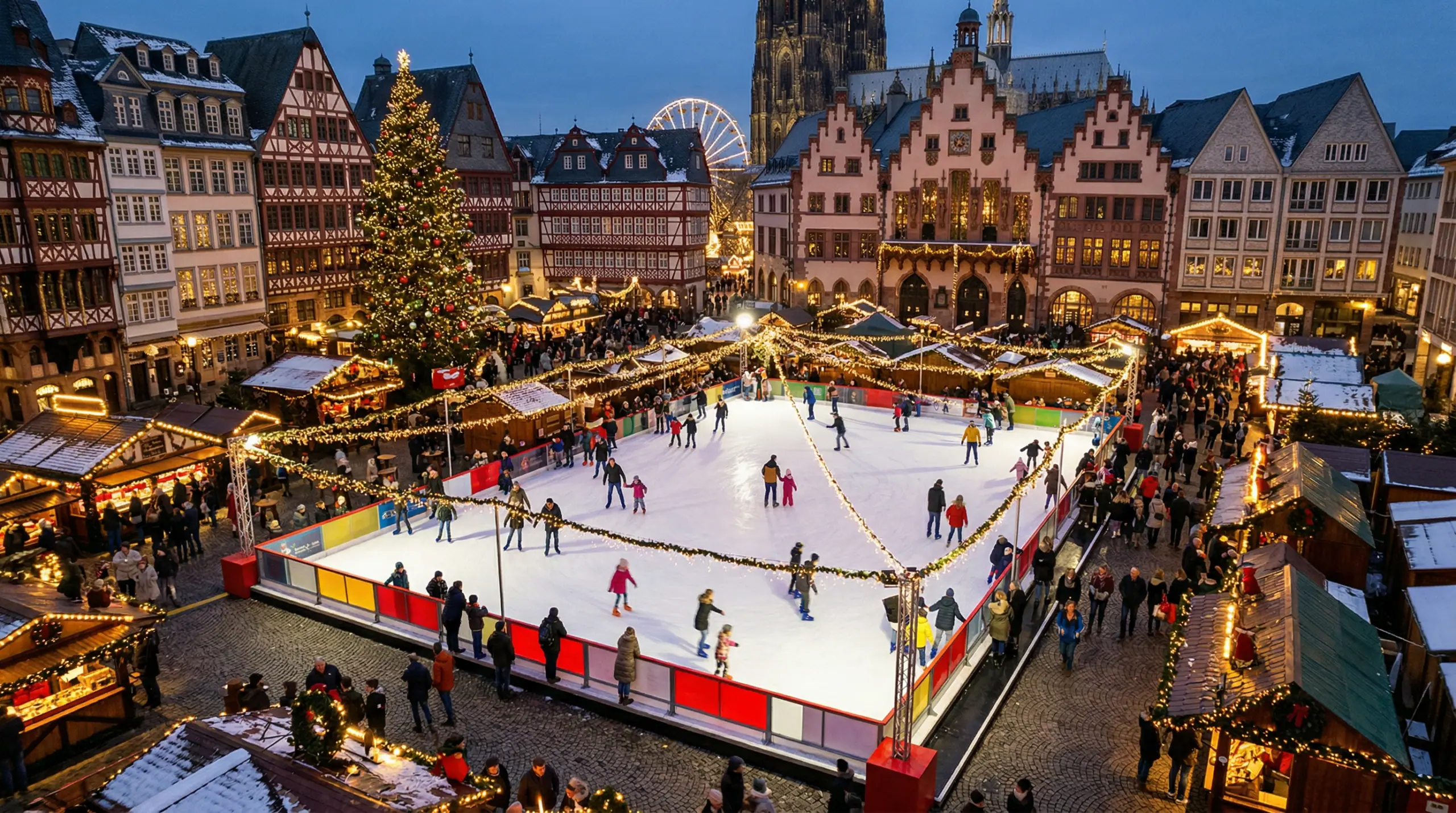
A synthetic ice rink is a modular polymer surface that delivers a genuine gliding experience with no refrigeration, no water consumption and no seasonal limit. Panels of high density polyethylene, or ultra high molecular weight polyethylene in premium grades, are treated to give a very low friction coefficient so that skate blades glide as they would on ice. For councils, event organisers and shopping centres facing rising energy prices and tightening carbon requirements in public procurement, it is the option that fits current policy. This guide covers panel technology, the comparison with refrigerated ice, installation, maintenance and budgets.
How the panels are made, and why it matters
Professional panels are produced by two processes. Extrusion melts the polymer and forms it into continuous sheets: cheaper, but with less homogeneous density and shorter service life. Sintering compresses ultra high molecular weight polyethylene powder under very high pressure, above 6,500 tonnes, at controlled temperature and without ever reaching a liquid state. That gives perfectly uniform density, better integration of the glide agents into the mass, and superior durability. It is the reference process for intensive installations.
The defining feature of premium panels is self-lubrication: the glide agents are incorporated into the material itself, so each pass of a blade releases a minute quantity of lubricant at the surface, forming a film that improves the glide over time.
| Parameter | Standard specification | Premium specification |
|---|---|---|
| Material | Extruded HDPE | Sintered UHMWPE |
| Thickness | 10 to 15 mm | 18 to 20 mm |
| Panel size | 1,000 x 1,000 mm | 1,000 x 1,000 mm, reversible |
| Glide performance | 80 to 85% of natural ice | 90 to 95% of natural ice |
| UV resistance | Surface treatment | Anti-UV through the mass |
| Estimated service life | 10 to 12 years | 15 to 20 years, doubled if reversed |
| Recyclability | 100% | 100% |
Panels interlock with a tongue and groove system or nylon screw connectors to form a continuous, perfectly flat surface with no visible joint. The reversible system lets you turn each panel over and use the second face once the first is worn, doubling the useful life of the investment.
Synthetic versus refrigerated ice
| Criterion | Synthetic HDPE rink | Refrigerated ice rink |
|---|---|---|
| Electricity consumption | None, beyond lighting | 50,000 to 200,000 kWh a year by size |
| Water consumption | None | Around 1,500 m3 a year, resurfacing included |
| Installation cost | Low to moderate: panels and boards | Very high: civil works and refrigeration plant |
| Installation time | A few hours to two days | Weeks to months |
| Demountability | Total, panels stored on pallets | Effectively impossible without demolition |
| All-season use | Yes, from minus 40 to plus 35 degrees | Limited by summer running costs |
| Daily maintenance | Sweeping plus glide spray | Repeated resurfacing with a machine |
| Glide performance | 85 to 95% of natural ice | 100%, the reference |
Formats and who installs them
| Format | Area | Simultaneous skaters | Typical use |
|---|---|---|---|
| Small | 60 to 108 m2 | 10 to 25 | Private events, small municipalities |
| Medium | 120 to 200 m2 | 30 to 60 | Christmas markets, shopping centres |
| Large | 216 to 400 m2 | 60 to 120 | Cities, ski resorts |
| Extra large | 400 to 1,800 m2 | 120 to 500 | Competitions, major events |
Formats are fully modular: rectangular, oval, L-shaped or any custom outline to suit the available space. Individual 1 m2 panels can be handled by one person, which makes the installation logistics straightforward. Typical clients are Christmas markets and seasonal events, shopping centres animating common areas in winter, councils looking to combine local animation with controlled running costs, ski resorts needing a shoulder-season attraction, and corporate events, where 60 to 150 m2 surfaces are common in exhibition halls and company grounds.
Installation requirements
The substrate must be hard, flat and stable: concrete, asphalt, timber flooring or tiling. Maximum tolerated level variation is 1 cm across the whole surface. On an irregular substrate, a levelling timber deck of 22 to 28 mm goes down first. Allow a buffer zone of 1 to 1.5 m around the rink for boards, access and skater circulation. Mains power is not needed for the rink itself, only for perimeter lighting, where a standard socket is enough. Outdoors, a slight perimeter fall is recommended to shed rainwater.
Assembly runs in five steps: prepare the substrate (clean, check level, lay the intermediate deck if needed); lay the panels line by line, interlocking panel to panel with nylon screws or integrated connectors; install the boards, welded metal barriers at a minimum 90 cm on the skater side with a handrail at 1.10 m, fixed to self-stabilising feet around the perimeter; complete the finishes, including accessible access points, the boot-changing zone and perimeter lighting; and apply the initial glide lubricant before first use. For a 150 m2 rink, assembly takes 4 to 6 hours with a team of three or four, and dismantling takes the same. Perimeter lighting at a minimum of 200 lux on the skating surface is strongly recommended for evening use.
Maintenance and service life
Upkeep bears no comparison with refrigerated ice: no resurfacing, no ice machine, no specialist technical intervention. After each session, sweep or vacuum to remove plastic shavings and debris. Apply glide lubricant by spray or fogger across the surface, once or twice a day on intensive outdoor installations. Once a week, deep clean with a scrubber using a non-abrasive cleaner diluted to 5% in warm water, then rinse and polish, which takes 30 to 60 minutes for 200 m2.
Wear concentrates on the busiest areas, the centre of the rink and the access points. Rotate the panels every three to six months, moving worn panels to lower-traffic zones. When one face is too degraded, turn the panel over and use the fresh face. Deep scratches or localised cracking are handled by swapping a single panel, which is immediate and inexpensive: panels are interchangeable and available individually. With rigorous maintenance, professional panels run 15 to 20 years on a single face, and premium manufacturers offer 10 to 12 year warranties.
Budget
| Line | 100 m2 | 200 m2 | 400 m2 |
|---|---|---|---|
| HDPE panels, supply | 15,000 to 25,000 EUR | 30,000 to 50,000 EUR | 60,000 to 100,000 EUR |
| Boards and feet | 5,000 to 8,000 EUR | 10,000 to 16,000 EUR | 20,000 to 32,000 EUR |
| Levelling deck, optional | 2,000 to 4,000 EUR | 4,000 to 8,000 EUR | 8,000 to 16,000 EUR |
| Lighting and accessories | 1,500 to 3,000 EUR | 3,000 to 6,000 EUR | 6,000 to 12,000 EUR |
| Total investment | 23,500 to 40,000 EUR | 47,000 to 80,000 EUR | 94,000 to 160,000 EUR |
All figures exclude VAT. For comparison, a refrigerated rink of the same area requires an investment of 500,000 EUR to several million in civil engineering and refrigeration plant, before any annual running cost.
Frequently asked questions
Does it skate like real ice?
Not identically. Premium sintered panels reach 90 to 95% of natural ice glide, standard extruded panels 80 to 85%. Skaters notice slightly more resistance and shorter glides. For public recreational skating this is a non-issue; for figure skating training it is a compromise that should be discussed openly.
Do skates need sharpening more often?
Yes. Polymer surfaces dull blades faster than ice, and a rental fleet needs a sharpening routine built into the operating plan. Plan the consumable and the labour into the running budget rather than discovering them mid-season.
Can it be installed on grass or gravel?
Not directly. The substrate must be hard, flat and stable within 1 cm across the whole area. On soft or uneven ground, a levelling timber deck of 22 to 28 mm goes down first, which is the optional line in the budget table above.
Is it viable as a permanent installation?
Yes, and that is where the economics are strongest: 15 to 20 years of service life on one face, doubled with reversible panels, against continuous refrigeration costs for an ice rink. The demountable option remains available, which is what makes the same asset usable for seasonal events at other sites.
Have your rink sized and quoted
Light In Fitness has been a manufacturer and B2B distributor of professional sports equipment since 2013, based at 6-8 rue Victor Laloux in Tours, France, with more than 2,500 customers equipped. We size synthetic gliding surfaces for councils and event operators, supply the panels, boards, lighting and maintenance kits, and prepare the technical documentation needed for a public tender. We deliver across France, Belgium, Switzerland and Luxembourg, with export priced per project. Browse the sports flooring and outdoor sports flooring ranges, then request a quote. We reply within 24 working hours.
Réalisations documentées
- Dalles et sols sportifs : livraisons documentées – plusieurs chantiers
- Sol sportif extérieur, square Georges-Vallerey – Taverny (95)
Sources et références
- Code de la commande publique – texte intégral en vigueur (Légifrance)
- Direction des affaires juridiques, ministère de l’Économie – réglementation de la commande publique et fiches techniques