Professional Fitness Equipment in Marseille
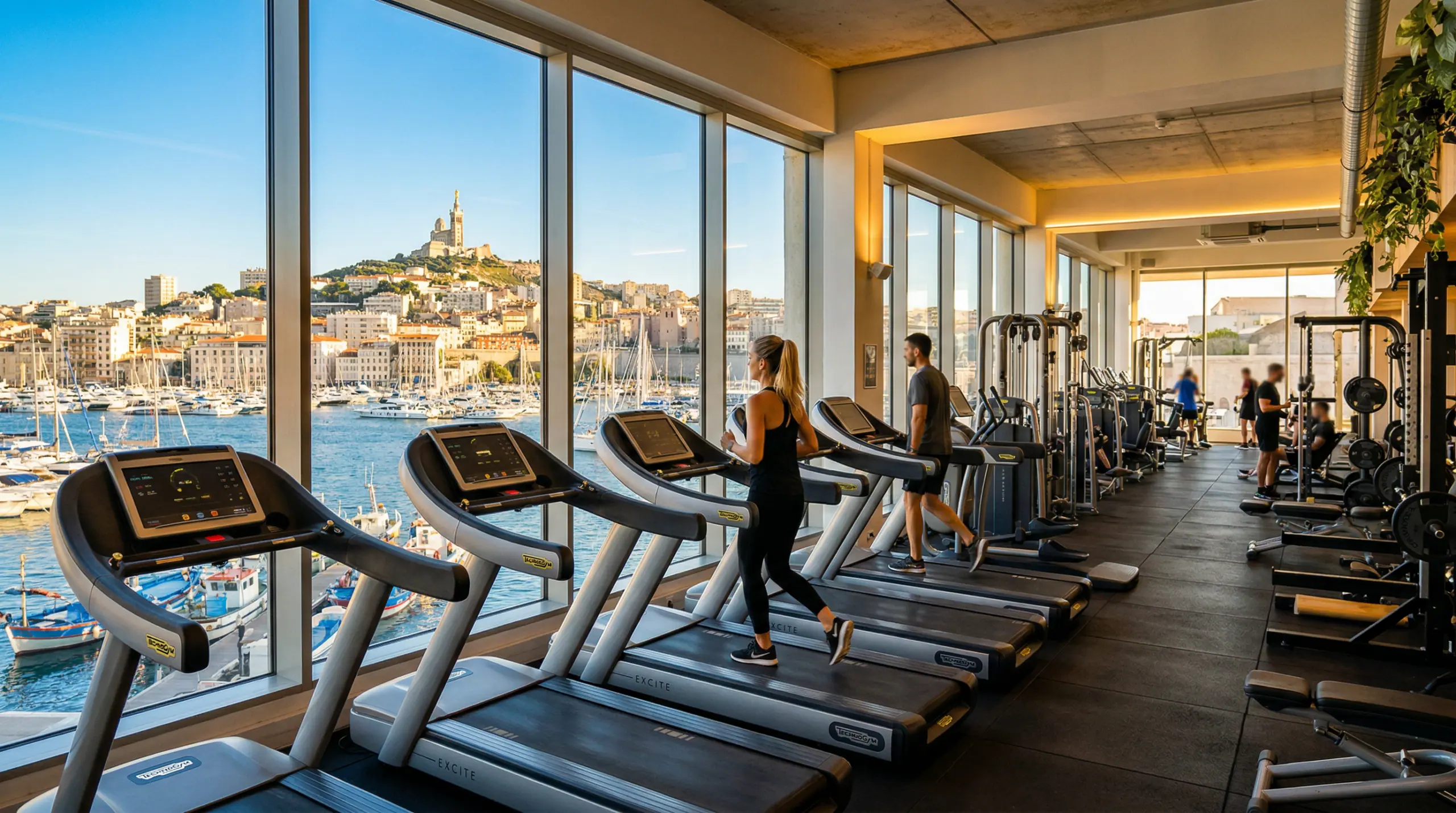
Marseille, the second city of France with more than 870,000 inhabitants and a metropolitan area of 1.8 million people, holds a distinctive place in the country’s sporting landscape. Named European Capital of Sport in 2017, the city has a strong relationship with physical activity: Olympique de Marseille football, rugby, sailing on the Mediterranean, trail running in the Calanques. Against that background, the market for professional gym equipment in Marseille has grown steadily, driven both by new openings and by the modernisation of existing facilities.
Whether you are developing an independent gym, running a sports club, managing a hotel on the coast, or responsible for sports facilities in a local authority in the Bouches-du-Rhone, this article sets out the state of the fitness market in the region, the project types that come up most often in Marseille, and how a specialist supplier works with you from design to commissioning.
The fitness market in Marseille and the Provence region
A national sector in expansion
The French gym market is in robust health. According to the Xerfi study published in 2025, the sector counts between 5,500 and 5,900 facilities nationally, for a turnover of 2.5 billion EUR in 2024, up 6.2 percent year on year. Active memberships approach 7 million, and club attendance rose 7.7 percent between the first quarter of 2024 and the first quarter of 2025. Fitness penetration in France nevertheless remains around 10 percent, against 13 to 15 percent in Germany or the United Kingdom, a gap that points to considerable growth potential, particularly in large regional cities such as Marseille.
Why Marseille is fertile ground
The Provence-Alpes-Cote d’Azur region combines a large population, solid spending power in several catchments such as Aix-en-Provence, Toulon and Nice, and an intensive sporting culture supported by the Mediterranean climate. In Marseille itself, several dozen chains and independent clubs are spread across the sixteen arrondissements, from the Vieux-Port to the Prado and from the Belle-de-Mai to Chateau-Gombert. National chains have opened multiple sites, while specialist studios covering cross-training, electrostimulation and HIIT continue to multiply in both central and outlying districts.
The profile of new gyms in the city has also changed. Traditional strength and cardio alone are no longer enough. Operators now build in functional cross-training zones, wellness areas covering sauna, steam room and stretching space, and group class studios aimed at attracting a younger and more female membership. That diversification means working with a supplier able to deliver a complete and coherent range, from a weights bench to a cross-training rig to the sports floor underneath both.
Project types in Marseille and the region
Independent and franchised gyms
The most common project remains the opening of an independent or franchised gym on a floor area between 300 and 1,500 square metres. These operators are looking for a supplier who can take them from the layout plan through to turnkey installation: making every square metre count, selecting machines built for intensive use, and holding a controlled budget without losing the quality that members judge the club on.
Sports clubs and associations
Marseille is home to Olympique de Marseille, one of the most followed football clubs in France, and to a dense network of sports associations covering rugby, judo, swimming, athletics and emerging disciplines. These organisations regularly need professional strength equipment for their physical preparation areas: dedicated weight rooms for professional and amateur players, and performance platforms for elite sections. Robustness and warranty requirements are at their highest here.
Coastal hotels and residences
Three, four and five star hotels along the coast, on the Corniche Kennedy, at the Prado and in the resorts between Marseille and Cassis, now include fitness spaces as standard for their international leisure and business guests. These projects are distinguished by the weight given to equipment design, to the ergonomics of the space and to acoustic discretion: here the gym is a commercial differentiator and a factor in hotel classification.
Local authorities and public facilities
The metropolitan authority, the city and the surrounding communes invest regularly in renovating or creating sports halls, multi-sport centres and municipal fitness areas. Public procurement imposes traceability of equipment, specific tender procedures and reinforced guarantees on durability.
Corporate and B2B wellness spaces
Quality-of-working-life programmes are pushing more and more companies in the region to create internal gyms. Large groups on the industrial estates, technology companies and healthcare institutions all see fitness equipment as a lever for retaining staff and reducing absenteeism.
The professional equipment range, zone by zone
Strength equipment
The weights floor remains the heart of any gym. Professional equipment, meaning multi-function benches, leg presses, lat machines, cables and pulleys, has to withstand intensive duty cycles of 12 to 16 hours a day in busy clubs. Wear-resistant finishes, treated steel cables and hot-welded structures are what keep the fleet alive and hold maintenance costs down. Browse our selection of professional strength training machines for every gym configuration. Specify to EN ISO 20957-1 class S, the class intended for supervised facilities.
Cardio
Treadmills, indoor cycling bikes, cross-trainers, rowers and recumbent bikes make up the first zone a member sees. Connected machines compatible with the most widely used training applications are the norm on new projects. Our range of professional cardio equipment covers everything from boutique studios to large clubs.
Cross-training and functional rigs
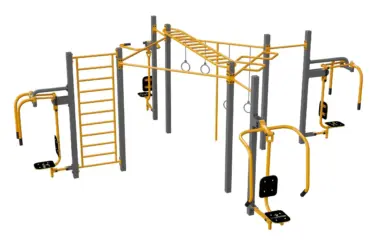
Cross-training is one of the most durable trends in the city, which counts several affiliated boxes and a growing number of HIIT studios. Modular rigs and cages, kettlebells, Olympic barbells, plyometric boxes and suspension systems form the core kit. The rig is specified around the clear ceiling height of the unit, which is the constraint that most often decides the configuration.
Sports flooring
Too often left until last, the sports floor governs user safety, impact absorption and the overall look of the space. In a strength zone, high-density rubber of 15 to 20 mm is the recommended build-up; in a functional zone, tiles rated for dropped loads are required, with 15 mm as the practical minimum. Our range of professional rubber gym flooring offers a solution for each zone, in a wide choice of colours.
Wellness and recovery
Wellness has taken hold in the higher end of the market. Saunas, cryotherapy areas and mobility and stretching zones are becoming meaningful differentiators for hotels and premium clubs targeting a demanding clientele. Building a wellness offer in at design stage raises average spend per member and positions the site in a growing segment.
How a project runs, from brief to opening
Design and specification
Every fitness project is different. Our specialists work from your brief, meaning the available floor area, the membership you are targeting, the budget and the technical constraints of the unit, and produce an optimised layout plan. For projects in Marseille and the wider region we carry out site visits and range presentations adapted to the local market, whether the project is a 300 square metre gym in the northern districts or a 1,200 square metre wellness centre on the coast.
Delivery and installation
Our carrier network delivers to your unit in the city or its outskirts. Our installers handle assembly, floor anchoring, cabling and final adjustment. At handover the gym is operational and every machine has been tested.
Aftersales and maintenance
The life of the investment depends on the quality of the aftersales service. Our technician network covers the region and can respond quickly to a breakdown. We offer preventive maintenance contracts matched to the usage volume of your gym, and hold spare parts for common machines, which is what keeps downtime short and members satisfied.
Fleet renewal
Fitness moves quickly, and member expectations sharpen from one year to the next. We work with clients over the long term on partial fleet renewal, buy-back arrangements, staged financing and advice on new ranges.
Order process and lead times
The sequence is consistent: first contact and capture of the brief, quotation with layout plan, order confirmation, shipping, delivery, installation and commissioning, staff training, and final acceptance.
For standard projects, the average lead time between order confirmation and delivery in Marseille is 3 to 6 weeks. For bespoke equipment, such as a specific cross-training rig or flooring cut to unusual dimensions, allow 6 to 10 weeks. Placing the order as soon as the commercial lease is signed or the building permit obtained is therefore strongly advised. Lead times to other destinations depend on the delivery address and are confirmed with the quotation.
Coordination between the building works and the equipment delivery is what prevents a delayed opening. A dedicated project manager liaises with the site trades, phases deliveries where necessary, with the sports floor first and the machines after the finishes, and adjusts the schedule when the works slip.
Funding a fitness project
Public funding for sports facilities in France is channelled mainly through the national sports agency and the regional and departmental authorities, with grant rates, ceilings and application deadlines that are set by each body and reviewed periodically. Sports associations, local authorities and their groupings are eligible under different schemes and rates, so the practical first step is to contact the relevant regional body before any works begin, in order to confirm eligibility and the current terms.
Private operators generally work with equipment leasing or hire purchase to spread the investment over time. Operators outside France should check the national and regional schemes that apply in their own country, since eligibility and rates differ from one jurisdiction to another and no scheme transfers across a border.
Frequently asked questions
How long does it take to equip a gym in Marseille?
For a standard project in Marseille or the Bouches-du-Rhone, allow between 3 and 6 weeks from order confirmation to delivery on site, installation included. The figure varies with the volume of equipment, the complexity of the installation, such as a bespoke cross-training rig or a sports floor split across several zones, and access to the unit. Ordering as soon as the administrative steps are complete is the reliable way to make delivery and completion of works coincide.
Does Light In Fitness work directly in Marseille and the region?
Yes. We support fitness projects across the whole region, from Marseille to Nice by way of Toulon, Aix-en-Provence and the communes of the Bouches-du-Rhone and the Var. Our teams travel for site visits, range presentations and site follow-up, and delivery and installation are handled by partner technicians covering the Mediterranean area.
What equipment does a cross-training gym need?
The core kit is a modular rig or cage matched to your clear ceiling height, Olympic barbells and bumper plates, cast iron kettlebells, plyometric boxes, skipping ropes, gymnastic rings and suspension systems. The sports floor should be high-density rubber, 15 mm as a practical minimum, to absorb dropped loads.
How does installation work?
Our technicians handle unloading, positioning to the approved layout plan, assembly and floor anchoring of the machines, electrical connections and function testing. Training on adjustment and basic maintenance is provided at handover.
Your project
Light In Fitness has equipped more than 2,500 customers since 2013, for gyms, clubs, hotels, local authorities, armed forces sites and rehabilitation centres. Send us the floor area, the ceiling height, the membership profile you are targeting and your budget envelope, and we will return a zoned layout, a matched equipment list and a floor specification. Request a quote for your project.
Réalisations documentées
- Dalles et sols sportifs : livraisons documentées – plusieurs chantiers
- Sol sportif extérieur, square Georges-Vallerey – Taverny (95)