Commercial Gym Fit-Out: The Complete Project Guide
Equipping a commercial gym means splitting the investment across three core categories — cardio, selectorised machines and free weights — in proportions dictated by your positioning and expected footfall, then sequencing the project from needs audit to opening day. Depending on format, the equipment budget runs from roughly 40,000 EUR excluding VAT for a 100 m² boutique studio to over 300,000 EUR for a 600 m²+ premium club. This guide walks through the full project: zoning, budgets by segment, brand selection, EN ISO 20957 compliance, logistics and the ROI case — step by step.
Step 1: audit, concept and zoning
Every successful fit-out starts with three questions: who is the member (demographics, price sensitivity, training culture), what is the competitive gap in the catchment area, and what surface can the building actually deliver after changing rooms and circulation? From there, zone the floor into the four non-negotiable areas:
- Cardio zone — typically 25–35% of training surface, positioned with sightlines and screens;
- Selectorised machine circuit — the beginner-friendly backbone, 25–30%;
- Free-weight zone — racks, benches, dumbbells to 50 kg+, 20–30%;
- Functional / group zone — open floor, rig, stretching, 15–20%.
Plan 5–7 m² per simultaneous user and at least 1.5 m of circulation between stations. Building compliance (fire safety, accessibility, ventilation) for publicly accessible premises must be locked in at drawing stage — retrofitting costs multiples.
Step 2: budget by segment
Boutique studio — around 100 m²
| Item | Contents | Budget (EUR, excl. VAT) |
|---|---|---|
| Cardio (4–6 units) | 2–3 treadmills, 1–2 bikes, 1 elliptical | 15,000–25,000 |
| Guided machines (4–6 stations) | Multi-station or individual units | 12,000–20,000 |
| Free weights | Squat rack, benches, bars, plates, dumbbells | 8,000–15,000 |
| Sports flooring (~80 m²) | Rubber tiles 20–30 mm | 3,500–6,000 |
| Accessories and storage | Racks, mirrors, ventilation | 2,000–4,000 |
| Total equipment | 40,000–70,000 |
Standard club — around 300 m²
Cardio 50,000–85,000 EUR (12–18 units), guided machines 35,000–60,000 EUR (10–14 stations), free weights 20,000–35,000 EUR, functional zone 8,000–15,000 EUR, flooring 10,000–18,000 EUR, signage and screens 5,000–10,000 EUR: a total of 128,000–223,000 EUR excluding VAT.
Premium club — 600 m² and above
Connected cardio parks (120,000–200,000 EUR), a 16–24 station machine circuit (80,000–140,000 EUR), full free-weight and functional builds, differentiated flooring and digital signage take the envelope to 300,000–525,000 EUR excluding VAT. Detailed per-surface benchmarks are in our cost by floor area guide.
Step 3: brands — commercial-grade only
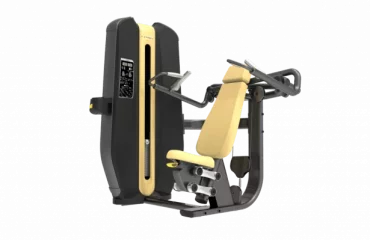
The decisive criterion is not the logo but the duty rating: equipment for a commercial floor must be certified to EN ISO 20957 class S (professional use). Domestic-class (class H) machines fail within 12–24 months of club duty and their warranties are void in commercial settings. Among the professional brands we distribute, Bodytone stands out for cost-to-durability — its EVOT3+ treadmill is 5,832.80 EUR excluding VAT with an AC motor built for continuous duty — alongside Etenon, Ziva and Xebex for strength and HIIT cardio. How the major manufacturers compare is covered in our professional brand comparison.
Step 4: compliance — EN ISO 20957 in practice
- Certification: every machine on a commercial floor should carry an EN ISO 20957-1 declaration for class S (or class I for inclusive professional equipment). Ask suppliers for the certificates, not catalogue claims.
- Operator duties: keep an equipment register, follow the manufacturer maintenance schedule, and document periodic inspections — your liability insurance will ask for these after any incident.
- Structures: rigs and racks should use structural steel with documented material grades (EN 10025) and verified floor anchoring.
Step 5: logistics — the timeline nobody budgets
- Lead times: 4–10 weeks for stocked professional equipment, 12–16 weeks for custom or premium lines. Order long-lead items first.
- Access: check door widths, lift capacity and floor loading — a commercial treadmill weighs 150–200 kg, a loaded dumbbell rack over 600 kg.
- Installation: professional assembly with levelling, anchoring and electrical commissioning typically adds 3–6% of equipment value — and prevents the misalignment failures that dominate year-one service calls.
- Preventive maintenance: contract 2,500–5,000 EUR excluding VAT per year for a 300 m² club; it doubles cardio lifespan.
Step 6: the ROI case
| Indicator | Low case | High case |
|---|---|---|
| Active members (300 m² club) | 400 | 600 |
| Average monthly fee | 35 EUR | 45 EUR |
| Annual revenue | 168,000 EUR | 324,000 EUR |
| Fixed costs (rent, staff, energy) | 120,000 EUR | 140,000 EUR |
| Annual operating surplus | 48,000 EUR | 184,000 EUR |
On a 180,000 EUR equipment investment, payback lands between 12 months and 4 years depending on fill rate. Levers that shorten it: group classes (15,000–25,000 EUR of additional annual revenue on 10 weekly sessions), personal training commissions and B2B corporate memberships. Full method in our ROI and payback guide; equipment can also be financed monthly rather than purchased — see financing and leasing options.
Frequently asked questions
How much does it cost to equip a 200 m² gym?
For a generalist positioning, plan 70,000–130,000 EUR excluding VAT of equipment (8–10 cardio units, an 8–12 station circuit, free weights and flooring). Turnkey packages for this format start around 75,000 EUR excluding VAT including delivery and installation.
What warranty should I demand on professional equipment?
Benchmark terms: 5–10 years on frames and welded structures, 2–3 years on parts and motors, 1 year on wear items and upholstery — in commercial use, confirmed in writing. Anything shorter signals a domestic product being sold into club duty.
Do I need specific permits to open a gym?
In most European jurisdictions a gym is a publicly accessible premises subject to fire safety, accessibility and sometimes acoustic requirements, plus local business registration. Requirements vary by country and municipality — confirm with the local authority before signing the lease.
Should I buy everything from one supplier?
A single professional supplier for the whole package — equipment, flooring, installation, after-sales — shortens the project, consolidates warranties and typically unlocks 8–15% package pricing versus line-by-line purchasing.
From floor plan to opening day
Light In Fitness has supplied and installed complete gym fit-outs across Europe since 2013 — audit, 3D layout, equipment, flooring, delivery, installation and maintenance from a single point of contact. Send us your project outline and receive a structured professional quotation within 24 working hours.
Réalisations documentées
- Dalles et sols sportifs : livraisons documentées – plusieurs chantiers
- Sol sportif extérieur, square Georges-Vallerey – Taverny (95)
Sources et références
- Code du sport, articles R322-4 à R322-43 – garanties d’hygiène et de sécurité applicables aux établissements d’activités physiques et sportives (Légifrance)
- NF EN ISO 20957-1 – équipement d’entraînement fixe, partie 1 : exigences générales de sécurité et méthodes d’essai (AFNOR)
- AFNOR Normalisation – dossier thématique sur les appareils d’entraînement fixes et leurs classes d’usage