Outdoor Fitness Areas and EN 16630: The Public Procurement Guide
EN 16630 is the European standard for permanently installed outdoor fitness equipment in free public access: it defines safety requirements, test methods, protective zones and maintenance obligations. For a municipality buying an outdoor gym through a public tender, writing EN 16630 conformity into the technical specification is the single most protective clause available — equipment installed in public space without it exposes the authority to direct liability under the EU General Product Safety framework. This guide covers the standard, the procurement process, equipment and surfacing choices, and the maintenance plan the file must include.
EN 16630 in plain terms
- Scope: fixed outdoor fitness equipment for users over 1.40 m in height, in free access — distinct from playgrounds (EN 1176) and from supervised sports equipment. If children’s play and adult fitness share a site, both standards apply to their respective zones; our comparison of EN 16630 vs EN 1176 explains where the line falls.
- Key requirements: entrapment-free geometry (head, finger, limb openings), maximum free-fall heights with matching impact-attenuating surfacing, protective zones around each station, corrosion resistance, permanent marking and user information panels.
- Certification: ask for type-test reports from an accredited laboratory and a declaration of conformity per station — not a generic brochure statement. The standard is voluntary in most jurisdictions, but it constitutes the recognised presumption of safety conformity.
The procurement route
Public purchases of outdoor fitness equipment follow the buyer’s national procurement rules under the EU directives. In practice, three bands matter:
- Low-value purchases (national direct-award thresholds, typically tens of thousands of euros): direct award with comparative quotes — where most single-site outdoor gyms at 15,000–35,000 EUR excluding VAT sit.
- Intermediate value: simplified or adapted competitive procedures with published notices.
- Above the EU threshold for supplies (221,000 EUR for sub-central authorities): full EU-wide open procedure.
Whatever the band, the technical specification should state: EN 16630 conformity with test reports, materials and anti-corrosion treatment, foundations and anchoring, surfacing with its critical fall height, installation by the supplier, a maintenance schedule and spare-parts availability over 10 years. Our outdoor fitness specification template provides ready-to-adapt clauses, and the wider process is covered in buying sports equipment through public tender.
Choosing durable equipment
Two material families dominate compliant outdoor ranges:
- Hot-dip galvanised steel with powder-coat finish — the standard specification for inland sites, offering 15–20 years of service at the best cost.
- Stainless steel 316L — for coastal and high-salinity environments, at a 30–50% premium.
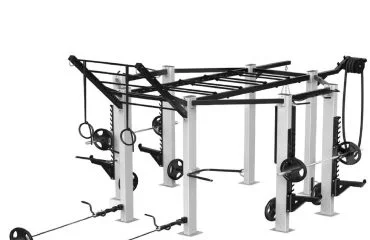
A complete area mixes cardio stations (elliptical, air walker), strength stations, a street workout structure and — increasingly required by funders — wheelchair-accessible and senior stations. Verified examples from our accessible range: the Tai Chi wheel station at 1,500 EUR excluding VAT and the accessible vertical ladder wall-bars station at 1,865 EUR excluding VAT, both designed for wheelchair users.
Surfacing and protective zones: the numbers
| Surfacing | Max free-fall height | Maintenance | Lifespan | Cost (EUR excl. VAT/m²) |
|---|---|---|---|---|
| Recycled rubber tiles 40 mm+ | 1.50 m | Low | 15–20 yrs | 60–90 |
| Wet-pour EPDM rubber | 1.50–2.00 m | Very low | 20–25 yrs | 90–130 |
| Wood chips (min. 30 cm depth) | Per depth | High (top-ups) | 3–5 yrs | 25–40 + annual top-up |
| Sand/gravel (min. 30 cm) | 1.00 m | Medium (raking) | Indefinite if maintained | 15–25 + groundworks |
| Natural grass | 0.60 m max | High | Variable | 5–15 |
Each station’s protective zone (typically at least 1.5 m clear around moving parts, no overlap with adjacent stations’ zones) and the surfacing’s certified critical fall height must both appear in the tender file. Accessibility matters too: at least one continuous firm-surface route to and between stations.
Maintenance: what the standard expects of the operator
- Routine visual inspection — weekly to monthly depending on usage and vandalism risk;
- Operational inspection — every 1–3 months: wear, moving parts, structural fixings;
- Annual main inspection — full check of foundations, corrosion, surfacing performance, ideally by a competent third party.
Written records of all three protect the authority legally. A supplier-side maintenance contract covering the operational and annual inspections typically costs around 890 EUR excluding VAT per year for a mid-sized area. Inspection duties and record-keeping are detailed in our guide to inspecting playgrounds and outdoor fitness areas. In the contract itself, demand 10-year structural warranties, 2–3 years on moving parts and documented spare-parts availability.
Worked example: an intermunicipal fitness area
A representative project for a shared-use site: 8 stations (4 strength, 2 cardio, 2 accessible), 200 m² of protective surfacing, information panels and installation — budget 35,000 EUR excluding VAT, procured by direct award with three comparative quotes. Public funding schemes (national sport agencies, regional health programmes, rural development funds) routinely cover 40–70% of such projects, leaving a modest net cost to the municipality; usage surveys on comparable sites show 60–120 users per week from month one.
Frequently asked questions
Is EN 16630 legally mandatory for public outdoor gyms?
Formally it is a voluntary standard in most countries, but it is the recognised benchmark of conformity with the EU General Product Safety framework. In practice, an authority that installs non-certified equipment in free access carries the burden of proving equivalent safety — which is why specifications should require it.
What surface area does an 8-station outdoor gym need?
Plan 150–250 m² including protective zones and circulation — roughly 20–30 m² per station. A linear trail layout can stretch the same stations along 200–400 m of path instead.
How much does a compliant outdoor fitness area cost?
A 6–10 station area with certified surfacing and installation generally lands between 15,000 and 35,000 EUR excluding VAT — usually within national direct-award thresholds, which keeps procedure light. Larger multi-zone parks with wet-pour surfacing reach 50,000–100,000 EUR.
Who is liable after an accident on public fitness equipment?
The operating authority, unless it can demonstrate compliant equipment, compliant installation and a documented inspection regime. The paper trail — certificates, handover report, inspection log — is the defence.
Prepare your tender with a specialist supplier
Light In Fitness supplies EN 16630-certified outdoor fitness ranges — outdoor fitness equipment for councils — with test reports, specification support, installation and maintenance contracts across Europe. Send us your project outline and receive a complete technical and price file within 24 working hours.
Réalisations documentées
- Cage street workout ultime, Carcassonne – armée française
- Cage street workout ultime, Tahiti – armée française, Polynésie
- Cage SP Max, centre EPIDE de Combrée – établissement public d’insertion
- Cage SP Max, lycée Saint-Bénigne de Dijon – établissement scolaire
Sources et références
- Code de la commande publique – texte intégral en vigueur (Légifrance)
- Direction des affaires juridiques, ministère de l’Économie – réglementation de la commande publique et fiches techniques
- NF EN 16630 – modules fixes d’entraînement physique de plein air : exigences de sécurité et méthodes d’essai (AFNOR)
- Code du sport, article L322-2 – garanties d’hygiène et de sécurité des établissements d’activités physiques et sportives (Légifrance)