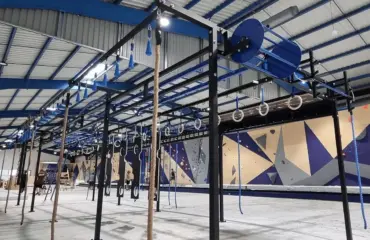
EN 16630 or EN 1176: which standard for outdoor fitness or a playground?
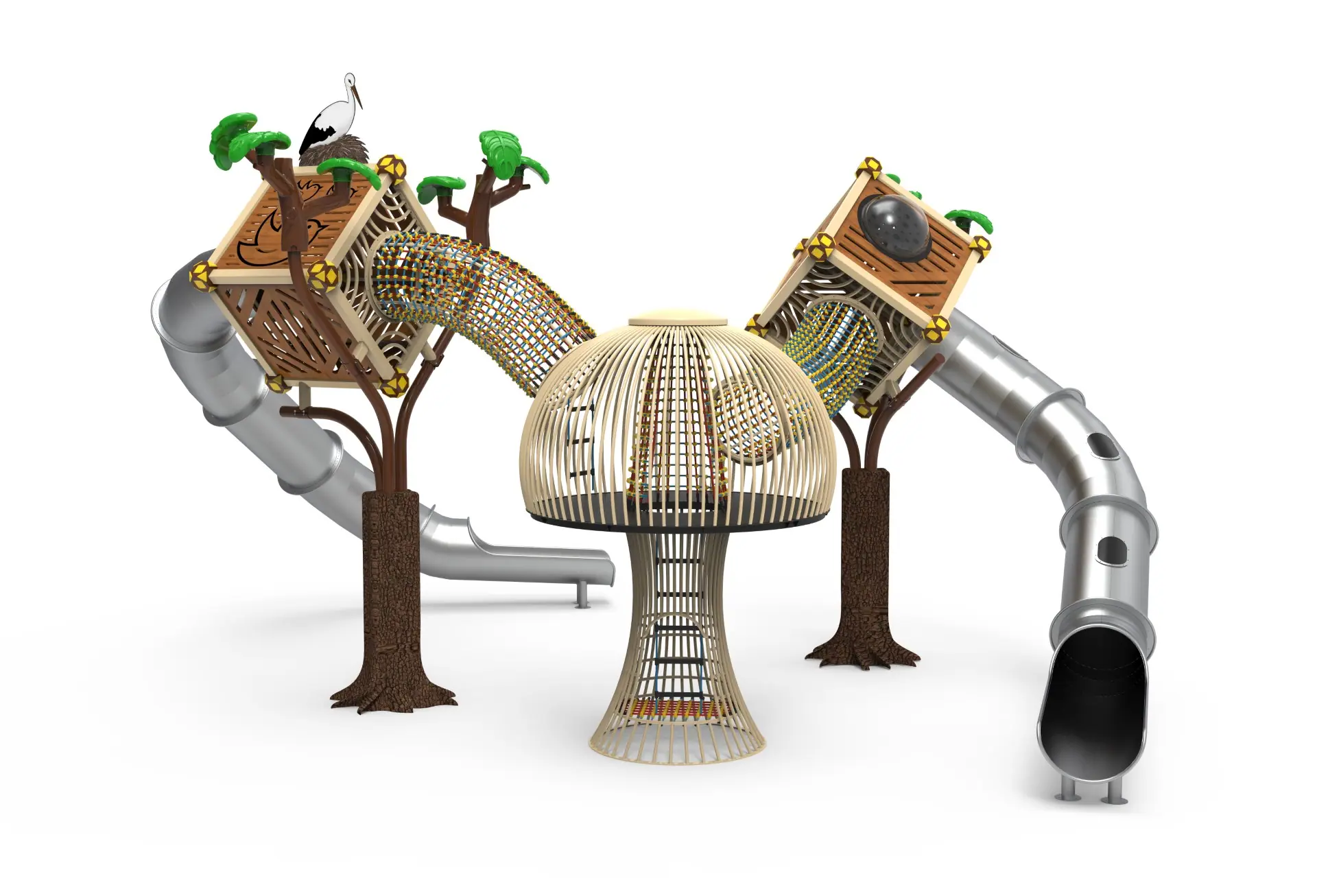
EN 16630 or EN 1176 — which standard applies? EN 16630 governs permanently installed outdoor fitness equipment for users taller than 1.40 m (roughly 13-14 years and up). EN 1176 governs children’s playground equipment. They are two distinct frameworks: you do not specify a fitness zone to EN 1176, nor a playground to EN 16630. On a mixed project — a park containing both — each zone follows its own standard, with its own equipment, safety zones, surfacing and conformity paperwork.
This is the arbitration that derails more outdoor public projects than any other: confusing fitness apparatus with play structures. The two families often share the same park, but they serve different users and answer different requirements. Here is how to decide, zone by zone.
EN 16630: open-air fitness for adolescents and adults
EN 16630 covers outdoor gym equipment and apparatus permanently installed in public space: bars, stations, outdoor bikes and cross trainers, street workout structures and fitness trails. It is written for users taller than 1.40 m and frames mechanical strength, stability, safety clearances around each apparatus and the durability of exposed materials — hot-dip galvanised steel for the standard ranges, stainless steel 316L for the dedicated coastal outdoor range.
EN 1176: children’s playgrounds
EN 1176 applies to playground equipment for public operators: play structures, slides, climbing modules for children. It specifically addresses risks particular to young users — entrapment, fall heights — and requires impact-attenuating surfacing under equipment, dimensioned to the free fall height using the critical fall height principle, with the test method defined in EN 1177. That is territory EN 16630 does not cover; see our guide to playground safety surfacing and fall height.
The difference that decides: the intended user
Everything follows from the user. Fitness apparatus designed for an adult has neither the dimensions, nor the guard rails, nor the safety clearances of a children’s play structure. Conversely, a children’s play module is not engineered for a loaded adult. Hence the rule: equipment is never transposed from one standard to the other.
| Criterion | EN 16630 | EN 1176 |
|---|---|---|
| Intended users | Adolescents / adults (taller than 1.40 m) | Children |
| Equipment type | Fitness apparatus, street workout, fitness trails | Play structures |
| Surfacing under equipment | Per the requirements of the apparatus | Impact-attenuating surfacing sized to fall height (EN 1177 test method) |
| Typical context | Park fitness zone, municipal or campus site | Park or school playground |
The mixed-project trap
Many public parks combine a playground and a fitness zone. The mistake is to look for a single standard. The correct approach is to treat each zone under its own framework — its equipment, its safety clearances, its surfacing. One project, two normative frameworks, and two sets of conformity documents in the tender file. We cover the layout side in combining a playground and an outdoor gym.
What this means for public purchasers
In tender procedures, both standards can legitimately be required for their respective zones. Ask the supplier for equipment-specific declarations of conformity — EN 16630 for the fitness apparatus, EN 1176 for the play structures — plus the surfacing documentation and the maintenance and inspection plan. A supplier who cannot produce zone-by-zone paperwork is a risk to the whole project timeline.
Frequently asked questions
Which standard covers street workout apparatus?
EN 16630: street workout is outdoor fitness for adolescents and adults (users taller than 1.40 m), not a children’s play structure.
Can fitness equipment be installed inside a children’s playground?
No. The requirements — dimensions, safety clearances, surfacing — differ. A fitness zone and a playground are laid out separately, each to its own standard, even within the same park.
Is impact-attenuating surfacing required under outdoor fitness apparatus?
Fall-height-calibrated surfacing is a core requirement of EN 1176 for children’s playgrounds. For EN 16630 fitness equipment, surfacing requirements depend on the apparatus and its use — they are assessed per station, not assumed.
Who checks compliance after installation?
The operator remains responsible for the installed equipment: post-installation inspection and a documented periodic inspection regime are expected under both frameworks, and public purchasers increasingly require the inspection plan in the tender response itself.
Planning a mixed outdoor project? Light In Fitness designs and supplies both zones — EN 16630 fitness apparatus in galvanised or 316L stainless steel and EN 1176 play structures — with the declarations of conformity, surfacing documentation and layout plans your tender file requires. Request a free quotation.
Réalisations documentées
- Cage street workout ultime, Carcassonne – armée française
- Cage street workout ultime, Tahiti – armée française, Polynésie
- Cage SP Max, centre EPIDE de Combrée – établissement public d’insertion
- Cage SP Max, lycée Saint-Bénigne de Dijon – établissement scolaire
Sources et références
- Décret n° 96-1136 du 18 décembre 1996 – prescriptions de sécurité relatives aux aires collectives de jeux (Légifrance)
- NF EN 1176-1 – Équipements et sols d’aires de jeux, partie 1 : exigences de sécurité et méthodes d’essai générales (AFNOR)
- NF EN 1177 – revêtements de surface amortissants : détermination de la hauteur de chute critique (AFNOR)
- NF EN 16630 – modules fixes d’entraînement physique de plein air : exigences de sécurité et méthodes d’essai (AFNOR)