Professional Gym Equipment in Lille: Hauts-de-France Supplier
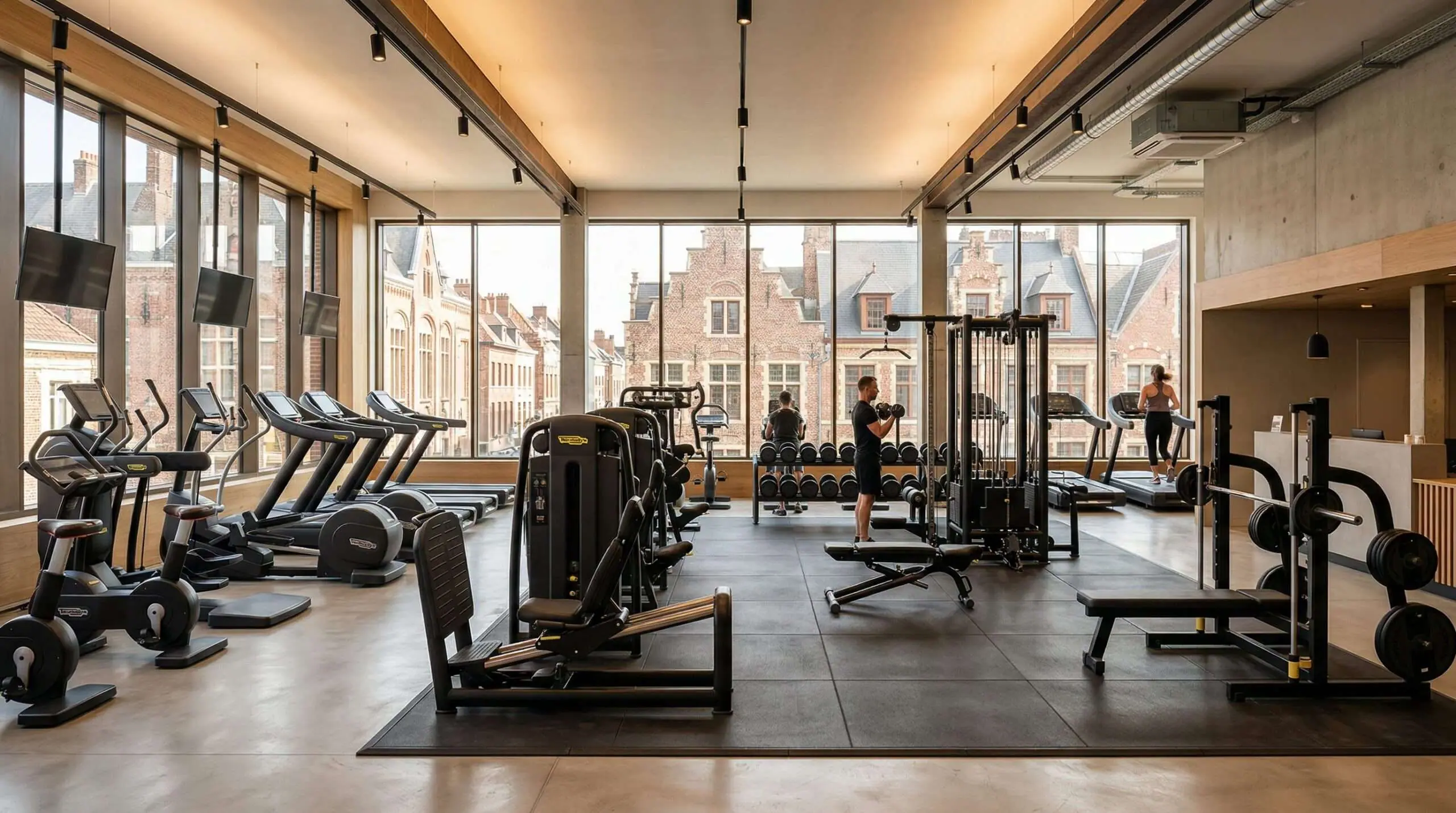
The Lille metropolitan area is one of the most active markets in France for professional gym equipment. It is the country’s third largest student city, a crossroads of northern European trade, and it concentrates a density of clubs, public facilities and institutions that creates structural demand for commercial fitness equipment. Whether you run an independent club in central Lille, manage facilities for a local authority in the Pas-de-Calais, or fit out a hotel or student residence in the region, this guide covers the decisions that matter before you invest.
Lille and Hauts-de-France: a market with room to grow
A young metropolitan area
The Metropole Europeenne de Lille counts around 1.1 million inhabitants and the wider Hauts-de-France region roughly 6 million, making it the third most populated region in mainland France. Its defining feature is how young it is: 187,400 people aged 15 to 24 live in the metropolitan area, and 136,000 students are enrolled in higher education, placing Lille third among French student cities according to 2024 ministry figures. That concentration of young adults is a large pool of gym users and a strong driver for club development across the conurbation.
The business districts of Villeneuve-d-Ascq, Roubaix and Tourcoing, the corporate hotels of Euralille and the student residences around the university campuses are all outlets for professional fitness equipment.
Sports facility provision below the national average
According to INSEE data, Hauts-de-France has 42 sports facilities per 10,000 inhabitants, below the national average of 46, which points to unmet demand and real investment opportunity for private operators and public bodies alike. The Nord department is lower still, at 31.7 facilities per 10,000 inhabitants, the signature of a market that is catching up.
At the same time, the legacy of the Paris 2024 Olympic and Paralympic Games, combined with the national sports facility programme running from 2024 to 2026 with a budget of 300 million euros, is driving local authority investment in the region. Municipalities, inter-municipal bodies and universities around Lille benefit directly from those national funding schemes.
Sporting events that move the market
Lille is also a major sporting city. The Decathlon Arena, home of LOSC, seats 50,186 and is one of the largest and most versatile stadiums in France. In 2026 the city stages the Lille international marathon on 25 October, the first marathon there in 31 years, an event that will bring thousands of runners into the metropolitan area. In March 2025 the Lille half marathon had already gathered 18,000 participants.
Events like these feed directly into demand for professional equipment: clubs prepare their members, public bodies invest in trails and infrastructure, and operators upgrade to commercial-grade machines to meet rising expectations.
Who buys gym equipment in the Lille area
Private clubs and franchises
The Lille club market is one of the most competitive in northern France, with operators across Lille, Villeneuve-d-Ascq, Marcq-en-Baroeul, Roubaix and Tourcoing covering every segment: low-cost monthly memberships, premium clubs with personal coaching, and specialist studios for pilates, cross-training and boxing. Every opening or refurbishment means significant investment in cardio and strength equipment, sports flooring and functional layout. For independent operators, durable commercial equipment is a retention tool: a well-equipped floor is now a decisive criterion when members choose a club.
Universities and higher education
The universities, business and engineering schools and technical institutes of the metropolitan area all run their own sports facilities for a combined student body of 136,000, and they renew their fitness equipment regularly. Public universities are also eligible for parts of the national sports funding programmes.
Local authorities
The metropolitan authority, the agglomeration communities around Lens, Douai, Dunkirk and Valenciennes, and the smaller municipalities of the Pas-de-Calais and the Somme are essential buyers. Their sports halls, aquatic centres and outdoor fitness trails are renewed as part of public health and community programmes, through public procurement procedures that require complete technical files and compliant product data sheets.
Hotels, residences and corporate sites
The hotel sector around Euralille and Lille-Lesquin airport, student and serviced residences, and the large industrial and service employers of the metropolitan area form the fastest growing segment. Demand for wellness space, from saunas to premium changing rooms and recovery zones, keeps increasing, driven by workplace wellbeing policies.
What to specify for a gym in Lille
The fundamentals: cardio and strength
| Type of facility | Essential cardio | Essential strength | Recommended additions |
|---|---|---|---|
| Independent club (200 to 500 sq m) | Treadmills, bikes, cross trainers | Benches, barbells, free weights, selectorised machines | Cross-training cage, sports flooring |
| University sports facility | Bikes, rowers, treadmills | Multi-station, free weights | Stretching area, soft flooring |
| Municipal centre or sports hall | Low-impact bikes, ergonomic treadmills | Selectorised machines, cable stations | Outdoor fitness trail, street workout |
| Hotel or serviced residence | Treadmill, bike, cross trainer in compact formats | Single multi-station unit | Wellness area, premium flooring |
| Cross-training box | Rowers, air bikes, treadmills | Olympic barbells, kettlebells, dumbbells | Cross-training cages, impact flooring |
For the cardio zone, see our professional cardio equipment. For the strength floor, the full range of strength training machines is built for commercial duty cycles.
Cages and functional training
Cross-training and functional work continue to shape investment in the region. A modular cage lets you offer squats, pull-ups, presses and interval training from a single station, which is the most efficient way to monetise floor area. Modular structures suit specialist boxes and municipal sports halls looking to broaden their offer equally well.
Sports flooring: safety and service life
Flooring is the item most often underestimated, although it determines user safety, equipment life and acoustic comfort. The main options are:
- Recycled rubber tiles, 15 to 40 mm. The reference for free-weight and weightlifting zones: they absorb impact and protect the machines. See the rubber gym flooring tiles range.
- PVC sports flooring. Recommended for cardio areas and multi-purpose rooms, easy to maintain and presentable.
- Tatami and high-density foam. For stretching, yoga, martial arts and recovery zones.
- Poured EPDM. A premium answer for high-traffic facilities, very durable and customisable in colour and markings.
Outdoor fitness and street workout
Several municipalities in the region are investing in open-air fitness areas to meet demand and support public health policy. Street workout structures and outdoor fitness trails designed for northern European weather, in stainless steel or treated timber, are built for that exposure. Outdoor adult equipment follows EN 16630. Where a site also includes play equipment for children, EN 1176-1 applies to the structures and EN 1177 to the impact-attenuating surface, and neither is interchangeable with the other.
Delivery and installation in the region
Light In Fitness is based at 6-8 rue Victor Laloux, 37000 Tours, and delivers and installs throughout France, Lille and the Hauts-de-France region included. A project is more than a machine order: it covers the site survey, layout advice on zoning and user flow, equipment selection, delivery, on-site assembly and after-sales support.
Why commercial equipment rather than consumer machines
Built for intensive use
Professional equipment is dimensioned for 8 to 12 hours of daily use, seven days a week. Welded frames, industrial bearings and sheathed cables are tested over millions of cycles, where consumer equipment wears out quickly.
Compliance and warranty
For premises open to the public, equipment must comply with EN ISO 20957. In practice that means class S, the studio and club level, for indoor machines. Class I is also a professional class, defined for inclusive access rather than a higher intensity tier. Certification protects users and supports the operator’s liability cover. A well-maintained professional machine has a service life of 10 to 15 years, provided spare parts and support remain available.
Typical projects in the region
Opening a new club in the Lille metropolitan area
A new club in the metropolitan area typically calls for an equipment investment of 40,000 to 200,000 euros depending on floor area, from 150 to 600 sq m, and on positioning. For a 250 sq m multi-purpose club, a typical budget breaks down as follows:
- 8 to 12 cardio machines, treadmills, bikes and cross trainers: 15,000 to 45,000 euros
- Selectorised strength zone, 8 to 12 stations: 12,000 to 35,000 euros
- Free-weight zone, barbells, plates, dumbbells and benches: 5,000 to 15,000 euros
- Modular cross-training cage: 3,000 to 10,000 euros
- Sports flooring for 250 sq m: 4,000 to 12,000 euros
Refurbishing a municipal sports hall
Municipalities and inter-municipal bodies renew their fitness rooms regularly, and public funding programmes for sports facilities can be mobilised for this. These purchases go through public procurement, which means complete technical files and product data sheets that meet the requirements of the tender.
Fitting out a hotel or student residence
Residences, business hotels around Euralille and university campuses have specific needs: compact, quiet, presentable equipment that is easy to maintain. Recovery and wellness equipment, from cold plunge baths to saunas and relaxation areas, increasingly forms part of the same brief.
Frequently asked questions
How do I find a professional gym equipment supplier for Lille?
Work with a specialist able to supply every range, cardio, strength, flooring and functional, with delivery and installation on site. Light In Fitness, based in Tours, delivers and installs throughout France, Lille and the whole Hauts-de-France region included.
Which equipment is mandatory to open a gym?
There is no mandatory equipment list, but the equipment must comply with EN ISO 20957, and premises open to the public are subject to the national rules that apply to them. Equipment must be inspected regularly, and impact flooring is strongly recommended to support the operator’s liability cover.
Can public bodies obtain funding for fitness equipment?
Yes. Local authorities can draw on national and state funding programmes for sports facilities, including the 2024 to 2026 national programme. Public universities are also eligible for part of that funding.
What budget should be planned for a 200 sq m gym?
Generally between 30,000 and 80,000 euros depending on the range and the number of stations, covering cardio, selectorised and free-weight strength, flooring and possibly a cross-training cage. Refurbished professional equipment can reduce that figure by 30 to 40 per cent.
How long does a professional machine last?
10 to 15 years with proper maintenance and available spare parts, against a fraction of that for consumer equipment used commercially.
Have your project costed
Send us the floor plan, the ceiling height, the expected number of users and the disciplines you want to cover, and we will return a layout, a station count and a costed equipment list. Request a quote for your Lille or Hauts-de-France project.
Réalisations documentées
- Cage street workout ultime, Carcassonne – armée française
- Cage street workout ultime, Tahiti – armée française, Polynésie
- Cage SP Max, centre EPIDE de Combrée – établissement public d’insertion
- Cage SP Max, lycée Saint-Bénigne de Dijon – établissement scolaire
Sources et références
- NF EN ISO 20957-1 – équipement d’entraînement fixe, partie 1 : exigences générales de sécurité et méthodes d’essai (AFNOR)
- AFNOR Normalisation – dossier thématique sur les appareils d’entraînement fixes et leurs classes d’usage
- NF EN 16630 – modules fixes d’entraînement physique de plein air : exigences de sécurité et méthodes d’essai (AFNOR)
- Code du sport, article L322-2 – garanties d’hygiène et de sécurité des établissements d’activités physiques et sportives (Légifrance)