Building an indoor pickleball court: dimensions, flooring and budget
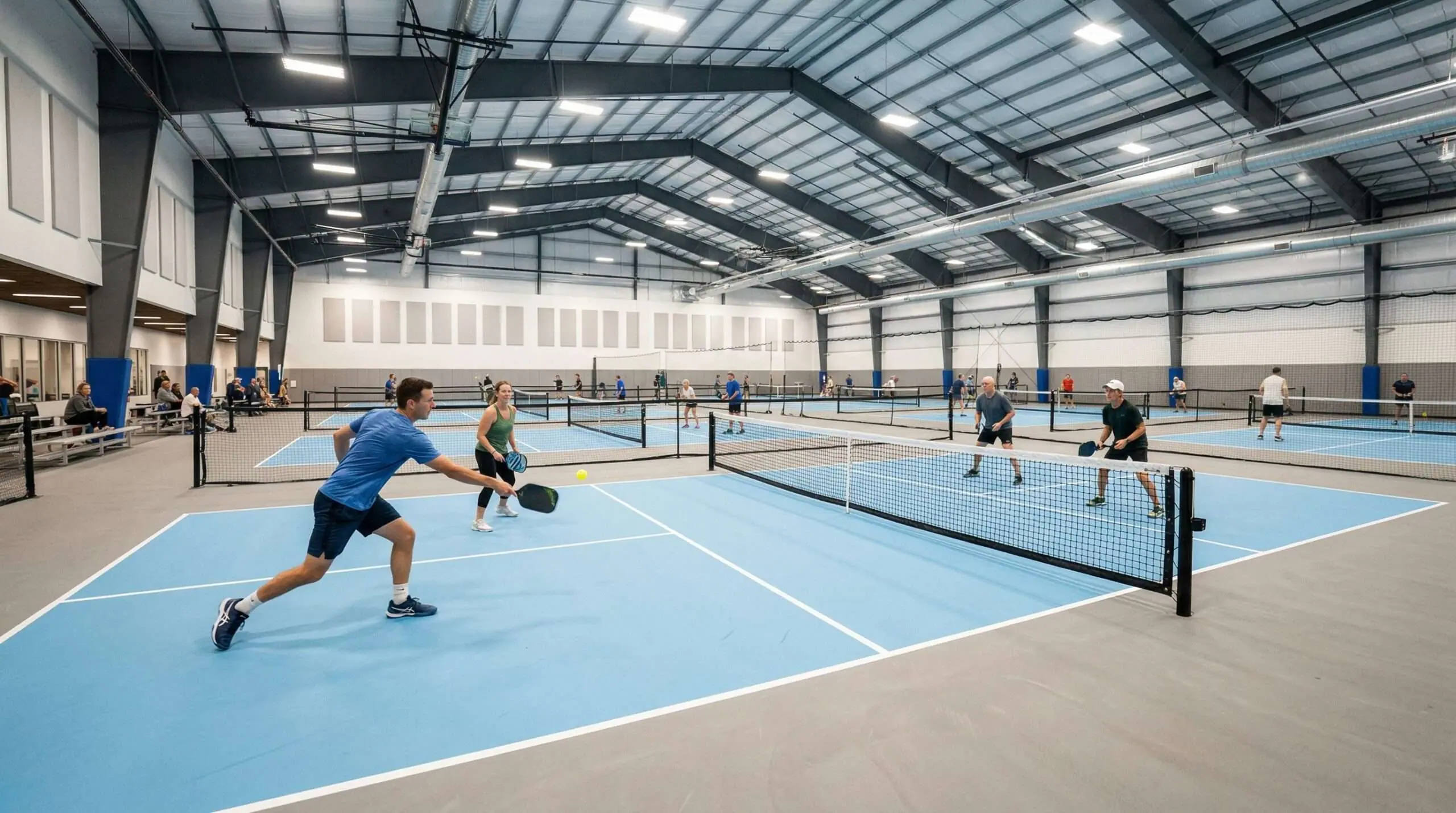
An indoor pickleball court needs a playing area of 6.10 × 13.41 m, a total surface of at least 9 × 18 m once run-off zones are included, a ceiling clearance of 5.5 m or more, and a sports floor that balances grip, ball bounce and joint comfort — for a turnkey budget of roughly 15,000 to 60,000 EUR excluding VAT per court depending on the surface system chosen. Pickleball is among the fastest-growing racquet sports in Europe, and clubs, municipalities, hotels and sports-hall operators are converting or building courts to meet demand. This guide covers the dimensions, flooring options, lighting, acoustics and budget of a professional indoor court.
Official dimensions and clearances
- Court: 6.10 × 13.41 m (20 × 44 ft), the same for singles and doubles, with a 2.13 m non-volley zone (“kitchen”) either side of the net.
- Net: 91.4 cm high at the posts, 86.4 cm at centre.
- Run-offs: a minimum total envelope of 9.14 × 18.29 m (30 × 60 ft) per court; 10 × 20 m is the comfortable club standard, and tournament layouts go larger.
- Ceiling height: 5.5 m minimum for recreational play; 6 m or more preferred for competition — lobs are a core part of the game, and low beams or luminaires in the flight path make a hall unsuitable.
- Multi-court halls: allow at least 2 m between adjacent court envelopes, or install divider netting.
Choosing the floor: the decision that defines the court
| Surface | Indicative cost / m² excluding VAT | Strengths | Limitations |
|---|---|---|---|
| Sports PVC (rolled) | 25 – 60 EUR | Best all-round choice: consistent bounce, controlled grip, joint comfort, easy cleaning | Needs a sound, level subfloor; heavy point loads require protection |
| Polyurethane resin | 40 – 90 EUR | The competition standard: seamless, durable, excellent uniformity | Highest cost; permanent — not for leased or multi-use conversions |
| Modular polypropylene tiles | 20 – 45 EUR | Fast installation over imperfect slabs, demountable, ideal for conversions and temporary courts | Slightly livelier bounce and joint feel than PVC or PU |
| Existing timber / multi-sport floor | Marking only: 500 – 1,500 EUR / court | Zero-surface-cost entry for sports halls; immediate multi-sport use | Line clutter with other sports; bounce and grip inherited, not chosen |
For permanent indoor courts, specify surfaces tested to EN 14904, the European standard for indoor multi-sport floors — it covers shock absorption, vertical deformation, friction and ball behaviour, and it is what tender documents for publicly accessible halls will reference; our guide to sports flooring compliance in public venues explains the framework. Product families and build-ups are detailed in our sports PVC flooring guide.
On subfloor condition: whichever surface you choose, verify slab flatness and moisture before installation. Rolled PVC telegraphs bumps, resin requires a primed and level base, and even modular tiles — the most forgiving option — click and creak over hollows. An afternoon with a straightedge and a moisture meter before ordering prevents the most common dispute in court construction.
Lighting and acoustics
- Lighting: 300 lux is a recreational minimum, 500 lux the club standard, 750+ lux for competition — LED, mounted outside the lob flight path, with good uniformity and a colour temperature around 4,000 K. Glare matters more than raw lux: players look up constantly.
- Acoustics: the pickleball “pop” is impulsive and carries; in a hard-surfaced hall with several courts it becomes a real operating issue. Absorbent wall and ceiling panels over 30 – 50 percent of surfaces, divider netting and scheduling all help — and if the hall adjoins housing, treat the acoustic question before the first complaint, not after.
- Colour scheme: a court colour contrasting with both ball and surroundings (typically blue or green court on a neutral run-off) measurably improves visibility for older players — a significant share of the pickleball audience.
Climate control rounds out the specification: pickleball players are disproportionately active seniors, so stable temperatures between 16 and 22 °C and draught-free air movement are comfort-and-safety features, not luxuries, in halls scheduled for daytime play.
Budget for a turnkey indoor court
| Item | Indicative budget excluding VAT |
|---|---|
| Surface (180 – 200 m² envelope, PVC or tiles) | 4,000 – 18,000 EUR |
| Line marking and colour coating | 500 – 2,000 EUR |
| Net system (posts, competition net) | 400 – 1,500 EUR |
| LED lighting (per court) | 3,000 – 10,000 EUR |
| Acoustic treatment and dividers | 2,000 – 12,000 EUR |
| Total per court | 15,000 – 60,000 EUR |
Conversions of existing halls land at the bottom of the range; new-build or resin-surfaced competition courts at the top. Operators already running racquet facilities will recognise the economics — the project structure is close to that of professional padel courts, with a lighter surface specification and no glass walls.
Converting an existing hall: the 48-hour project
The fastest route into pickleball is conversion, and it is genuinely quick where the fundamentals exist. The checklist: confirm the envelope and ceiling clearance against the dimensions above; verify the existing floor’s grip and bounce with racquets and balls before deciding whether to overlay; mark lines in a dedicated colour (taped for a trial phase, painted once demand is proven); install posts — freestanding weighted systems avoid drilling and suit multi-use halls; and adjust lighting only if measurements fall below 300 lux at court level. A trial phase of taped courts and hired equipment for one season is the cheapest market study available: it converts “we think there is demand” into booking data before any permanent surface investment, and most operators who run the trial phase end up building more courts than they originally planned — with evidence instead of hope.
Frequently asked questions
Can pickleball share a hall with badminton or basketball?
Yes — the envelope fits comfortably inside a badminton or basketball footprint, which is why marking existing halls is the fastest route to opening. Use a distinct line colour and publish clear court-priority scheduling.
What ceiling height is really necessary?
5.5 m clears recreational lobs; 6 m or more is safe for all levels. Below 5 m, expect constant let-replays and frustrated players — better to rule the space out early.
Which floor gives the best playing experience?
Cushioned sports PVC or PU resin: consistent medium-fast bounce, controlled grip for lateral movement and the joint comfort an older-skewing player base notices immediately. Modular tiles are the pragmatic choice over poor slabs and for demountable projects.
How profitable is an indoor court?
At typical European court-hire rates of 15 – 30 EUR per hour and realistic utilisation of 20 – 40 booked hours per week, a converted court can recover a mid-range fit-out within 2 – 4 seasons — before counting memberships, coaching and events. Run the numbers against your local demand before building multiple courts.
Indoor or outdoor: which should a club build first?
Indoor, in most European climates: it guarantees year-round bookable hours, protects the surface investment and suits the sport’s older-skewing base, for whom wind is a bigger obstacle than rain. Outdoor courts complement later as summer overflow. If an existing hall is available, the conversion economics beat any new outdoor build on both cost and revenue certainty.
Build your pickleball court with Light In Fitness
Light In Fitness supplies sports flooring, marking, nets and lighting for racquet-sport projects, from single-court conversions to multi-court halls. Request a quotation with your hall dimensions and we will return a court layout and costed specification.
Réalisations documentées
- Dalles et sols sportifs : livraisons documentées – plusieurs chantiers
- Sol sportif extérieur, square Georges-Vallerey – Taverny (95)