Fitting Out a Professional Gym: Equipment by Zone and Indicative Budgets
Equipping a professional fitness facility is a zoning exercise with a price attached to each zone. Two projects with the same floor area and the same budget can end up completely different, because what decides the outcome is how the space is divided between strength, cardio, flooring, functional training and recovery, and which of those the operating model actually depends on.
This guide sets out what belongs in each zone, what flooring each zone needs, which buyer profile each configuration serves, and what the equipment is likely to cost. It is written for gym operators, local authorities, hotels, employers and education providers planning an opening, a renovation or a partial renewal.
The essential zones of a professional facility
Strength training: the backbone of the room
The strength zone is the space members expect most and the one that most determines retention. A complete equipment park has to serve very different profiles: beginners who want reassuring guided machines, experienced users who require a full free weight range, and functional athletes working compound movements. Where a facility targets an international membership used to the highest European standards, the quality of the strength training machines is a decisive differentiator.
What to plan for in a professional room: flat, incline and decline bench press stations with safety guides; pulley stations covering high pulley, low pulley and cable crossover; leg press, leg extension and leg curl; shoulder, biceps and triceps machines; a complete dumbbell rack with integrated storage; Olympic barbells and bumper plates for free lifting; and multi-purpose adjustable benches.
Cardio: the offer that retains members
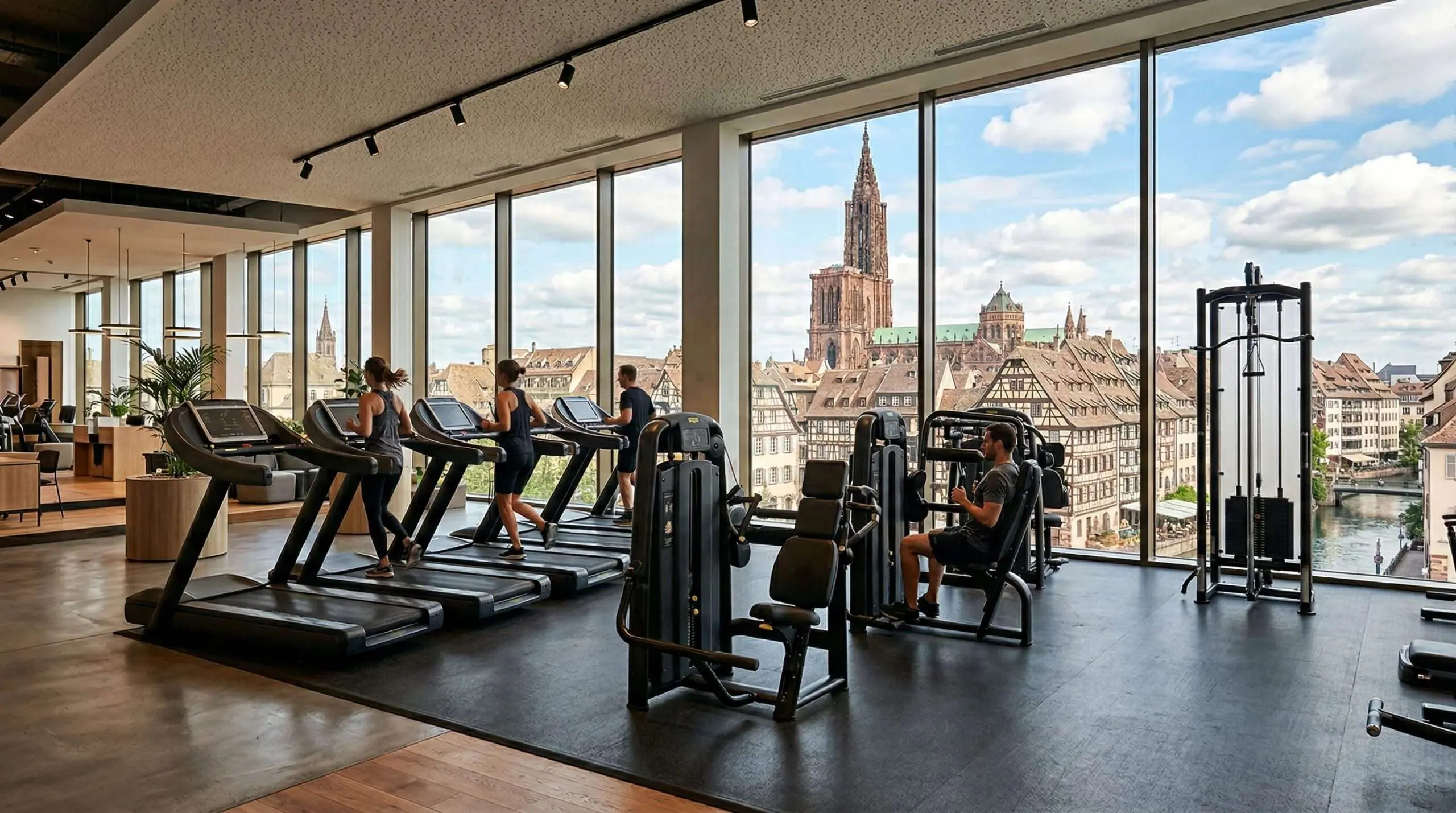
In a competitive market the cardio zone is often the first thing a prospective member judges. Modern equipment is expected to carry connected screens, personalised programmes and connectivity with activity tracking applications. Variety matters as much as quality, because the zone has to satisfy every profile at once.
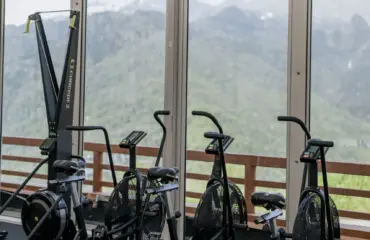
Plan for treadmills from entry level to high performance; indoor cycling bikes and upright bikes; cross trainers and rowing machines; stair climbers, a category growing strongly; recumbent bikes for older members and rehabilitation users; and ski ergometers and air rowers for high-intensity work. The full cardio equipment range covers all of these.
Sports flooring: the base of any serious installation
A badly chosen floor is a risk to users and a permanent source of maintenance cost. In buildings where the facility sits in a basement or on an upper floor, acoustic and vibration isolation is a regulatory constraint that is regularly underestimated. Check the applicable national building regulations for your site before specifying, and commission a structural load study before installing anything heavy.
| Zone | Recommended flooring | Recommended thickness | Key properties |
|---|---|---|---|
| Weightlifting and free weight zone | Vulcanised rubber | 15 to 20 mm | Impact absorption, non-slip, resistant to dropped loads |
| Cardio zone | Sports vinyl or 8 mm rubber | 8 to 10 mm | Comfort, cushioning, easy to clean |
| Functional and cross-training zone | Recycled rubber or EPDM | 15 to 20 mm | Versatility, durability, vibration isolation |
| Group class and yoga zone | Sports parquet or flexible vinyl | 6 to 12 mm | Flexibility, energy return, acoustics |
| Common areas and reception | Design vinyl | 2 to 4 mm | Appearance, easy maintenance, traffic resistance |
The rubber gym flooring range covers the rubber specifications in the table above.
Cross-training cages and functional training
Cross-training and functional fitness take an increasing share of the offer, particularly among students and young working adults drawn to formats such as HIIT and Hyrox. Cross-training cages are the core of these spaces: squat racks with pull-up bar, gymnastic rings, climbing rope, parallel bars and a high pull-up bar. A well-equipped functional area occupies 40 to 80 square metres and generates strong engagement from the most committed members.
Street workout and fitness trails: the public sector zone
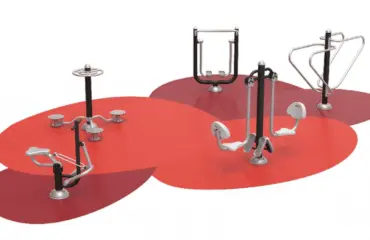
Local authorities invest steadily in outdoor sports equipment. Street workout modules and fitness trails answer several objectives at once: free and open access, mixed user groups, and complementarity with public health prevention policy. Adult outdoor fitness equipment installed in a public space falls under EN 16630; children equipment is covered by EN 1176-1, with impact-absorbing surfacing under EN 1177, and the two must never be confused.
Wellness: sauna, cold plunge and recovery spaces
Recovery has become a major differentiator for premium facilities. A complete wellness area with sauna, cold plunge, infrared cabins and recovery pools can turn a standard gym into a lifestyle destination. These installations are equally sought after by hotels, upmarket student residences and health centres.
Buyer profiles and what each one needs
Independent and franchised gym operators
This is the most active segment by purchase volume. Equipment renewal typically happens every 5 to 8 years, with more frequent additional purchases to follow new formats. These operators want a supplier able to support the project end to end, from quotation to installation, including warranty and after-sales service.
Local authorities and public bodies
Municipalities and their groupings invest regularly in public sports facilities. These purchases follow national public procurement rules, which means the supplier needs serious references, controlled delivery times and the ability to answer precisely defined technical lots. Where public funding is available for sports investment, apply through the scheme applicable in your own country and involve the funding body from the earliest project phase, because eligibility is usually decided before the specification is written.
Hotels and serviced residences
Three, four and five-star hotels now include a fitness or wellness space almost as a matter of course. These buyers prioritise compact, attractive, quiet equipment with low maintenance requirements, and flooring that matches the interior design of the property.
Employers and workplace facilities
Corporate fitness rooms have become a retention tool since the spread of home working. The equipment list is closer to a hotel room than to a commercial gym: compact, low maintenance, and usable without supervision.
Higher education
Universities and business schools renew equipment regularly for their sports departments, and campus sports centre projects are among the largest single equipment orders in the sector.
Indicative equipment budgets by facility type
The ranges below are reference points for decision-makers planning a project. They cover equipment only, excluding installation and excluding sports flooring unless stated.
| Type of facility | Indicative area | Equipment budget | Equipment priorities |
|---|---|---|---|
| Boutique studio | 50 to 100 m2 | 15,000 to 40,000 EUR | Cardio, guided strength, flooring |
| General fitness facility | 200 to 400 m2 | 50,000 to 120,000 EUR | Cardio, strength, free weights, group classes |
| Premium multi-activity club | 500 m2 and above | 100,000 to 300,000 EUR | All zones plus wellness and cross-training |
| Hotel fitness room | 30 to 80 m2 | 15,000 to 60,000 EUR | Cardio, light strength, design flooring |
| Public sports facility | 200 to 600 m2 | 40,000 to 150,000 EUR | Multi-purpose, public building compliance, outdoor trail |
These are indicative figures. Every project needs a precise analysis of the brief, the configuration of the premises, the regulatory constraints applicable to public buildings and accessibility in your own jurisdiction, and the commercial objectives of the operator.
Choosing a supplier
Three criteria separate suppliers once the catalogue looks similar. Technical advice and project support: a good supplier helps optimise the layout, respect floor loading constraints, size each zone correctly and anticipate how the offer will evolve. After-sales responsiveness: a machine out of service is lost revenue and dissatisfied members, so parts availability, technician response times and the existence of a maintenance contract are non-negotiable. Range breadth: sourcing strength, cardio, flooring, cross-training, wellness and sports furniture from one supplier simplifies project management, reduces delivery costs and improves the commercial terms.
Trends shaping the specification
Four movements are currently changing what facilities buy. Functional fitness and HIIT continue to take market share among 18 to 35 year olds, which shows up as investment in versatile functional zones, cross-training rigs, ergometers, kettlebells and sleds. Wellness has become a standard rather than an extra in the premium segment. Outdoor sport and urban trails are a distinct but complementary market to the indoor one, driven by public authorities. And connectivity is now expected: touchscreens, USB ports, Bluetooth and Wi-Fi are the norm in upper-tier commercial facilities.
Frequently asked questions
What budget should be planned for a professional facility?
It depends on floor area and positioning. For a 200 to 400 square metre general configuration covering cardio, strength and flooring, plan 50,000 to 120,000 EUR of equipment. A 500 square metre premium club with a wellness area can require 100,000 to 300,000 EUR. These figures exclude renovation works and specific fit-out items.
Is public funding available for sports facility investment?
Support schemes for sports investment exist in most countries, generally aimed at municipalities, public bodies, clubs and associations, with eligibility and intervention rates set nationally or regionally. Check the scheme applicable where the facility is located, and involve the funding body from the earliest project phase.
How do we choose flooring for a basement or upper-floor room?
For premises in a basement or on an upper floor, acoustic and vibration isolation is the priority constraint. Rubber flooring 15 to 20 mm thick under the free weight zone is generally recommended to absorb impact and protect the building structure. Commission a structural load study from an engineering consultancy before any heavy installation.
Which equipment do hotels ask for most?
Connected cardio first, meaning treadmills, bikes and cross trainers, then compact strength machines with a small footprint, design vinyl flooring and, increasingly, wellness equipment such as sauna, cold plunge and recovery space. Quietness, ease of maintenance and visual consistency with the interior design come before raw specification.
Planning your project
Send us the floor area, the type of facility, the zones you want and your budget envelope, and we will return a zone-by-zone equipment list, a flooring specification and a costed layout. Request a quote and we will build the proposal around your premises.
Réalisations documentées
- Cage street workout ultime, Carcassonne – armée française
- Cage street workout ultime, Tahiti – armée française, Polynésie
- Cage SP Max, centre EPIDE de Combrée – établissement public d’insertion
- Cage SP Max, lycée Saint-Bénigne de Dijon – établissement scolaire
Sources et références
- NF EN 16630 – modules fixes d’entraînement physique de plein air : exigences de sécurité et méthodes d’essai (AFNOR)
- Code du sport, article L322-2 – garanties d’hygiène et de sécurité des établissements d’activités physiques et sportives (Légifrance)