Outdoor Fitness Area: Which Equipment to Choose
For a town council, a campsite, a hotel group or a housing association, an outdoor fitness area is sports infrastructure, not garden furniture. It has to withstand weather, unsupervised use and the occasional act of vandalism, while remaining safe for a fourteen-year-old and a seventy-year-old on the same afternoon. The equipment list should therefore be built from a specification, not from a catalogue.
Start with the users, not the machines
The first question is who will actually train on the site. A seafront promenade used by residents and holidaymakers calls for guided, low-load equipment with wide access. A campus or a suburban sports ground used by teenagers and young adults calls for calisthenics bars, rigs and body-weight stations. A rehabilitation centre or a care home needs stations that can be reached and used from a wheelchair. Most public sites mix two or three of these profiles, and the layout has to reflect that rather than average it out.
Traffic matters as much as the profile. Equipment installed in a public park is in service every day of the year, with no supervision and no staff on site. That single fact rules out anything designed for indoor or private use and points to professional outdoor ranges built from galvanised and powder-coated steel or, in coastal and chlorinated environments, stainless steel.
Strength stations: the backbone of the area
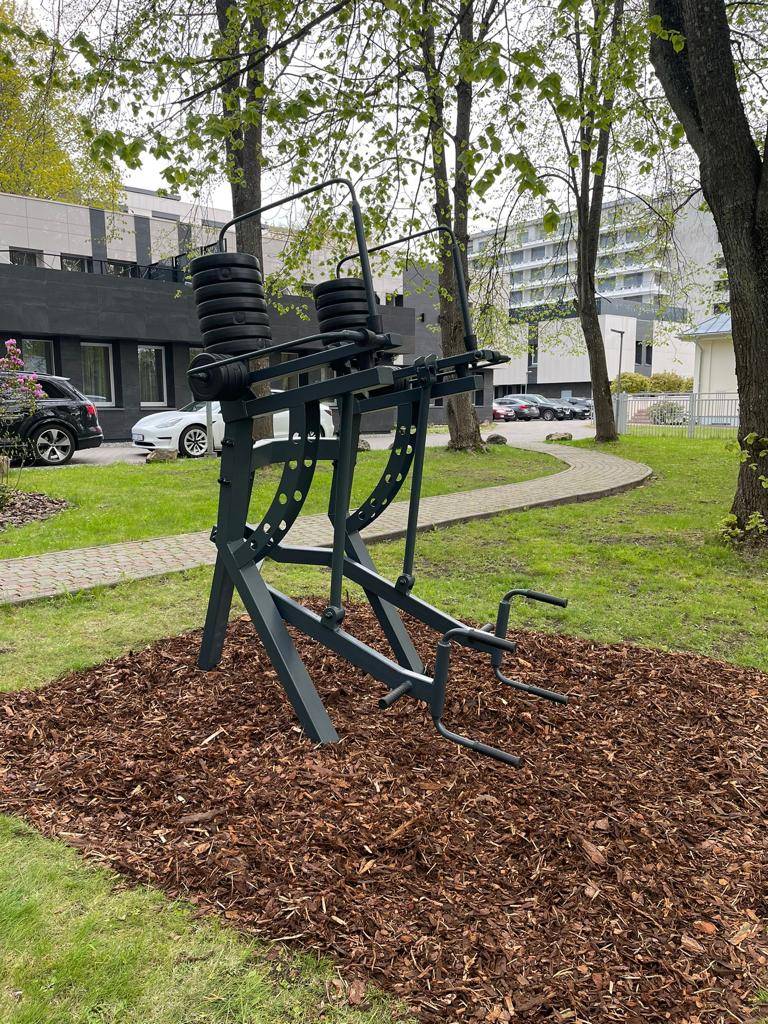
Outdoor strength equipment uses the user’s own body weight or a fixed mechanical resistance rather than weight stacks, which cannot be left unattended outdoors. A balanced installation usually covers pushing (chest press, dip station), pulling (lat pull, row), legs (leg press, stepper) and core (abdominal bench, back extension). Grouping them in a single zone keeps circuits short and makes supervision easier during organised sessions.
Our outdoor gym equipment range covers these movements in single and multi-user stations, with fixings for buried foundations as well as surface-mounted base plates.
Cardio in the open air
Outdoor cardio is not a copy of the indoor gym. Air walkers, cross-trainers, seated bikes, steppers and outdoor rowing stations work without electronics and without a power supply: the resistance comes from the user’s own movement. They are the entry point of most fitness trails because they are intuitive, need no instruction and are used by every age group.
Calisthenics, functional training and fitness trails
Bar structures, monkey bars, wall bars and rigs have become the most requested outdoor category. They serve street workout groups, candidates preparing for physical entrance tests, and school PE sessions. Where the site is a linear route rather than a plaza, the same content can be spread out as a fitness trail, with stations distributed along a path and signage at each stop.
Inclusive and children’s zones
Accessible stations designed for wheelchair users increasingly appear in public tenders as a requirement rather than an option added at the end. They need a firm, level approach surface and clear space beside the machine, which has to be planned at layout stage. Where families are the main audience, a dedicated children’s outdoor fitness zone keeps younger users off adult equipment sized for a different body.
Adult outdoor fitness equipment is covered by EN 16630. Equipment intended for children falls instead under EN 1176-1, with impact-attenuating surfacing to EN 1177. The two frameworks are not interchangeable, and a children’s zone specified under the adult standard will not pass inspection.
Surfacing, spacing and access
Surfacing belongs in the equipment budget, not in the landscaping afterthought. Grass wears out under the busiest stations within a season, and loose gravel is unsuitable for accessible approaches. Rubber tiles, poured surfacing or shock-absorbing artificial turf are the usual answers, chosen according to fall height and expected traffic. The safety area around each station must be kept clear, which is why the number of machines a site can take is dictated by usable surface rather than by budget.
The items that get forgotten
Signage with pictograms and QR-coded exercise instructions, benches, litter bins, a water point, shade and lighting decide whether an area is used in the evening and in high summer. Lockable storage is worth planning where a club or an instructor runs group sessions on site.
Frequently asked questions
How much space does an outdoor fitness area need?
It depends on the number of stations and on the safety area each one requires, which is set by the equipment’s own installation drawing. Rather than starting from a target surface, we work back from the station list and the site plan, and a scaled layout is produced with every quotation.
Can outdoor equipment be installed without concrete foundations?
Some ranges offer surface-mounted base plates for an existing concrete slab, or ballasted frames for temporary installations. Most permanent public installations still use buried foundations, which is the option we specify unless the ground makes it impossible.
What maintenance does an outdoor fitness area need?
Routine visual inspection, periodic checks of fixings and moving parts, and an annual main inspection. The frequency depends on traffic and on the inspection regime that applies in your country; the operator remains responsible for keeping the records.
Is outdoor equipment suitable for a coastal site?
Yes, provided the material is chosen for it. Stainless steel ranges are specified for seafronts, pool surroundings and other corrosive environments, while galvanised and powder-coated steel is used inland.
Building your equipment list
A successful outdoor fitness area is a coherent set of stations matched to real users, on a surface that can take them, with enough clear space between them. Send us the site plan, the audience you expect and the budget envelope, and we will return a station list and a scaled layout: request a quote.
Réalisations documentées
- Cage street workout ultime, Carcassonne – armée française
- Cage street workout ultime, Tahiti – armée française, Polynésie
- Cage SP Max, centre EPIDE de Combrée – établissement public d’insertion
- Cage SP Max, lycée Saint-Bénigne de Dijon – établissement scolaire