Professional Fitness Equipment: How to Choose Your Supplier
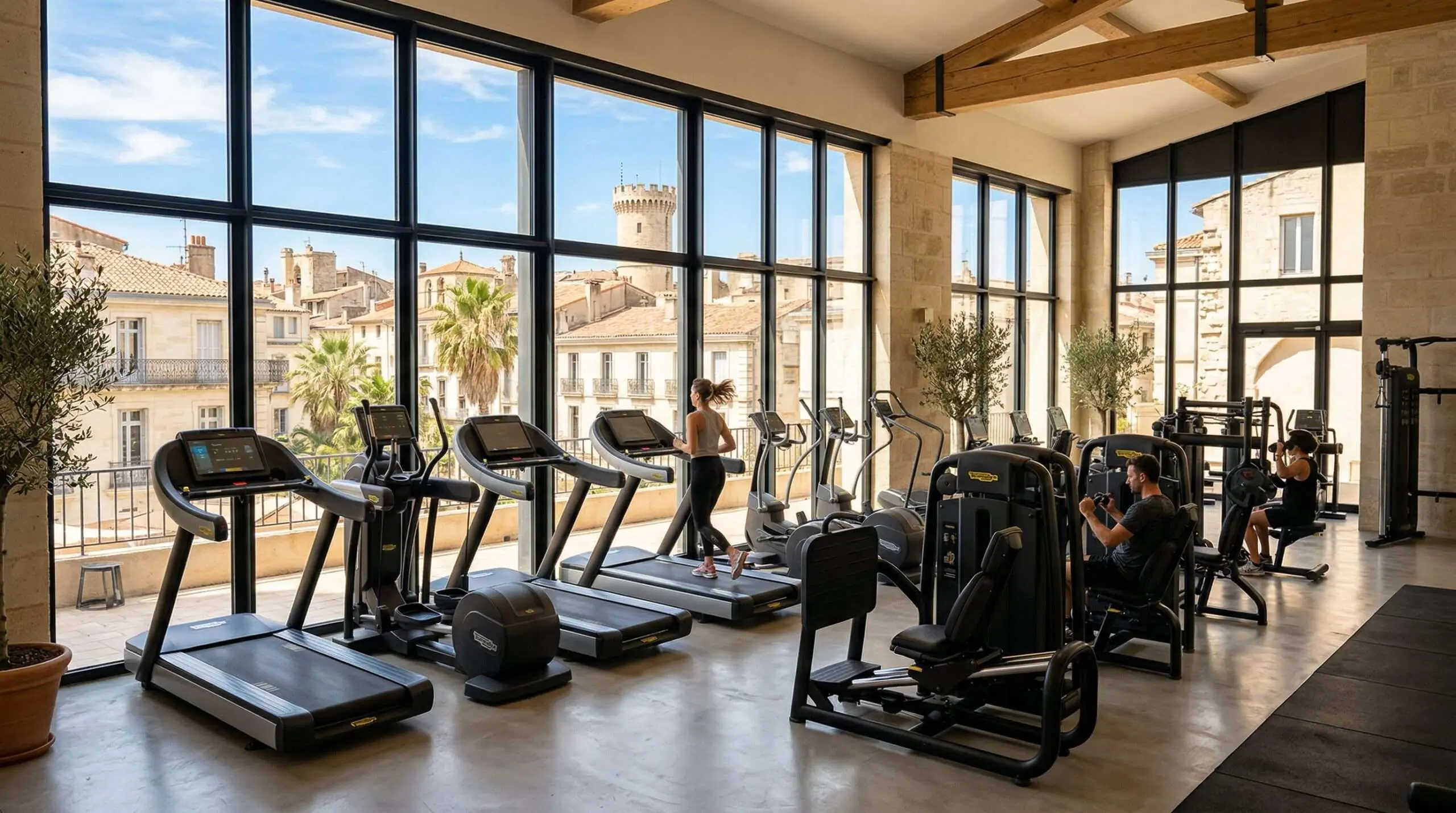
Equipping a gym, a hotel wellness suite, a residential fitness room or a municipal sports facility is a project with a long shadow. The equipment you choose will be used twelve to fourteen hours a day, seven days a week, by people who did not buy it and will not maintain it. This guide sets out the buyer segments, the equipment each zone actually needs, the criteria that separate a serious supplier from a catalogue reseller, and the four steps that take a project from a floor plan to an opening.
The professional buyer segments
Demand for professional fitness equipment covers very different buyers, each with its own constraints and its own budget shape.
| Segment | Typical buyers | Priority needs | Indicative budget |
|---|---|---|---|
| Independent gyms | Neighbourhood clubs, cross-training studios, boutique gyms | Selectorised strength, cages, shock-absorbing flooring, cardio | 20,000 to 150,000 EUR |
| Franchised chains | New site openings across a network | Equipment in series, consistent ranges, fast after-sales response | 100,000 to 400,000 EUR |
| Hotels and holiday residences | Three to five star hotels, spa resorts | Compact cardio, wellness, premium finish | 15,000 to 80,000 EUR |
| Local authorities | Municipalities and their surrounding communes | Fitness trails, street workout, outdoor equipment | 30,000 to 200,000 EUR |
| Care and rehabilitation facilities | Care homes, rehabilitation centres, specialist units | Adapted physical activity equipment, gentle wellness, accessibility | 10,000 to 50,000 EUR |
| Corporate wellbeing | Companies fitting out staff facilities | Corporate room, cardio, light strength equipment | 10,000 to 60,000 EUR |
Budgets are indicative and depend on the specification, the floor area and the intensity of use planned.
What equipment does a professional facility need?
Selectorised strength and free weights
The strength floor remains the heart of any professional gym. For intensive commercial use, with high footfall and extended opening hours, the selection criteria have to be strict:
- Resistance to intensive use: reinforced tubular steel frame, construction to EN ISO 20957-1 class S, the class for intensive commercial use.
- Multi-user ergonomics: quick adjustments, adaptable seat positions, replaceable cables.
- Serviceability: access to spare parts, technical documentation available, responsive after-sales support.
- Durable finishes: anti-corrosion coatings suited to the environment, which matters more in humid, hot or coastal locations.
Our full range of professional strength training machines covers benches, cable stations, multi-station frames, selectorised machines and free weights.
Cardio equipment built for endurance
For high-traffic facilities, cardio equipment needs to be specified on the mechanics rather than on the console:
- Treadmills: high-output motor of at least 3 hp continuous, speed range of 0 to 22 km/h, biomechanical cushioning, compatibility with fitness apps.
- Cross trainers and steppers: silent magnetic resistance, heavy frame for maximum stability.
- Upright and recumbent bikes: adjustable ergonomic seats, connected consoles for performance tracking.
- Rowers and air bikes: the signature machines of functional and cross-training zones.
Our professional cardio equipment range covers all of these uses, with connected options where member engagement matters.
Sports flooring: the invisible decision
Flooring is the specification most often cut and the one that causes the most damage when it is wrong: user accidents, damage to heavy equipment and premature replacement costs. Specify it zone by zone.
- Free weight zone: high-density vulcanised rubber tiles, 20 to 40 mm, resistant to dropped loads.
- Cardio zone: standard rubber tiles, 8 to 15 mm, vibration comfort, easy to clean.
- Group class studio: floating sports parquet or non-slip PU vinyl.
- Cross-training and functional zone: recessed weightlifting platform, wall protection.
See our catalogue of rubber gym flooring tiles: rolls, tiles and bespoke platforms.
Cross-training cages and functional areas
The growth of cross-training and functional training makes a dedicated zone with robust equipment close to mandatory in a new build. The cage is the backbone of that space: squat rack, pull-up bar, suspension anchor points, and provision for pull-ups and dips. The same structures are in demand from muay thai gyms, MMA clubs and the hybrid clubs opening in most cities.
Street workout and fitness trails: the outdoor offer
Municipalities are investing steadily in neighbourhood outdoor sports equipment, and two families answer that policy. Street workout structures are modular bar, dip and ring assemblies in stainless or galvanised steel, resistant to ultraviolet light and to salt corrosion on coastal sites. Fitness trail stations cover stretching, balance and mobility, and suit urban parks, care homes and schools. Both families are designed for free public access and for minimum maintenance, and both fall under EN 16630, the European standard for permanently installed outdoor fitness equipment for adults. Children’s play equipment is a separate framework, EN 1176-1 for the equipment and EN 1177 for the impact-attenuating surfacing.
Wellness and spa fitness
The rise of wellness-positioned hotels is generating steady demand for recovery and relaxation equipment integrated into the fitness offer: relaxation benches, active recovery equipment, spa fitness furniture and aqua bike solutions for private pools and aquatic centres.
Choosing a supplier: five criteria that matter
- A complete range. Strength, cardio, flooring, functional training, outdoor and wellness under one supplier simplifies ordering, delivery scheduling and warranty management.
- Normative conformity. Equipment for supervised facilities open to the public is built to EN ISO 20957-1 class S; outdoor adult equipment to EN 16630; children’s equipment to EN 1176-1 with EN 1177 surfacing. CE marking and declarations of conformity should be available for your compliance file on request.
- Structured after-sales support. Defined response times, spare parts availability, and technicians trained by the manufacturers.
- Project advice. The ability to propose an optimised layout based on your floor area, circulation and zoning rather than a list of products.
- Financing options. Leasing, hire purchase or long-term rental to spread the initial investment.
Logistics belongs in that list too. Some cages weigh 500 kg, and coordinating delivery with a construction programme is a discipline of its own. Ask how a supplier handles volume, access constraints and installation scheduling before you ask about price.
Equipment by project type
| Project type | Indicative floor area | Priority equipment |
|---|---|---|
| General fitness club | 200 to 400 m2 | Cardio, selectorised strength, cross-training |
| Hotel wellness space | 40 to 120 m2 | Premium cardio, flooring, wellness |
| Cross-training box | 150 to 500 m2 | Cages, platform flooring, air cardio |
| Urban park or municipal site | Variable | Street workout, fitness trail |
| Care or rehabilitation facility | 30 to 80 m2 | Adapted activity equipment, non-slip flooring, wellness |
How to launch your equipment project
Step 1: define the zoning and the usable area
Before any order, a precise zoning plan optimises where the equipment goes. For a typical 200 m2 facility the usual split is cardio 40 per cent, selectorised strength 30 per cent, functional zone 20 per cent and stretching or recovery 10 per cent. The ratio shifts with the positioning: a general fitness club, a cross-training box and a hotel wellness space distribute their space very differently.
Step 2: select equipment for the real duty cycle
The most common mistake is underestimating the durability required for commercial use. A machine designed for four to six hours of daily use will fail early in a facility open twelve hours a day. Commercial-class equipment must be certified for intensive use and come with warranty terms that match that duty cycle.
Step 3: plan delivery and installation
Logistics coordination is critical, particularly on city-centre refurbishments where access constraints such as pedestrian zones and tram lines complicate the delivery of large volumes. A supplier with structured logistics can coordinate delivery and installation with the site teams to minimise the interruption to trading.
Step 4: consider the financing
On larger projects, leasing or hire purchase preserves working capital and can improve the tax treatment of the spend. Long-term rental also allows equipment to be renewed every three to five years without a large cash outlay, which suits hotels that need to keep their fitness space current. Public buyers should check the funding routes available under their own national and regional rules.
Frequently asked questions
What equipment is recommended for a commercial gym?
Equipment certified to EN ISO 20957-1 class S for intensive use: selectorised strength machines, high-endurance cardio including treadmills, cross trainers and bikes, rubber sports flooring rated for heavy loads, and cross-training cages for the functional zone. The choice should follow the projected footfall and the opening hours, since those determine the durability required.
What budget should be planned to equip a professional gym?
It depends on the type of facility and the floor area. A general fitness room of 100 to 200 m2 with cardio, selectorised strength and cross-training typically falls between 30,000 and 100,000 EUR. A compact hotel wellness space of 40 to 80 m2 sits between 15,000 and 40,000 EUR. A professional cross-training box of 200 to 400 m2 will require between 50,000 and 200,000 EUR. Financing solutions can spread that investment over three to five years.
Which equipment suits local authorities and outdoor spaces?
Street workout stations in galvanised or stainless steel, resistant to ultraviolet light and to salt corrosion, and modular fitness trails covering stretching, balance and mobility. Both are designed for free public access with minimal maintenance. Public funding routes for such projects vary by country and region and should be checked against the rules applicable where the site is located.
How do I identify a reliable supplier?
Check conformity to the applicable standards and CE marking, a structured after-sales service with defined response times, a complete range so you deal with one supplier rather than five, references on comparable projects, and the financing options offered. A supplier who proposes a layout plan before quoting is generally the one worth talking to.
How long does a professional installation last?
Frames outlast wear parts by a wide margin, which is why spare part availability and the after-sales structure matter more at purchase than the discount does. Plan the renewal of upholstery, cables and consoles into the operating budget rather than into the capital one.
Getting your project specified
Every project starts from a floor plan, an expected membership and a budget cycle. Send us those three things and we will come back with a zoning proposal, an equipment schedule and a price. Request a quote and our team will follow the project from the layout through to installation on site.
Réalisations documentées
- Cage street workout ultime, Carcassonne – armée française
- Cage street workout ultime, Tahiti – armée française, Polynésie
- Cage SP Max, centre EPIDE de Combrée – établissement public d’insertion
- Cage SP Max, lycée Saint-Bénigne de Dijon – établissement scolaire
Sources et références
- NF EN ISO 20957-1 – équipement d’entraînement fixe, partie 1 : exigences générales de sécurité et méthodes d’essai (AFNOR)
- AFNOR Normalisation – dossier thématique sur les appareils d’entraînement fixes et leurs classes d’usage
- NF EN 16630 – modules fixes d’entraînement physique de plein air : exigences de sécurité et méthodes d’essai (AFNOR)
- Code du sport, article L322-2 – garanties d’hygiène et de sécurité des établissements d’activités physiques et sportives (Légifrance)