Campsite and resort fitness spaces: formats, equipment and budgets
Dans un camping ou un resort, l'espace fitness est devenu un critère de choix d'hébergement, au même titre que la piscine. Les contraintes sont la saisonnalité, l'absence d'encadrement et la diversité des publics accueillis. Le matériel doit donc être robuste, sans réglage complexe et résistant à l'humidité comme aux écarts de température.
Equipping a fitness space in a campsite, holiday village or resort means designing for four constraints a city gym never faces: extreme seasonality (near-zero use for months, then saturation in August), humidity and weather exposure, a completely heterogeneous guest base — families, seniors, committed athletes, first-timers — and tight, often unsupervised spaces. Get those four right and a fitness area becomes a booking criterion; get them wrong and it becomes a maintenance liability photographed for the wrong reasons. This guide covers format choice (indoor, semi-outdoor or hybrid), equipment selection and budgets by site size. The revenue side — what a fitness offer does to occupancy and rates — is modelled in our campsite outdoor fitness ROI guide.
The four constraints that drive every choice
- Seasonality: equipment must tolerate months of storage or idleness followed by intensive holiday use. Simple, robust mechanics beat electronics; winterisation must be part of the purchase decision, not an afterthought.
- Humidity and weather: even indoor rooms near pools live in humid air. Specify corrosion-protected frames, sealed bearings and stainless hardware; for open-air and coastal sites, material grade is the whole game — see our coastal outdoor equipment guide.
- Heterogeneous users: holiday guests span every age and level and receive no induction. Every station must be understandable in ten seconds, safe unsupervised and certified EN ISO 20957-1:2024 class S (indoor) or EN 16630 (fixed outdoor).
- Space and flexibility: most sites allocate 30 – 80 m². Compact multi-purpose stations and self-powered cardio (no cabling) preserve layout freedom.
Indoor, semi-outdoor or hybrid: choosing the format
| Format | Strengths | Constraints | Indicative budget excluding VAT |
|---|---|---|---|
| Indoor room (30 – 80 m²) | Year-round use, standard equipment, weather-proof guest experience | Building cost, ventilation and dehumidification, floor area taken from other uses | 15,000 – 50,000 EUR + building works |
| Semi-outdoor (canopy / open barn) | Holiday atmosphere guests love, natural ventilation, lower build cost | Weather-rated equipment only, seasonal shutdown routine, humidity management | 12,000 – 35,000 EUR + canopy |
| Outdoor fitness area (EN 16630) | No building at all, all-ages appeal, near-zero running cost, 15 – 20 year lifespan in galvanised or stainless steel | Weather-dependent use, surfacing requirements where fall heights exist | 8,000 – 40,000 EUR installed |
| Hybrid (small indoor + outdoor area) | Best coverage of guest profiles and weather; each part sized modestly | Two maintenance regimes; requires coherent signage and placement | 20,000 – 60,000 EUR |
The hybrid format wins most often in practice: a compact climate-protected room for cardio and strength, plus an outdoor area that doubles as family animation. Placement rule: visible from main circulation paths — a fitness area guests discover on day one gets used all week.
Equipment selection by zone
- Cardio (the majority of holiday use): one treadmill, one or two bikes, one elliptical or rower for a typical room. Self-powered machines avoid cabling and survive power cuts; simple consoles beat smart screens that outdate and break.
- Strength: a compact multi-station covers the whole upper body in 3 – 4 m² and is intrinsically safe for unsupervised guests; add a urethane dumbbell set (2 – 20 kg) with one adjustable bench.
- Wellness and stretching: mats, a stretching corner and clear self-guided exercise signage — the zone seniors and beginners actually use, and the cheapest square metres in the project.
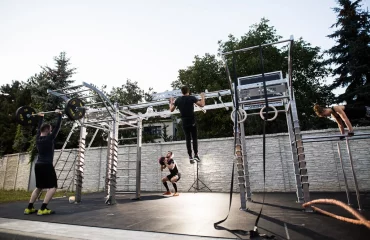
- Outdoor: mixed-ability stations (cardio + bodyweight + accessible units) so three generations can use the area together; that family-simultaneity is unique to the holiday context.
Configurations by site size
| Site | Sensible configuration | Budget excluding VAT |
|---|---|---|
| Campsite up to ~150 pitches | Outdoor area (6 – 8 stations) or 30 m² room with 3 cardio + multi-station + free weights | 8,000 – 25,000 EUR |
| Large campsite / holiday village | Hybrid: 50 m² room + outdoor area near the pool or play zone | 25,000 – 50,000 EUR |
| Resort / premium village | 60 – 80 m² room with premium cardio line + strength zone + outdoor area + classes programme | 40,000 – 80,000 EUR |
Signage deserves a line of its own: multilingual, pictogram-led usage instructions turn an unsupervised space into a self-service one for an international guest base, and posted age rules protect both children and your insurance position.
Operate for seasonality
- Pre-season service every year: the annual technician visit belongs in April/May, so the fleet opens the season at 100 percent.
- Daily wipe-down and weekly checks in season by site staff — 15 minutes a day protects the August experience.
- Winterise honestly: indoor equipment in unheated rooms needs dehumidification or covers; semi-outdoor equipment is cleaned, lubricated and protected; outdoor steel simply keeps working.
- Photograph it properly. The fitness area earns bookings on your listing before any guest touches it — treat it as marketing capital the way resort operators do; see our overview of hotel and resort fitness.
Procurement calendar for a seasonal site
Seasonality shapes the buying calendar as much as the equipment list. The window that works: specify in autumn, order in winter, install in early spring, so the facility opens the season complete and staff are briefed before the first arrivals — a fitness area installed in July loses its season and its launch photography. Winter is also when suppliers have installation capacity and when building works (canopy, ventilation, flooring) can proceed without guests on site. For phased investment, start with the format that serves your longest season: an outdoor area earns from April to October with no building cost, and its usage data then sizes the indoor room honestly for the following winter’s works. Finally, involve your insurer at specification stage rather than at claim stage — unsupervised facilities, minors on site and semi-outdoor equipment all have coverage implications that are trivial to resolve on paper and expensive to resolve after an incident.
Frequently asked questions
Is a fitness area worth it for a seasonal site?
Yes — not through direct revenue but through occupancy and rate positioning: fitness is now a standard filter on booking platforms, and outdoor areas double as family animation. The financial mechanics are in the ROI guide linked above.
What lasts longest in a coastal or poolside environment?
Hot-dip galvanised or 316L stainless outdoor equipment, and indoor machines specified with corrosion-protected frames and sealed electronics. Standard indoor equipment placed in humid semi-outdoor spaces is the most common and most expensive mistake.
Do we need staff supervision?
No, if the equipment is intrinsically safe, certified, signed with clear usage instructions and age rules, and inspected routinely. Most sites run access via the general site rules, with children under a stated age accompanied.
How much space should we allocate?
A useful indoor room starts at 30 m²; an outdoor area at 50 – 100 m². Beyond 80 m² indoor, holiday usage rarely justifies the extra area — spend the difference on quality and on the outdoor offer.
Should we charge guests for the fitness area?
Almost never for basic access: the area’s value is in bookings, ratings and on-site satisfaction, and a paywall suppresses exactly the usage that generates reviews. Monetise around it instead — coached morning sessions in high season, towel service, family activity programmes — and keep the space itself a headline inclusion in the pitch price.
Equip your site with Light In Fitness
Light In Fitness equips campsites, holiday villages and resorts across Europe — indoor rooms, outdoor fitness areas and hybrid projects, from layout to installation. Request a quotation and we will configure a fitness offer sized for your site and season.
Réalisations documentées
- Dalles et sols sportifs : livraisons documentées – plusieurs chantiers
- Sol sportif extérieur, square Georges-Vallerey – Taverny (95)