Coastal outdoor gym equipment: specifying for marine and corrosive environments
On a seafront site the decisive question is not whether the equipment is stainless steel, but which grade of stainless steel. Equipment that lasts ten years twenty kilometres inland can pit within a single season on a promenade. Grade 304 pits in the presence of chlorides; 316L, alloyed with molybdenum, is the marine reference. Three implementation errors then decide whether even the right grade survives: galvanic corrosion from mismatched fasteners, ferrous contamination during assembly, and the absence of fresh water rinsing in the maintenance plan. None of the three can be corrected afterwards.
Why marine air is so aggressive
Three mechanisms combine and reinforce each other. Airborne chlorides deposit salt continuously on every surface, and chloride ions attack the passive layer of stainless steel locally, initiating pitting corrosion, a deep, localised defect that is invisible at first glance and structurally far more dangerous than uniform surface rust. Wetting and drying cycles concentrate that salt rather than washing it away, which is why a surface sheltered from rain often degrades faster than one directly exposed. Wind blown sand abrades the finish and exposes bare metal in places the design never anticipated.
Qualify the environment before specifying anything. ISO 12944-2 defines atmospheric corrosivity categories from C1 to C5, plus the extreme category CX. A seafront promenade typically falls in C5; a direct spray zone or a pier can reach CX. Writing that category into the specification converts a subjective requirement into a verifiable criterion and lets two offers be compared honestly. A vague reference to anti corrosion treatment does not.
304 or 316L: the grade that changes everything
Corrosion resistance in stainless steel does not come from a coating. It comes from an extremely thin passive chromium oxide layer that forms spontaneously as soon as the chromium in the alloy, at least 10.5 per cent, meets oxygen in the air. That layer reforms by itself after a scratch, but it is vulnerable to chlorides, which puncture it locally. Molybdenum is what changes the outcome: 316L contains roughly 2 to 3 per cent, while 304 contains none. The L suffix denotes low carbon, which also limits sensitisation in welded zones.
| Grade | Molybdenum | Behaviour in marine air | Recommended use |
|---|---|---|---|
| 304 and 304L | None | Pitting in the presence of chlorides, frequent superficial rust staining | Indoor, urban and inland sites, not the seafront |
| 316 and 316L | 2 to 3 per cent | Markedly better resistance to chloride pitting | The reference for seafront, spray zones, pools and salt water |
Material comparison for a seafront installation
| Material | Chloride resistance | Target service life | Maintenance | Seafront |
|---|---|---|---|---|
| 316L stainless | Excellent | 15 years and above with compliant maintenance | Low, periodic rinsing | Yes, the reference |
| 304 stainless | Moderate, pits in chloride zones | Variable, exposure dependent | Moderate | Not advised in direct exposure |
| Hot dip galvanised plus powder coat | Good if zinc thickness and paint system are specified for C5 | 10 to 15 years | Moderate, impact touch up mandatory | Possible in the second line, not the front |
| Anodised aluminium | Good | Long | Low | Valid alternative, costlier at equivalent structure |
| Painted steel only | Low | 5 to 7 years | High | No |
These service lives assume equipment correctly specified, correctly installed and maintained per the manufacturer instructions. Actual exposure, meaning distance from the shore, orientation to prevailing winds and whether the equipment is sheltered from rain, moves these figures significantly. For inland rural and suburban authorities, hot dip galvanised steel with a powder coat remains an excellent compromise; on the coast, the 316 stainless range is what we recommend.
The three errors that make stainless steel rust
Most failures on coastal installations come not from the wrong material choice but from three execution errors.
Galvanic corrosion comes first. Putting two metals of different potential in contact in the presence of an electrolyte, and seawater is an excellent one, accelerates corrosion of the less noble metal. A 316L structure bolted with galvanised fasteners will see those fasteners degrade quickly, and they are what holds the structure together. Require fasteners and base plates in the same grade as the structure, or polymer washer isolation at interfaces with foundations and other materials.
Ferrous contamination during assembly comes second. Grinding, brushing or drilling stainless steel with tools that have worked carbon steel deposits iron particles on the surface. Those particles rust within weeks and produce the rust marks on stainless that make clients doubt the material, when the problem is a site practice issue. The remedy is known: dedicated tooling, stainless brushes, and pickling and passivation of worked areas before commissioning. Write it explicitly into the installation requirements.
Absence of rinsing comes third. Stainless steel by the sea is not a fit and forget material. Without regular washing, salt concentrates. Simple fresh water rinsing, more frequent on areas sheltered from rain than on exposed ones, removes most of the risk, provided it appears in the maintenance plan from handover.
Surfacing and safety: getting the references right
A common confusion is worth correcting. Specifications frequently state that an outdoor fitness surface must comply with both EN 1177 and CFL-s1. Both statements are wrong as written. EN 1177 covers impact attenuating playground surfacing and applies where there is a free height of fall above 0.60 m, not as a matter of principle. CFL-s1 is a reaction to fire class under EN 13501-1, relevant to interiors of buildings open to the public, and it has no meaning on a beach.
What actually needs verifying on a coastal outdoor fitness surface: impact attenuation to EN 1177 wherever free height of fall exceeds 0.60 m, and a cushioned surface without formal certification below that; wet slip resistance, which is the primary safety criterion on a spray swept promenade; ultraviolet and salt water resistance, watching for discolouration, chalking and binder breakdown; drainage, since standing water beneath the surface is the leading cause of failure on any outdoor floor; and abrasion resistance to wind blown sand, a beach specific point rarely addressed in tender documents. In practice recycled rubber tiles give the best durability to cost ratio for these areas, with cast in place EPDM justified on accessible routes and older user zones.
Equipment suited to a seafront site
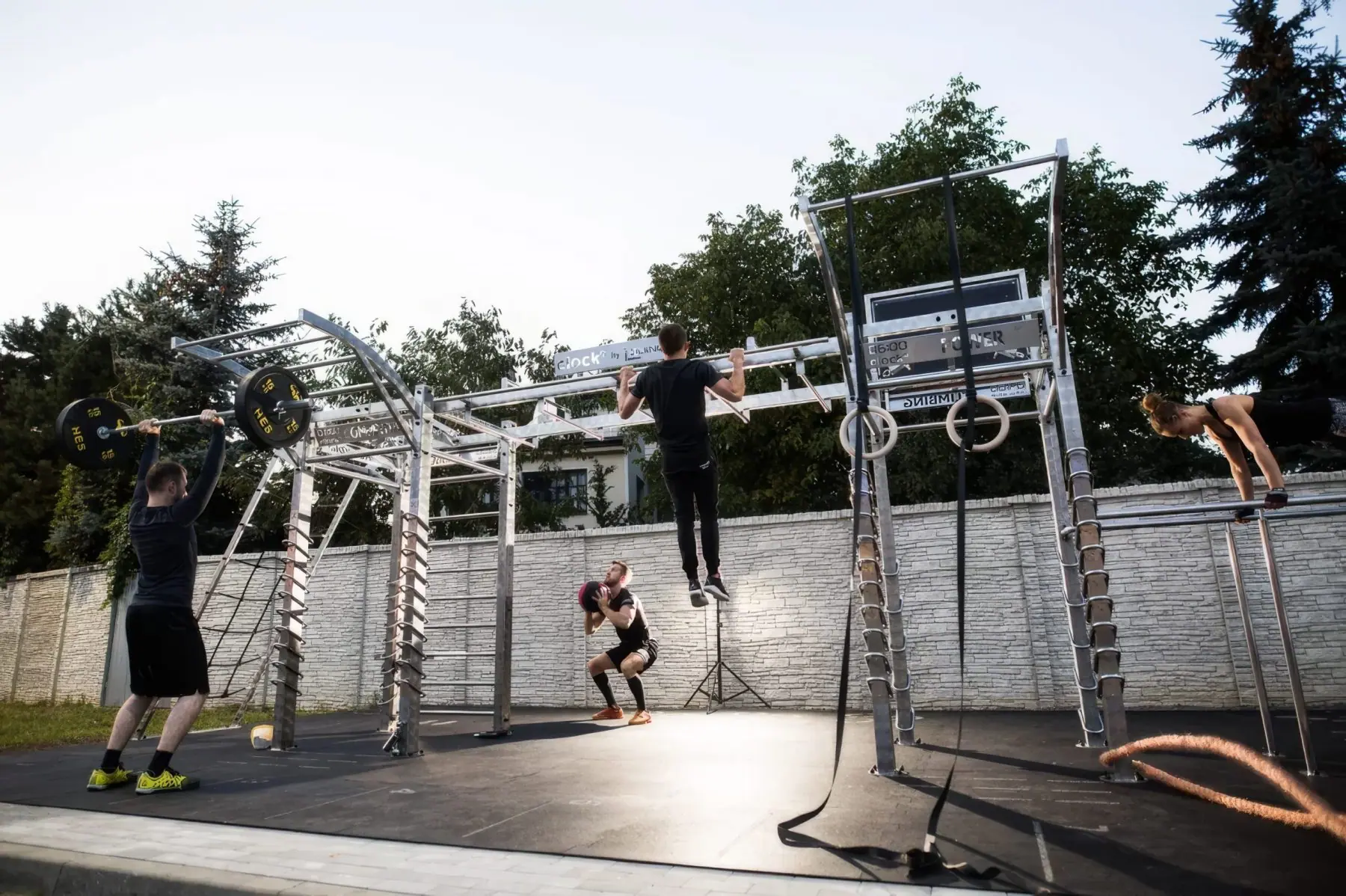
Plate loaded stainless strength equipment covers bench, incline and decline press, leg press, leg extension, lat pulldown, row, biceps, triceps and abdominal benches, deadlift and multi bar stations. Loading by plate avoids fine mechanisms exposed to spray, which is a decisive advantage. Multifunction stations and stainless power racks concentrate several positions on a small footprint. Stainless benches and dumbbell packs are designed to remain outdoors permanently. Stainless calisthenics rigs cover pull up bars, parallel bars and dips for group functional training. Roman chairs, pull up and dip modules are the most used positions on any free access promenade. Outdoor cardio in the form of bikes, cross trainers, rowers and non motorised treadmills has no exposed electronics, which matters more by the sea than anywhere else. Adjustable load machines compliant with EN 16630 and ASTM F3101 complete the range, alongside ninja and obstacle course modules where the brief includes a play dimension.
Frequently asked questions
Which corrosivity category should a seafront specification state?
C5 under ISO 12944-2 for a typical promenade, and CX for direct spray zones or piers. Stating the category makes the requirement verifiable and allows honest comparison between suppliers, which a general anti corrosion clause does not.
Why does stainless steel sometimes rust on new installations?
Almost always because of ferrous contamination during assembly or galvanic corrosion at mismatched fasteners, not because the grade is wrong. Specify dedicated stainless tooling, pickling and passivation of worked areas, and fasteners in the same grade as the structure.
How often should coastal equipment be rinsed?
Regularly, and more often on surfaces sheltered from rain than on those directly exposed, because sheltered surfaces never get washed by rainfall and accumulate salt fastest. Set the frequency at handover, in writing, and record each rinse.
Is impact absorbing surfacing always required?
No. EN 1177 impact attenuation applies where the free height of fall of a piece of equipment exceeds 0.60 m. Below that threshold the surface should still be cushioned, but no formal certification is triggered. Wet slip resistance, drainage and abrasion resistance matter on every coastal site regardless.
Can galvanised steel be used near the sea?
In the second line, yes, provided the zinc thickness and paint system are specified for C5 exposure and impact damage is touched up systematically. In the front line, facing direct spray, specify 316L.
Specify your coastal fitness area with Light In Fitness
Send us the site location, distance from the shore, prevailing wind orientation and ground conditions, and we will return a material specification, a corrosivity category and a 3D layout plan. Request a quote within 24 working hours, or browse our stainless steel outdoor fitness and outdoor gym equipment ranges.
Réalisations documentées
- Cage street workout ultime, Carcassonne – armée française
- Cage street workout ultime, Tahiti – armée française, Polynésie
- Cage SP Max, centre EPIDE de Combrée – établissement public d’insertion
- Cage SP Max, lycée Saint-Bénigne de Dijon – établissement scolaire
Sources et références
- NF EN 16630 – modules fixes d’entraînement physique de plein air : exigences de sécurité et méthodes d’essai (AFNOR)
- Code du sport, article L322-2 – garanties d’hygiène et de sécurité des établissements d’activités physiques et sportives (Légifrance)
- Décret n° 96-1136 du 18 décembre 1996 – prescriptions de sécurité relatives aux aires collectives de jeux (Légifrance)
- NF EN 1176-1 – Équipements et sols d’aires de jeux, partie 1 : exigences de sécurité et méthodes d’essai générales (AFNOR)
À lire aussi sur le même thème
- Quelles sont les caractéristiques essentielles à vérifier avant d acheter une plaque anti-vibration en caoutchouc ?
- Rubber flooring for shops, hotels and restaurants: comfort, safety, design and compliance
- Padel Court for a Club or a Council: What to Buy
- Buying a galvanised steel playground: documents, impact areas and real costs