Professional Gym Equipment: Supply, Layout, Installation and Support
Choosing the company that equips your facility is one of the few decisions in a gym project that you cannot easily undo. Machine quality, layout advice, installation, spare parts and aftersales all decide how the site performs for the next ten years, and they decide it before the doors open. Whether you are opening a strength-training gym, fitting the wellness floor of a four-star hotel, or refurbishing a multi-sport club, the equipment partner is a strategic choice rather than a purchasing formality.
This guide sets out the project types that come up most often, the equipment families a professional facility needs, and the services that turn a delivery into a working gym: needs analysis, 3D layout, installation, aftersales and the ordering sequence from first contact to opening day.
Who gets equipped: the four project types
Independent gyms and specialist studios
Independent gyms and specialist studios make up the largest share of professional equipment projects. A 300 square metre strength gym, a cross-training studio, a boxing room or a pilates studio each need a different answer, sized to the space, the budget and the member profile. The trend across every market we serve is the same: operators increasingly choose certified, durable equipment over entry-level ranges, because machine quality has become a retention factor rather than a line item.
Sports clubs and federation structures
Clubs affiliated to sports federations – rugby, football, swimming, handball, athletics – have specific physical preparation needs. Even at amateur level, equipping the strength and recovery areas has become a performance issue rather than a comfort, and the standards expected have risen steadily as professional clubs have raised the bar for what a training centre looks like.
Hotels, public bodies and employers
Three- to five-star hotels, aquatic centres, youth centres and schools generate steady demand for compact, reliable professional equipment that survives unsupervised use. Larger employers also invest in internal gyms, typically between 100 and 500 square metres, as part of their workplace wellbeing offer. In all three cases the machines are used by people of every level without a coach on the floor, which is exactly what the class S classification of EN ISO 20957-1 is written for.
Diversified formats
Cross-training, functional fitness, pilates, indoor cycling and Hyrox-style formats keep pulling new members into facilities that would otherwise compete on price alone. Diversifying the offer measurably reduces membership churn, and it is the main reason a strength-only floor plan is now the exception rather than the rule.
The equipment ranges a professional facility needs
Selectorised and free-weight strength equipment
The core of any professional offer rests on robust, versatile strength training machines. Selectorised machines – presses, pulldowns, shoulder press, leg press, leg extension, leg curl, pec deck – allow safe use by every level of member. Free-weight areas with benches, olympic barbells, rubber plates, hexagonal dumbbells and proper storage complete the offer for advanced users and strength coaches. Equipment certified to EN ISO 20957-1 class S is built for intensive multi-user service, which is the minimum condition for any facility open to the public.
Cardio: treadmills, cross trainers, bikes and rowers
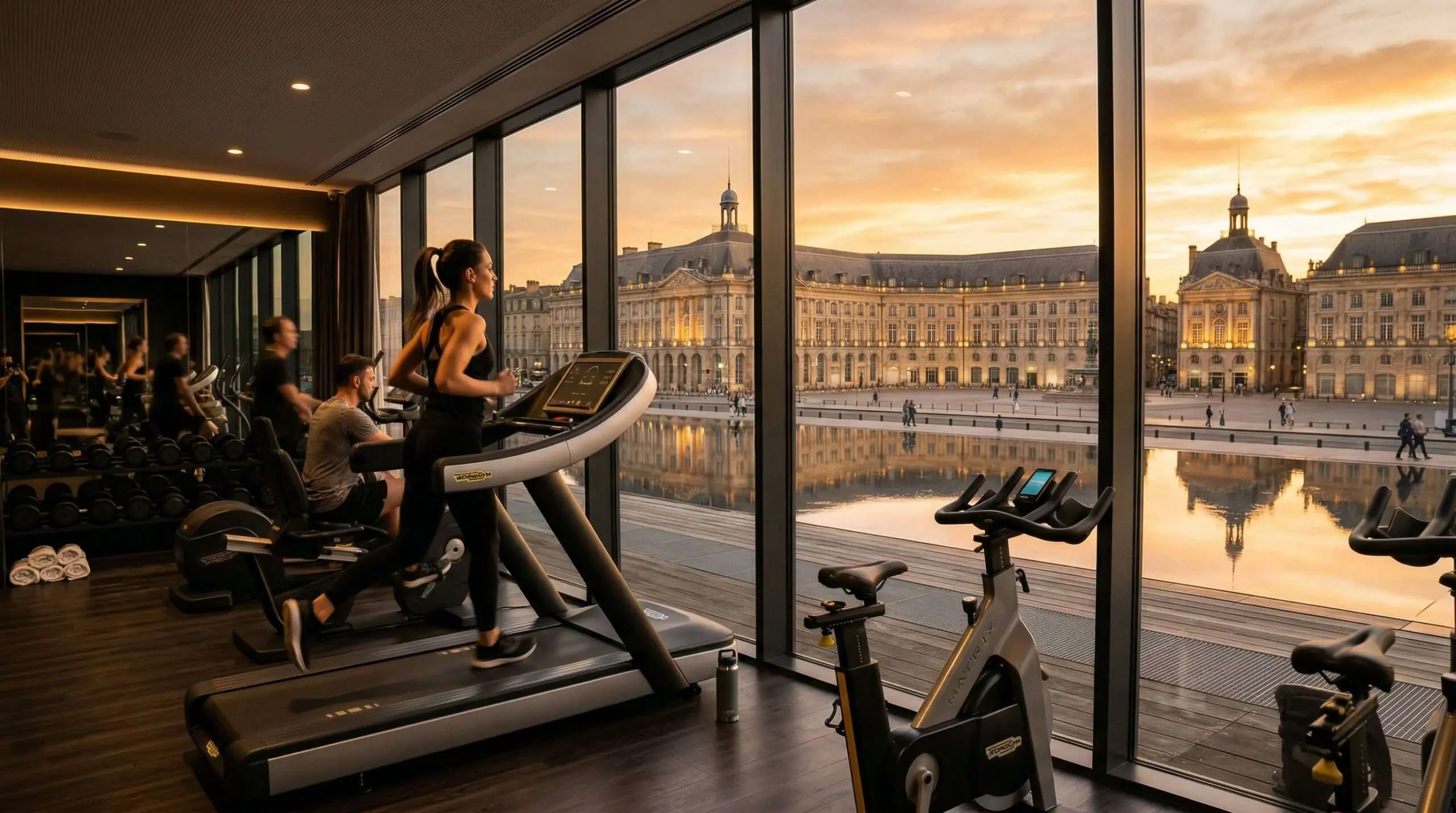
Cardio equipment is usually the first contact a member has with a facility. Professional treadmills with powerful motors, connected exercise bikes, dual-action cross trainers, rowers and steppers have to combine robustness, quiet operation and connectivity through Bluetooth, ANT+ and partner applications. For high-traffic sites, reliability and ease of maintenance are the deciding criteria, because every hour a machine is out of service is an hour of member frustration.
Cross-training, functional fitness and rigs
Demand for cross-training space keeps growing, driven by functional fitness and competition formats such as Hyrox. Cages and racks – half racks, full racks, power racks and wall-mounted rigs – form the backbone of these areas. Olympic barbells, bumper plates, kettlebells, wall balls, weighted skipping ropes and plyo boxes complete a functional set that supports a varied class timetable for a young and demanding membership.
Professional sports flooring
The floor is the most underestimated line in a fitness project, and it decides user safety, room acoustics and the service life of everything standing on it. High-density rubber gym flooring tiles, continuous rolls, modular tatami and artificial turf for functional lanes each suit a different zone: heavy strength, cardio, stretching, group classes. A badly chosen floor causes slips, premature machine wear and noise complaints from neighbouring occupants, all of which are far cheaper to prevent at design stage than to fix afterwards.
Wellness and recovery
Beyond the active training zones, higher-end facilities increasingly add recovery and wellbeing space: cold water immersion, sauna, balneotherapy, stretching and mobility areas. These are a strong differentiator, and they are what justifies a premium membership position rather than a discount one.
The services that turn a delivery into a working gym
Project support from brief to opening
Light In Fitness is the official Bodytone distributor for France, and works with the brand’s European stock: selectorised, plate-loaded, cardio and outdoor equipment certified to EN ISO 20957-1 and warranted for up to 10 years. The approach goes beyond supplying boxes. Every project starts with a needs analysis, a study of the available space, and specific advice on which equipment suits your target membership and your budget.
Custom 3D layout
Before any order is placed, a custom 3D layout of your future gym is produced free of charge. It lets you test configurations, optimise circulation, check clearances against safety requirements and see the user experience before it exists. It earns its keep fastest on difficult premises: columns, beams, low ceilings and rooms that are anything but rectangular.
Delivery and professional installation
Once machines arrive, assembly, adjustment and testing of each unit are handled for you. That turnkey step is what guarantees the gym is operational from day one instead of tying up your own staff on technical work. Large projects above 500 square metres get dedicated logistics coordination. Delivery timescales depend on the destination country and on whether the equipment is stocked or made to order, so they are confirmed on your quotation rather than published as a single figure.
Aftersales and spare parts
Professional equipment needs regular servicing and a responsive aftersales channel. When a machine fails, the availability of a competent technician is what limits downtime and protects member satisfaction. Direct access to European Bodytone stock is what keeps spare parts moving; the service coverage available for your own country is confirmed with your quotation.
From first contact to opening day
Equipping a facility follows six steps: (1) needs gathering, covering floor area, member profile, budget and technical constraints; (2) a commercial proposal with the 3D layout and an itemised quotation; (3) validation and order; (4) delivery to site; (5) installation and commissioning by technicians; (6) post-installation follow-up with a maintenance agreement and aftersales.
The single most useful thing an operator can do is start early. Bringing the equipment partner in as soon as the premises are confirmed – well before the planned opening – is what keeps the layout, the electrical provision and the floor build-up coherent instead of compromised. Professional financing arrangements such as leasing and hire purchase are available to spread the investment and protect working capital; terms are set case by case.
Frequently asked questions
What equipment is available for a professional gym?
A complete range: selectorised and free-weight strength equipment, cardio machines including treadmills, cross trainers and bikes, cross-training cages and racks, sports flooring in rubber tiles, rolls and tatami, and wellness equipment. Every project gets specific advice so the selection fits your space, your membership and your budget.
Is installation included?
Yes. The turnkey service covers delivery, unloading, professional assembly, adjustment and testing of every item, so the gym is operational at opening and the equipment is installed under the conditions required for user safety.
Are there funding schemes for sports facility projects?
Public funding for sports facilities exists in most countries, but the schemes, the eligibility rules and the deadlines are strictly national and often regional. We do not publish figures for markets we do not administer: check the applicable national and regional programmes for your own country before building them into your budget.
How do I get a quotation?
Send us the floor area, the training formats you want to offer, your indicative budget and your planned opening date. Our team will qualify the project and propose a solution, and a 3D layout plan can be produced free of charge so you can see the gym before ordering.
Start your equipment project
Light In Fitness has equipped professional facilities since 2013, from single studios to multi-room clubs, and works from your surface area and your membership rather than from a standard package. Request a quote and our team will come back with a costed proposal and a suggested layout.
Réalisations documentées
- Dalles et sols sportifs : livraisons documentées – plusieurs chantiers
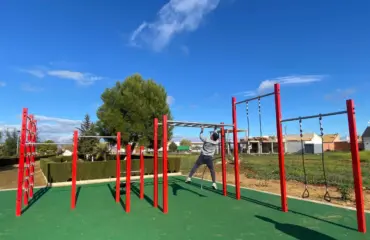
- Sol sportif extérieur, square Georges-Vallerey – Taverny (95)
Sources et références
- NF EN ISO 20957-1 – équipement d’entraînement fixe, partie 1 : exigences générales de sécurité et méthodes d’essai (AFNOR)
- AFNOR Normalisation – dossier thématique sur les appareils d’entraînement fixes et leurs classes d’usage