Outdoor Fitness Trail Equipment: The Station Types Explained

An outdoor fitness trail is not one product. It is a set of station types, laid out along a route, chosen so that a resident of any age or fitness level can use them without instruction and without supervision. For the municipality, campsite, resort, housing association or school specifying one, the question is which categories of equipment belong on the route and which standard governs each of them.
This article works through the equipment families that make up a fitness trail, what each one is for, and the specification points that decide whether the installation passes inspection and lasts.
Strength and calisthenics stations
These are the backbone of any trail. Parallel bars, pull-up bars, abdominal benches, dip stations, step-up platforms and body-weight resistance units let users load the major muscle groups using their own mass. Because the resistance comes from the user, the stations self-regulate: a fifteen-year-old and a seventy-year-old use the same bar at very different intensities.
Some ranges add adjustable-load outdoor strength machines, which bring the leg press, chest press and lat pulldown movements outdoors with a defined weight rather than body mass alone. These are the right choice where the trail has to serve a rehabilitation or senior population who cannot yet lift their own body weight.
The governing standard for permanently installed outdoor adult fitness equipment is EN 16630. It covers construction, stability, entrapment, free-fall height and the surfacing required underneath. Ask for the declaration and the test report, not a general claim of compliance.
Gymnastic and street workout structures
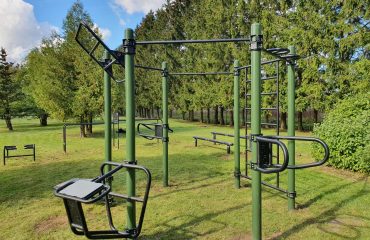
Pull-up rigs, monkey bars, wall bars, rings and multi-bar frames sit at the athletic end of the trail. They enable traction work, muscle-ups, hanging core work and the whole calisthenics repertoire, and they are the stations that attract younger users and keep a trail busy in the evenings.
Two points matter here. First, free-fall height: a bar above the threshold set by EN 16630 needs impact-attenuating surfacing beneath it, not compacted earth or grass. Second, grip diameter: a bar sized for adult hands will not suit a primary-school user, which is why mixed-age sites specify two bar heights rather than compromising on one.
Outdoor cardio stations
Outdoor cardio units are mechanically driven rather than motorised: air walkers, elliptical trainers, seated cycles, rowing stations and step machines that need no electricity and no enclosure. They give the endurance component of the trail and, because they are seated or supported, they are often the most-used stations on sites serving older residents.
Specify the bearing and pivot protection carefully. An outdoor cardio unit lives with rain, grit and UV, and the difference between a station that still runs smoothly in year eight and one that seizes in year three is entirely in the sealed bearings and the coating system.
Stretching and mobility areas
A trail that ends without a stretching zone is an incomplete trail. Stretching posts, calf ramps, balance beams, hip and shoulder mobility wheels and simple leaning bars give users somewhere to warm up at the start and to release at the end. They occupy very little footprint, cost the least per station, and are the element most often left out of a first budget and added later.
Play areas for children
Many trails run alongside a children’s play area, because a parent who can exercise while their child plays uses the trail far more often. That adjacency is good planning, but it is a hard standards boundary and it is the one municipalities most often get wrong.
Children’s playground equipment is governed by EN 1176-1, and the impact-attenuating surfacing beneath it by EN 1177. These are not the same standard as EN 16630 and they are not interchangeable. EN 16630 never applies to children’s equipment, and adult fitness equipment must not be installed inside a playground area as if it were play equipment. In practice this means two zones, each with its own equipment, its own surfacing specification and its own inspection regime, with signage that makes the age boundary explicit.
Paths, circuits and signage
The route itself is equipment. Marked paths, distance markers, running loops and, on larger sites, mountain-bike or trail-running links turn a scattered set of stations into a circuit people follow. Signage at each station showing the exercise, the muscle group and a safe technique is what allows the whole installation to work unsupervised, and it is a requirement rather than a nicety on a public site.
Adjacent sports facilities
On larger municipal sites a fitness trail often sits alongside multi-sport courts, basketball or handball areas and open spaces for group activity. These are specified under their own rules rather than under EN 16630, but planning them together matters: shared access, shared surfacing contracts and shared maintenance schedules are where a site saves money.
Choosing materials for the site
Three build families cover most trails. Timber ranges suit wooded parks, campsites and rural settings and read as part of the landscape. Galvanised steel ranges are the durable municipal default, resistant to vandalism and to weather, and the easiest to maintain. Stainless steel is specified for coastal and pool-side sites where chloride attack would destroy a coated steel frame.
Our outdoor fitness trail range covers all three, from single stations to complete circuits. The timber fitness trail range is the usual answer for parks and campsites, while a children’s zone alongside the trail is specified separately from our EN 1176 playground equipment.
Frequently asked questions
Which standard applies to outdoor fitness equipment?
EN 16630 covers permanently installed outdoor fitness equipment for adults. It sets requirements for construction, stability, entrapment, free-fall height and surfacing. Children’s playground equipment is covered instead by EN 1176-1, with EN 1177 for the impact-attenuating surface.
Can adult fitness equipment be installed in a children’s play area?
No. The two are governed by different standards with different age assumptions, different dimensional requirements and different inspection regimes. Plan them as two adjacent but separate zones with clear signage.
Does an outdoor fitness trail need special surfacing?
It depends on the free-fall height of each station. Stations above the threshold in EN 16630 require impact-attenuating surfacing; low stations may sit on grass or a bound surface. This is assessed station by station, not for the trail as a whole.
How many stations does a fitness trail need?
That is a function of route length, expected users and budget rather than a fixed number. A useful principle is to cover push, pull, legs, core, cardio and mobility before adding a second station of any one type.
Plan your trail
A fitness trail works when the station mix matches the people who will actually use it and when the standards boundaries are drawn correctly from the start. Both are decided at the planning stage, on a site plan, long before anything is ordered.
Send us your site plan, your user profile and your route length, and we will put together a costed station-by-station specification. Request a quote and our team will work through the layout with you.
Sources et références
- Décret n° 96-1136 du 18 décembre 1996 – prescriptions de sécurité relatives aux aires collectives de jeux (Légifrance)
- NF EN 1176-1 – Équipements et sols d’aires de jeux, partie 1 : exigences de sécurité et méthodes d’essai générales (AFNOR)
- NF EN 1177 – revêtements de surface amortissants : détermination de la hauteur de chute critique (AFNOR)