How to Design a Trail Course with Obstacle Equipment
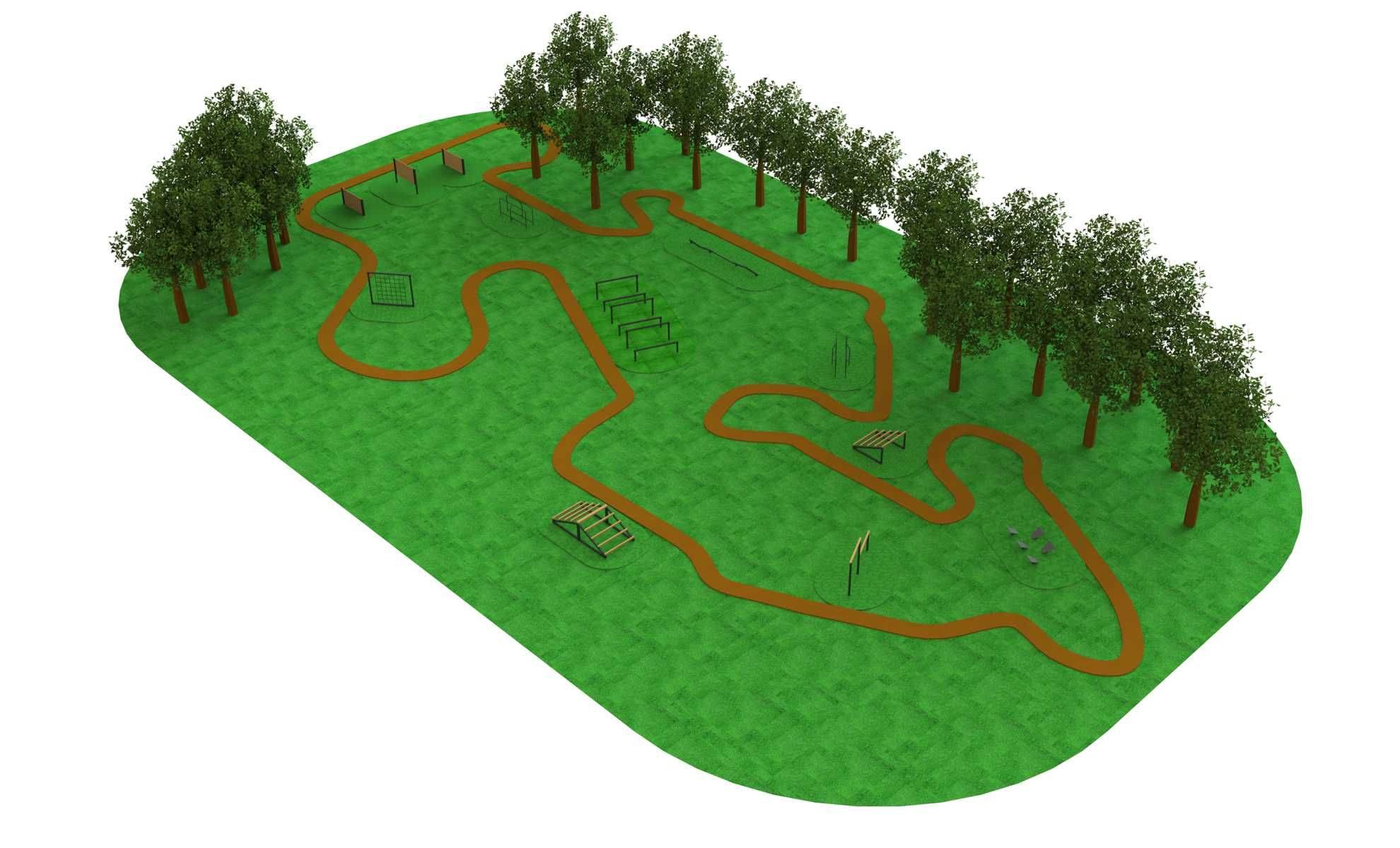
Laying out a trail course with the right equipment is what separates a race people come back to from one they finish once. Whether the format is a short loop, a long-distance event or an obstacle course race, the same planning questions come up: which paths to use, where to place the obstacles, how to keep runners safe, and what has to be permanently installed rather than set up for a single weekend. This guide is written for the people who actually commission that work: local authorities, sports clubs, campsites, outdoor centres and event organisers.
Start with the route, not the obstacles
Choose the paths first, based on the distances and the elevation gain you want to offer. Runners value variety: climbs, descents and technical sections. Hills, ridgelines and open countryside paths usually give the mix of scenery and terrain that makes a course memorable. Only once the route is fixed does it make sense to decide where obstacles go, because the terrain determines which obstacles are even possible.
Sites in woodland, hill country or along a coastline are the classic choice for obstacle events. They already provide uneven natural ground, which does much of the work for you, and they let you concentrate built equipment at the points where the route would otherwise be flat and uneventful.
Choosing the obstacles
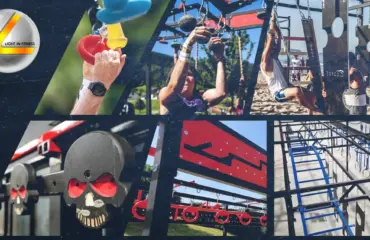
The obstacles used in these events are well established: walls to climb, cargo and climbing nets, hurdles, hanging and pull-up sections, climbing ropes, crawl tunnels, tyre jumps and mud pits. The point of a good selection is variety. A course that repeats the same movement pattern every few hundred metres tires runners in one way only, and it reads as monotonous even when it is physically hard.
Think in terms of movement families rather than individual items: climbing, hanging, crawling, carrying, balance and jumping. Cover four or five of those across the course and the event feels complete. Our obstacle trail modules and complete OCR obstacle courses are built around exactly that logic, so a configuration can be assembled without leaving gaps.
Temporary event or permanent installation?
This is the decision that changes the budget most, and it is often taken too late. A course built for a single event can rely on lightweight and inflatable elements. A course that stays in place all year, used outside race days by clubs, schools or the public, is a different specification: galvanised or stainless steel structures, proper foundations, and equipment designed for unsupervised use.
The permanent option is what most local authorities end up choosing, because the same investment then serves training sessions, school groups and casual users for the rest of the year. A warped wall or a fixed hanging rig becomes a year-round facility rather than a weekend prop.
Safety and applicable standards
Every obstacle has to be checked for entrapment points, sharp edges, safe landing areas and secure anchoring before anyone runs it. On race day, marshals or safety staff positioned at the demanding obstacles are not optional: they help runners who get stuck and they stop a queue turning into a hazard.
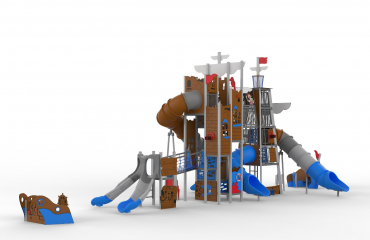
For permanently installed structures the regulatory framework matters. Outdoor fitness and training equipment intended for adults falls under EN 16630. Where an installation is intended for children, it is playground equipment and falls under EN 1176-1, with impact-attenuating surfacing to EN 1177 in the areas concerned. These are separate frameworks and they should never be mixed on the same piece of equipment. Clarify at the design stage which audience the structure is for, because it determines fall heights, free space and surfacing.
Barriers, signage and route marking
Install barriers at genuinely dangerous points and mark difficult sections clearly. Whatever the distance, signage along the whole route is what prevents runners from taking a wrong turn: boards at junctions, continuous tape or flags between them, and clear marking of the point where a course splits by distance. Poor marking generates more complaints than any obstacle ever will.
Aid stations and event logistics
Set the aid station positions from the route profile, not from the map distance, so that they fall after the hardest climbs rather than at neat round numbers. Around those, the organisational detail decides how the day runs: bib distribution, whatever medical clearance the applicable national rules require of entrants, accurate timing, and a supply plan for each station.
Entrants should be told about medical contraindications before they register rather than on the start line. Bib collection and the prize ceremony are part of the experience too, and a covered or indoor space for both is worth planning from the start.
Who organises these events
Running clubs, sports associations, local partners and members affiliated to the national athletics federation are usually involved together. For heavily oversubscribed races a ballot for places is standard practice, as used by long-established events such as the Ultra-Trail du Mont-Blanc.
Keep the atmosphere
Obstacle races are also an occasion for participants to dress up and enjoy themselves. A costume prize or a few inflatable obstacles adds a genuinely popular dimension without weakening the course. Whether this is your first edition or your fourth, self-challenge, team spirit and enjoyment should sit at the centre of the event.
Frequently asked questions
How long should an obstacle course be?
It follows the level of difficulty you want to offer: obstacle events run from a few kilometres up to full marathon distance. Decide the audience first, then the distance, then the number of obstacles.
How many obstacles per kilometre?
There is no universal figure, and any number quoted as a rule is a guess. Work from the terrain: place obstacles where the route needs a change of rhythm, and space them so that a queue at one does not reach back to the previous one.
Can permanent obstacles be used outside race days?
Yes, and it is the main argument for a permanent installation. A fixed course serves club training, school groups and public use all year, provided it is specified for unsupervised access and inspected on a documented routine.
What surfacing is needed under the obstacles?
It depends on the fall heights involved and on whether the equipment is for adults or children. Natural ground is often acceptable, but landing zones under climbing and hanging elements usually need a specified impact-attenuating surface.
Planning a trail or obstacle course?
Send us the site, the audience you want to serve and whether the installation is temporary or permanent, and we will propose a configuration and a costed layout. Request a quote to start the project.
Réalisations documentées
- Parcours ninja sur mesure, Rennes – îlot des Hautes-Ourmes
- Double mur ninja extérieur, Sallanches – Haute-Savoie