Building a professional padel court: budget, dimensions and surfacing
Building a professional padel court: budget, dimensions and surfacing
Padel is the fastest growing racket sport in Europe, and the questions asked by every project owner are the same everywhere: what are the regulation dimensions, what does a court really cost, which surface should be laid, and how long does the investment take to pay back? This guide answers them, using documented figures from the French market, where the growth of the last five years is particularly well recorded.
Padel in France: an unprecedented boom
Padel is today the fastest growing team sport in France. In the space of five years the number of courts has more than quadrupled: from 998 courts recorded in 2020, France reached more than 4,100 installations in 2025, of which around 3,500 are approved by or affiliated to the French Tennis Federation (FFT). According to the Observatoire du Padel, more than 1,100 new courts were built in a single year, a rate without precedent in the history of French sports facilities.
The FFT passed the symbolic mark of 100,000 licensed padel players in 2025, a rise of 42.7 per cent in one year, while the total number of regular players exceeds 850,000. For tennis clubs, local authorities and private investors, this enthusiasm creates an exceptional window. But building a professional padel court cannot be improvised: regulation dimensions, choice of materials, installation budget, federation standards and return on investment all have to be mastered before starting.
Official dimensions and standards for a padel court
FIP regulation dimensions
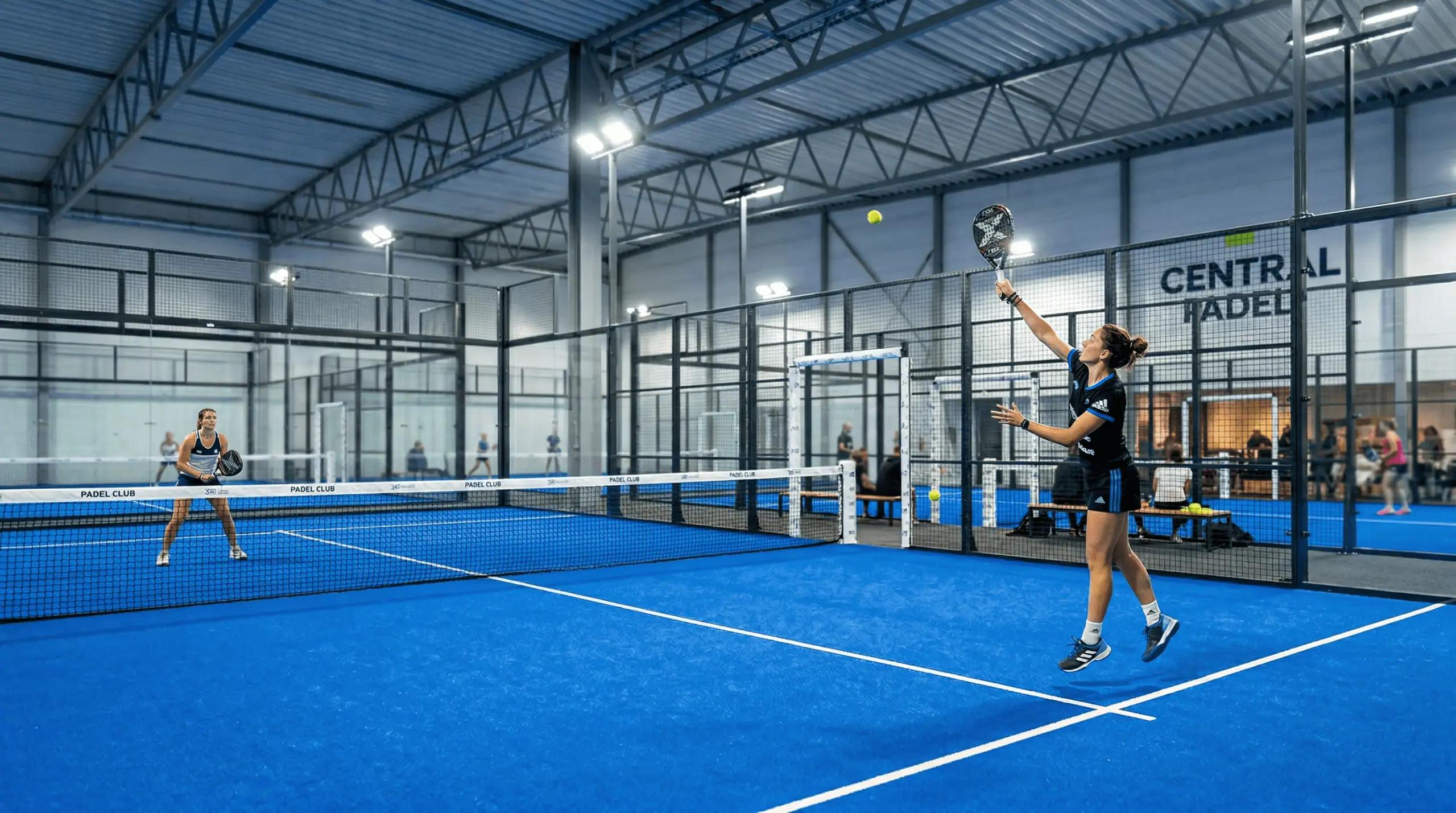
An approved padel court answers to precise dimensions, defined by the International Padel Federation (FIP) and adopted in full by the national federations, the FFT among them. These figures are not negotiable as soon as you want to host official competition or obtain federation approval.
| Element | Regulation dimension |
|---|---|
| Overall length | 20 m |
| Overall width | 10 m |
| Playing area | 200 sq m |
| Net height (centre) | 0.88 m |
| Net height (posts) | 0.92 m |
| Service line (from the net) | 6.95 m |
| Height of back glass | 3 m plus 1 m of mesh |
| Height of side mesh | 3 m |
| Width of marking lines | 5 cm |
| Dimensional tolerance (competition) | plus or minus 0.5 per cent |
Total space required and run-offs
The court itself measures 20 m by 10 m, but the total footprint to allow for is larger. The FIP requires buffer zones of at least 1 metre on each side of the structure, for access and for player safety. In practice, professional builders recommend reserving a space of 26 m by 14 m minimum, around 364 sq m, for a comfortable installation. For a panoramic court or a multi-court scheme, that space grows to take in circulation, changing rooms and spectator areas.
For indoor installations, the recommended minimum clear height is 7 to 8 metres, to allow high trajectories, lobs and proper ventilation. The FIP officially sets a threshold of 6 metres, but practitioners advise going beyond it for fluid play and proper comfort.
Structure and materials of a professional padel court
The metal frame
The load-bearing structure of a padel court is generally made of galvanised steel or anodised aluminium. Steel gives greater rigidity, essential for courts exposed to harsh weather; aluminium has the advantage of reduced maintenance thanks to its natural corrosion resistance. The sections are bolted together, which makes assembly, dismantling or relocation of the installation straightforward.
Glass and mesh
The glass walls are one of the signature elements of padel: they allow the technical rebounds that give the game its tactical depth. The standards require toughened laminated safety glass 10 to 12 mm thick, impact resistant and designed not to break into sharp fragments. The glass covers both back walls (over 4 metres of height: 3 m of glass plus 1 m of mesh) and part of the sides depending on the configuration chosen: standard, panoramic, double glazed or fully glazed.
The mesh is galvanised steel with hexagonal or square apertures, treated against corrosion. Its height varies between 3 and 4 metres depending on position. For outdoor courts, additional UV protection of the silicone joints is recommended to extend the life of the glazing.
Foundations and civil works
Before any installation, a ground investigation is essential to establish the nature of the ground, its bearing capacity and the risk of differential settlement. A reinforced concrete slab is the standard foundation: for a 20 m by 10 m court its cost runs between 8,000 and 15,000 EUR excluding VAT on the French market, including earthworks, compaction and drainage. For outdoor courts exposed to the weather, a perimeter drainage system is compulsory to carry away rainwater and prevent premature deterioration of the surface.
Surfacing: artificial turf, resin or porous concrete?
The choice of surface is central to both playing quality and the durability of the installation. Three options dominate the professional market.
| Surface | Average price (EUR/sq m) | Service life | Recommended use | Maintenance |
|---|---|---|---|---|
| Sand-filled artificial turf (PP/PE) | 80 to 130 | 6 to 10 years | Indoor and outdoor | Low (brushing, topping up sand) |
| Synthetic resin (acrylic or rubber) | 100 to 150 | 8 to 12 years | Indoor and tournaments | Moderate (regular cleaning) |
| Porous concrete | 70 to 110 | 15 to 20 years | Mainly outdoor | Low (pressure washing) |
Sand-filled artificial turf: the reference choice
Accounting for more than 85 per cent of professional installations in France, sand-filled artificial turf in polypropylene (PP) or polyethylene (PE) is the reference surface recommended by the FFT. It absorbs impact well, reduces the risk of injury, slows the game slightly in favour of technical rallies, and suits indoor and outdoor configurations alike. The silica sand worked in between the fibres gives shoe grip and stabilises the bounce.
Light In Fitness supplies sports surfacing suitable for padel, including artificial turf ranges available in several pile heights according to the standard of play sought. See the outdoor sports flooring range, and the modular multi-sport courts if the scheme also has to accommodate other sports.
Synthetic resin: the competitor’s choice
Acrylic resin surfaces, or resin mixed with rubber, give a uniform, fast and precise surface, particularly valued for tournaments. Their service life is longer than artificial turf, but laying them demands professional expertise to avoid the cracking, delamination and surface irregularities that would distort the bounce.
Porous concrete: the durable outdoor solution
Porous concrete stands out for its complete drainage capability: unlike standard concrete, its controlled sand-free grading lets water pass straight through, which makes it the ideal solution for outdoor courts in wet regions. Its service life exceeds 15 years with minimal maintenance. On the other hand it gives a faster game, which can unsettle some beginners. The same drainage logic applies to pickleball court surfacing, often built alongside padel on the same site.
Indoor or outdoor: constraints and strategy
The outdoor court
An outdoor installation is the most accessible entry point, with a budget of 35,600 to 71,600 EUR excluding VAT on the basis of the itemised costs below. It suits clubs with space who want to test the activity before committing to a heavier investment. Its main constraints are dependence on the weather, which cuts use to 6 to 8 months a year in northern regions, and the need for closer maintenance of glazing and surfacing exposed to UV and frost.
Lighting is essential to extend operation into the evening. An LED system suited to an outdoor court costs between 3,000 and 8,000 EUR excluding VAT, with high performance competition solutions reaching 10,000 EUR. In France, the FFT requires a minimum illuminance of 300 lux for recreational play and 500 lux for approved competition; the corresponding requirement in another country is set by its own federation.
The semi-covered court
A semi-covered structure protects the court from rain while keeping natural ventilation. It is a sensible compromise for clubs looking to extend their operating season without taking on the cost of a full indoor building. The cover alone runs between 25,000 and 50,000 EUR excluding VAT on top of the bare court.
The indoor court: maximum return
A covered court is playable 365 days a year whatever the weather: that is the precondition for a high occupancy rate and solid profitability. Building a dedicated structure (steel frame, roof, joinery, surfacing, lighting, changing rooms) calls for a total budget of 110,000 to 260,000 EUR excluding VAT per court on the itemised basis below, and more for prestige projects or dense urban sites. The building envelope alone accounts for 60,000 to 150,000 EUR.
For multi-court schemes, which everyone in the sector recommends as the route to profitability, significant economies of scale are made on the envelope, the civil works and the shared facilities.
Itemised budget for building a padel court
The table below sets out a realistic breakdown of the installation budget for each configuration, in euros excluding VAT, on the basis of French market prices in 2026. The totals are the sum of the lines above them.
| Cost item | Outdoor | Semi-covered | Indoor |
|---|---|---|---|
| Metal structure, glazing and mesh | 18,000 to 30,000 | 18,000 to 30,000 | 18,000 to 35,000 |
| Surfacing (artificial turf) | 1,600 to 2,600 | 1,600 to 2,600 | 2,000 to 3,000 |
| Concrete slab, civil works and drainage | 8,000 to 15,000 | 8,000 to 15,000 | 10,000 to 20,000 |
| LED lighting | 3,000 to 8,000 | 4,000 to 10,000 | 5,000 to 12,000 |
| Transport and installation | 2,000 to 8,000 | 3,000 to 10,000 | 5,000 to 15,000 |
| Cover or building | – | 25,000 to 50,000 | 60,000 to 150,000 |
| Studies, project management, sundries | 3,000 to 8,000 | 5,000 to 12,000 | 10,000 to 25,000 |
| Total per court (sum of the lines) | 35,600 to 71,600 | 64,600 to 129,600 | 110,000 to 260,000 |
To these direct costs must be added any roadworks and access works, changing and reception areas, and architect’s fees where planning consent requires them. Public funding for sports facilities exists in many countries, but the schemes, the rates and the eligibility rules differ from one country to the next: the competent national or regional body is the only reliable source on what your project can claim.
Consents and applicable rules
Planning consent
A standard padel court has a footprint of 200 sq m, which puts it well beyond the thresholds under which minor works are exempt in most planning regimes. In France, that footprint exceeds the 20 sq m threshold of the planning code and planning permission is therefore compulsory in almost every case, with a processing time of 2 to 4 months for private use and up to 5 months for a public-access building. For uncovered outdoor courts, some French municipalities accept a simple prior declaration, provided the structures stay below 12 metres in height and the local plan allows it.
Outside France, the thresholds, the procedure and the processing times are set by the national and local planning rules that apply to the site. The local planning authority should be consulted before the project is committed, not after.
Technical standards
In France, standard NF P90-110 governs the construction of racket sport courts, tennis and padel included. It defines the requirements on dimensions, materials, the mechanical characteristics of the sports surface (shock absorption, vertical deformation, slip resistance) and safety conditions. Other countries apply their own national rules for the same subject matter. Whatever the country, a professional builder should be able to produce certificates of conformity for the standard applicable on site.
Federation approval
To host official competition or attract affiliated clubs, the court will need to be approved by the national federation. In France the application goes to the regional league, with plans, photographs and technical data sheets. The criteria are: dimensional conformity to FIP rules, an approved surface, safe access, approved lighting and construction by a certified professional. Even without competitive ambitions, approval is a mark of quality that raises the standing of the installation with players and institutional partners.
Profitability: pricing, occupancy and ROI
Revenue streams
Hourly court hire is the base of the business model. In France, prices run between 20 and 40 EUR an hour depending on location, peaking at 50 EUR in the largest cities. Evening slots (18:00 to 22:00) and weekends command 20 to 30 per cent more than off-peak hours. Projections published by Padel Magazine put the average hourly price at 32 EUR in 2026, rising continuously since 2022. These are French market figures; hourly rates in other countries follow their own local market and should be checked before any business plan is built on them.
Beyond bare court hire, the most profitable operations diversify: group classes and coaching (20,000 to 40,000 EUR a year for three courts), tournaments, equipment sales, a bar or light catering area, and hiring space for corporate events.
Profitability by configuration
| Configuration | Average investment | Estimated annual revenue per court | Payback | Annual ROI |
|---|---|---|---|---|
| 1 court | 80,000 to 150,000 EUR | 40,000 to 50,000 EUR | 4 to 5 years | 10 to 15 per cent |
| 3 courts | 300,000 EUR total | 50,000 to 60,000 EUR | 2 to 3 years | 17 to 27 per cent |
| 5 courts | 500,000 EUR total | 45,000 to 55,000 EUR | 2 to 3 years | 15 to 25 per cent |
| 10 courts | 1,000,000 EUR total | 50,000 to 70,000 EUR | around 2 years | 15 to 35 per cent |
The target occupancy rate for economic viability is 70 per cent minimum. In practice, clubs of 3 to 5 courts strike the best balance between initial investment and return: fixed costs (reception, changing rooms, lighting of common areas) are shared, which cuts the operating cost per court by 15 to 20 per cent compared with a single court.
Choosing a builder and running the project
The success of a padel court project rests on choosing a specialist, experienced builder. The essential selection criteria are: command of FIP and national federation rules, the ability to deliver the concrete slab as part of the package, experience of approval procedures, and references on comparable projects (number of courts, type of use, location).
Ask for at least three detailed quotations, making sure each proposal covers the same scope: structure, surfacing, lighting, civil works, transport and commissioning. A properly framed project avoids unpleasant surprises and holds to the opening date, which is critical to profitability.
For existing tennis clubs adding padel to their offer, the average ratio of 2.82 padel courts per site observed in France in 2024 illustrates a clear trend: padel is no longer a discreet complement to tennis, it has become a strategy in its own right, capable of reviving attendance and attracting new members.
Frequently asked questions
What are the official dimensions of an approved padel court?
An approved padel court measures 20 metres long by 10 metres wide, a playing area of 200 sq m. The dimensions are set by the FIP with a maximum tolerance of plus or minus 0.5 per cent for official competition. The net is 0.88 m at the centre and 0.92 m at the posts. The total space to reserve, including safety run-offs, is at least 26 m by 14 m.
What is the budget for building a professional padel court?
On French market prices for 2026, the itemised budget comes to 35,600 to 71,600 EUR excluding VAT for an outdoor court, 64,600 to 129,600 EUR for a semi-covered court and 110,000 to 260,000 EUR for a full indoor court. Those ranges cover the metal structure, the glazing, the surfacing, the concrete slab, the lighting and the installation. The cover is the heaviest single item, at 60,000 to 150,000 EUR.
Is planning permission needed to build a padel court?
In most cases yes: a standard court has a 200 sq m footprint, far beyond the thresholds for exempt works. In France planning permission is compulsory, with a processing time of 2 to 5 months depending on the project, plus a public-access authorisation for facilities open to the public. In other countries the applicable thresholds and procedures are those of the local planning regime, which should be checked with the planning authority before committing.
Which surface should be chosen for an approved court?
Sand-filled artificial turf in polypropylene or polyethylene is the reference surface, used on more than 85 per cent of professional installations in France. It gives cushioning, grip and durability of 6 to 10 years. Synthetic resin is favoured for tournaments, being faster and longer lived. Porous concrete suits outdoor courts thanks to its complete drainage. See our sports surfacing range.
How long does a padel court take to pay back?
Payback depends on the number of courts and the occupancy rate. For a single court it generally falls between 4 and 5 years. For a club of 3 to 5 courts, the configuration recommended for profitability, it drops to 2 or 3 years, with an annual ROI of 15 to 27 per cent. The aim is at least 70 per cent occupancy, combining hourly hire, group classes, tournaments and membership packages.
Your padel project
Light In Fitness supplies the sports surfacing for padel projects and advises project owners on choosing a surface that meets federation requirements. Send us the number of courts, the site and whether the scheme is indoor or outdoor: request a quote.
Réalisations documentées
- Dalles et sols sportifs : livraisons documentées – plusieurs chantiers
- Sol sportif extérieur, square Georges-Vallerey – Taverny (95)
Sources et références
- Arrêté du 19 avril 2011 – étiquetage des produits de construction ou de revêtement de mur ou de sol sur leurs émissions de polluants volatils (Légifrance)
- Ministère de la Transition écologique – étiquetage des produits de construction : classes d’émission A+ à C