Equipping a university gym: zones, standards, budget and procurement
A university gym is not a commercial club with students in it: it serves taught sport science classes, free access sessions, staff use and inter university events on the same floor, usually from 08:00 to 22:00 and on Saturday mornings. That multi use pattern puts mechanical loads on floors, bars, cables and upholstery well above those of a private club, so durability and ease of maintenance become selection criteria on a par with technical performance.
This guide is written for university sports services, campus directors, sport science departments and estates managers, and covers the specification method, applicable standards, equipment by zone, a budget grid and the procurement rules that shape the purchase.
The constraints that make a campus different
Three constraints drive every later decision. Usage is intensive and diverse, mixing complete beginners in their first year with competitive athletes in the same room. The building is a public access facility, in France an ERP of type X, with fire safety duties covering escape routes, smoke extraction, extinguishers and signed emergency exits, periodic inspection by a safety commission, and, for the higher categories, a conformity certificate issued by an approved inspector or architect.
And accessibility is not negotiable: entrance, reception, internal circulation, changing cubicles, toilets, parking and signage all have to be treated, corridors must let a wheelchair and a companion pass, equipment must be height adjustable, and controls and interfaces must sit between 0.40 m and 1.30 m from the floor.
| Occupancy category, French type X classification | Total permitted occupancy |
|---|---|
| Category 1 | Above 1,500 people |
| Category 2 | 701 to 1,500 |
| Category 3 | 301 to 700 |
| Category 4 | 200 to 300 |
| Category 5 | Below 200 |
Most university gyms fall into category 3 or 4, and the category determines escape route provision, alarm equipment, inspection frequency and the composition of the safety file. Equivalent classification systems apply in other European countries, so the principle transfers even where the numbers do not.
Diagnosis before purchase
Survey the existing situation before specifying anything: building condition, available area, ceiling height, which needs a minimum of 3 m for a weights room and 6 to 7 m for a multi sport hall, electrical supply, since some high specification cardio equipment needs a three phase feed, ventilation, and natural and artificial lighting.
Cross that with a flow study: how many students are registered with the sports service, which time slots are planned and which activities the teaching staff have identified as priorities. Only then define the functional zones, because modularity is the real requirement on a campus. Cardio goes on the perimeter, which makes supervision easier and limits noise transfer.
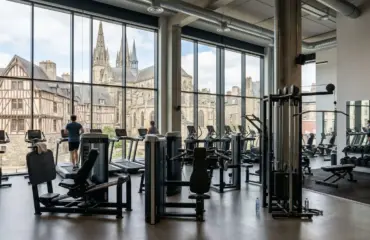
Selectorised strength suits beginners and is the zone that must be wheelchair accessible. The free weight and cross training zone serves advanced users and taught classes. A group exercise space with sprung floor, mirrors, barres and audio covers yoga, Pilates, step and martial arts. Where the area allows, a multi sport court with line markings for badminton, basketball, volleyball and handball completes the offer.
Equipment and budget by zone
| Zone | Main equipment | Minimum recommended | Cost excluding VAT |
|---|---|---|---|
| Cardio | Treadmills, bikes, cross trainers, rowers | 15 to 20 stations | 15,000 to 40,000 EUR |
| Selectorised strength | Cable machines, presses, multi station gyms | 10 to 15 machines | 20,000 to 60,000 EUR |
| Free weight and cross training | Cages, racks, Olympic bars, dumbbells, kettlebells | 2 to 4 cages plus accessories | 10,000 to 30,000 EUR |
| Group exercise | Mats, steps, suspension trainers, barres, audio | For groups of 20 to 30 | 3,000 to 10,000 EUR |
| Sports flooring | Vulcanised rubber for weights, sports timber for group areas | Whole project area | 8,000 to 35,000 EUR |
| Accessibility and safety signage | Signs, tactile paving, fire equipment | Per accessibility plan | 2,000 to 5,000 EUR |
| Estimated total | 58,000 to 180,000 EUR |
As a sizing rule, plan at least 15 to 20 cardio stations for 200 to 300 students active per week. Specify ISO 20957-1:2024 class S for the whole floor, which is the professional and commercial use class; class H is domestic and will not survive a campus timetable, and semi professional is not a class that exists in the standard whatever a catalogue states.
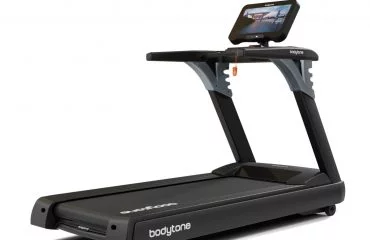
Touchscreen consoles with preset programmes and accessible interfaces, meaning contrasted text and controls at reachable height, materially improve autonomous use in a room that is often unsupervised between taught sessions.
For the free weight zone, a well designed cage replaces around ten isolated machines and adapts to every body size, which is why two to four cages is a sound base for a sport science faculty. Free weights from 2 to 40 kg, Olympic bars and kettlebells complete the offer for experienced users.
Flooring and the standards that apply to it
Flooring is routinely underestimated in campus budgets and is the element that determines safety, comfort and the service life of everything standing on it. For a university weights and cross training room, specify 15 to 20 mm vulcanised rubber, which absorbs dropped loads, resists humidity, cleans easily and prevents slips.
For multi sport and group exercise areas, sprung sports timber or a competition polyurethane resin provides the ball bounce and shock absorption those activities require. Indoor sports surfaces are covered by EN 14904, which defines shock absorption, slip resistance, deformation resistance and vertical ball behaviour, and French projects additionally reference NF P90-202 for minimum resistance to dropped loads in weights areas.
Both belong in the technical specification annexed to your tender. Add accessibility markings: colour contrast and tactile paving at entrances.
Procurement: thresholds and lotting
Universities are public bodies, so equipment purchases follow public procurement law. In France, a lot of sports equipment above 40,000 EUR excluding VAT requires documented competition, above 90,000 EUR an adapted procedure, and above the EU supplies threshold, quoted at 221,000 EUR excluding VAT in our French source, a full open tender.
EU thresholds are revised every two years and differ between central and sub central authorities, so verify the current figure before launching rather than relying on a published article. Lotting by equipment type, meaning cardio, selectorised strength, free weights and flooring as separate lots, is worth doing: it widens the field of bidders in each lot and generally improves prices.
Budget levels
Campus projects tend to fall into three levels. A minimal project of 40,000 to 70,000 EUR excluding VAT renews an existing room: new cardio, some additional selectorised machines and new flooring in the worn zones, which suits small campuses and technical institutes. An intermediate project of 70,000 to 130,000 EUR creates or completely reworks a multi purpose room of 200 to 400 m2 with every functional zone equipped, a new floor and partial accessibility upgrading, which fits a mid sized university sports service.
A complete project sits above that and generally involves building works alongside the equipment, which changes the procurement route as well as the budget.
Frequently asked questions
How many cardio stations for a campus?
Fifteen to twenty for 200 to 300 students active per week, positioned on the perimeter. Below that, the queues at 17:00 will define the reputation of the whole facility.
Should we buy selectorised or free weight equipment first?
Selectorised first. First year students arrive with no training background, and guided machines let them work safely without an instructor present, which is the normal condition in free access slots.
What ceiling height do we need?
At least 3 m for a weights room and 6 to 7 m for a multi sport hall. Check it before specifying cages, because a 2.7 m rig will not fit under a 2.8 m soffit once the fixings are counted.
Which standards go into the technical specification?
ISO 20957-1:2024 class S for training equipment, EN 14904 for indoor sports surfaces, plus your national requirements for weights room flooring and the accessibility dimensions. Ask bidders to supply the declarations, not just to assert compliance.
Can the equipment be leased rather than bought?
Yes, and for a public body an operating lease can be easier to approve because rentals sit in operating rather than capital budgets. Check the rules governing your own institution before assuming it.
Equip your campus facility
Light In Fitness has equipped more than 2,500 customers since 2013 from Tours, France, and supplies public buyers with the documents their procedure requires: unit price schedules, price breakdowns, technical datasheets and conformity declarations. Send us your room dimensions and student numbers and you will have a costed layout within 24 working hours. Delivery covers France, Belgium, Switzerland and Luxembourg, with export quoted per project. See cardio equipment, racks and cages and turnkey projects, or request a quote.
Réalisations documentées
- Dalles et sols sportifs : livraisons documentées – plusieurs chantiers
- Sol sportif extérieur, square Georges-Vallerey – Taverny (95)
Sources et références
- Code de la commande publique – texte intégral en vigueur (Légifrance)
- Direction des affaires juridiques, ministère de l’Économie – réglementation de la commande publique et fiches techniques
- Code du sport, articles R322-4 à R322-43 – garanties d’hygiène et de sécurité applicables aux établissements d’activités physiques et sportives (Légifrance)