Gym acoustics: reducing noise without wrecking the budget
Le bruit en salle de sport se traite à la source, par le sol et par la séparation des zones, avant tout traitement acoustique mural. Une dalle amortissante de forte épaisseur sous les zones de levée réduit l'essentiel des transmissions solidiennes vers les voisins. La démarche évite les plaintes de voisinage, qui peuvent aller jusqu'à la fermeture administrative.
Around 80 percent of a gym’s noise problem can be solved with affordable measures — provided you match the right treatment to the right type of noise. Gym noise is a double-faced problem: internally, reverberation degrades the member experience and exhausts coaches’ voices; externally, structure-borne vibration generates neighbour complaints that can escalate into enforcement action. This guide maps each noise source to its correct treatment and gives budget tiers for a typical 200 m² facility, so you can plan acoustics into the fit-out instead of retrofitting it after the first complaint.
Noise sources and their levels
| Source | Level (dB) | Noise type | Primary treatment |
|---|---|---|---|
| Loaded barbell drop (100+ kg) | 95 – 115 | Impact / structure-borne | 40 – 60 mm rubber tiles, lifting platforms, dead-bounce bumper plates |
| Dumbbells hitting the floor | 85 – 100 | Impact | 20 – 40 mm rubber tiles, rubber or urethane dumbbells rather than chrome |
| Music system | 75 – 90 | Airborne | Absorbent panels; distributed audio (many small speakers at low volume, not two large ones) |
| Treadmills | 65 – 80 | Vibration + airborne | 15 – 20 mm anti-vibration tiles under machines; AC motors |
| Coaching, shouting, classes | 70 – 85 | Airborne | Absorbent panels (reduce reverberation, not the source) |
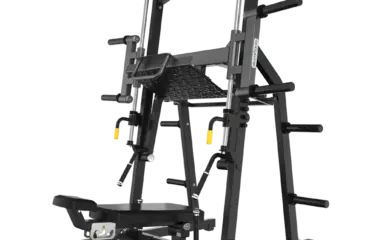
| Weight-stack impacts | 70 – 85 | Impact | Rubber stack dampers — standard on professional machines, absent on domestic ones |
Two problems, two physics, two treatments
- Airborne noise (internal reverberation). Sound bounces off hard surfaces — concrete, metal, glass. The remedy is absorption: porous materials such as acoustic panels and baffles. This lowers the internal sound level and makes coaches intelligible.
- Impact noise (structural transmission). Vibration from drops, machines and footfall travels through the slab and structure into neighbouring premises. The remedy is vibration isolation: thick rubber flooring, anti-vibration mounts, floating floors.
The classic and expensive mistake: fitting ceiling panels to fix a complaint from the flat downstairs. Panels absorb airborne sound; they do nothing for structure-borne vibration. If your problem is neighbours, start with the floor — our guide to impact noise and neighbour complaints covers assessment and the four-level treatment plan; for upper-floor units, see the full isolation stack in our soundproofing and vibration guide.
Treatment by zone: cost and effect
| Zone | Solution | Typical reduction | Budget / m² excluding VAT |
|---|---|---|---|
| Drop / weightlifting zone | 40 – 60 mm rubber tiles, ideally double layer (dense base + standard top), or lifting platforms | −20 to −35 dB impact | 45 – 80 EUR |
| Free-weights zone | 20 – 30 mm rubber tiles + rubber/urethane dumbbells | −10 to −20 dB impact | 17 – 45 EUR |
| Cardio zone | 15 – 20 mm tiles or anti-vibration mats under each machine | −5 to −15 dB | 17 – 29 EUR |
| Ceiling (absorption) | Suspended baffles or panels, absorption class αw ≥ 0.8, over 30 – 50% of the area | −6 to −12 dB reverberation | 30 – 80 EUR |
| Walls (absorption) | Fabric-faced panels, perforated wood or acoustic foam on 30 – 50% of wall area | −4 to −8 dB reverberation | 40 – 100 EUR |
Thickness by zone follows the same logic as load protection — the full matrix is in our rubber tile thickness by zone guide.
Three budget tiers for a 200 m² gym
- Basic — floor only (3,500 – 7,000 EUR excluding VAT): 20 – 40 mm rubber tiles throughout. Resolves roughly 60 – 70 percent of the impact problem, and it is where every budget should start.
- Intermediate — floor + ceiling (7,000 – 15,000 EUR excluding VAT): full flooring plus ceiling baffles over a third to a half of the area. Roughly 80 – 85 percent of the total problem addressed.
- Complete — floor + ceiling + walls + reinforced drop zone (15,000 – 30,000 EUR excluding VAT): adds wall panels, lifting platforms and 60 mm tiles in the drop zone. 90 – 95 percent of the problem treated; the remainder is behavioural (drop discipline, class scheduling).
The best cost-to-effect ratio in gym acoustics is always the floor: rubber tiles solve the majority of impact issues for a fraction of what glazing, partitions or professional acoustic consultancy cost — and they simultaneously protect the slab and the equipment.
Equipment choice is itself an acoustic measure worth pricing in: urethane dumbbells over chrome, bumper plates with dead bounce over iron, selectorised stacks with dampers, magnetic cardio over friction and air. Across a full fit-out these choices cost little as premiums but remove several decibels at the source — the cheapest decibels you will ever buy.
Sequence it into the fit-out, not after it
Acoustics is cheapest when it is a line in the fit-out plan and most expensive when it is a response to an enforcement letter. The sequence that works: identify the sensitive neighbours (above, below, adjoining) before signing the lease; place the loudest zones — drops, group classes, music sources — against the least sensitive walls; specify flooring thickness by zone as part of the layout drawing; and only then decide absorption quantities from the room’s surface materials. Retrofitting the same measures costs more for three reasons: machines must be moved off the floor, treatments must fit around installed services, and by then the complaint has usually hardened into a legal position. If you are taking on a lease, check it for noise clauses and permitted hours — a lease that is silent on gym use is an invitation to a dispute, and a measured acoustic baseline before opening is inexpensive insurance.
One more source is worth naming because it is invisible on plans: plant. Air-handling units, compressors for cooling, and roof-mounted extract fans generate steady tonal noise that neighbours notice at night more than any barbell. Specify anti-vibration mounts and acoustic louvres at purchase — retrofitting them means scaffolding.
Frequently asked questions
What should we treat first on a limited budget?
The floor, always. Impact noise carries the legal and neighbour risk, and rubber flooring addresses it at the lowest cost per decibel. Panels come second, once the structure-borne path is treated.
Do acoustic panels reduce noise for the neighbours?
Barely. Panels absorb airborne sound inside the room; complaints from adjoining premises are almost always structure-borne vibration, which only isolation (flooring, mounts, floating floors) can fix.
How loud is a gym for neighbours, in practice?
A barbell drop can inject 95 – 115 dB of impact energy into the slab. What the neighbour hears depends on the building structure, which is why identical gyms generate complaints in one building and none in another — and why upper-floor units need engineered stacks rather than mats.
When do we need an acoustic consultant?
When you are on an upper floor above sensitive uses, when a formal complaint or enforcement notice exists, or when a landlord requires measured compliance. For ground-floor units without complaints, zone-appropriate flooring plus absorption is normally sufficient.
Do acoustic measures change how the gym feels to members?
Noticeably, and for the better: treated rooms let members hear their own music at lower volume, let coaches speak instead of shout, and make group classes energising rather than fatiguing. Operators who treat reverberation report the change in atmosphere as the benefit members actually comment on — the neighbour protection is invisible, the sound of the room is not.
Get your acoustic plan costed
Light In Fitness supplies rubber flooring from 15 to 60 mm plus lifting platforms, and plans acoustics zone by zone as part of every fit-out. Request a flooring and acoustics quotation for your project.
Réalisations documentées
- Dalles et sols sportifs : livraisons documentées – plusieurs chantiers
- Sol sportif extérieur, square Georges-Vallerey – Taverny (95)