Fitness equipment for care homes, rehabilitation centres and hospitals
Les équipements adaptés aux EHPAD, centres de rééducation et hôpitaux comprennent vélos à bras, pédaliers passifs, tapis de marche médicalisés, machines à charges guidées légères et dispositifs d'aide à l'équilibre. Le critère commun est le démarrage à résistance nulle et l'accessibilité depuis un fauteuil. Le matériel de balnéothérapie complète ce plateau selon les protocoles pratiqués.
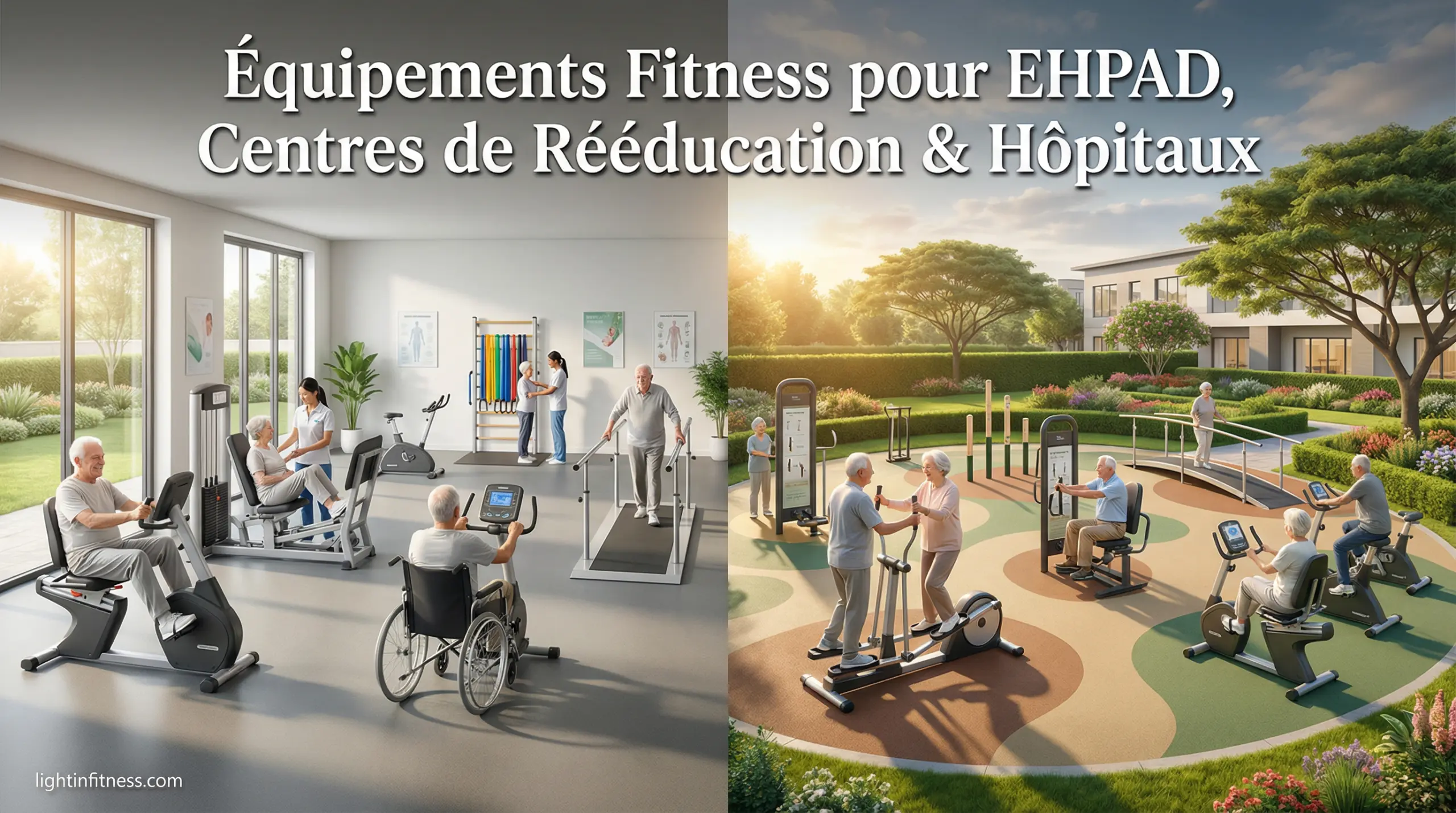
The fitness equipment suited to care homes, rehabilitation centres and hospitals falls into a few clear families: arm ergometers, active-passive pedal trainers, medical-grade walking treadmills, light selectorised strength machines, balance and proprioception aids, and — where a pool exists — hydrotherapy equipment. The right mix depends on the patient profile (stroke recovery, orthopaedic rehabilitation, neurological conditions, age-related decline) and the therapeutic objectives. A complete technical floor for around 20 patients represents an investment of roughly 15,000 to 50,000 EUR excluding VAT depending on the level of equipment. This guide details the choices setting by setting.
Cardiovascular equipment for medical settings
Machines in clinical environments must offer maximum accessibility and resistance adjustable from very low levels — they are used in post-stroke, post-cardiac-surgery and autonomy-maintenance programmes.
| Equipment | Main use | Target users | Indicative price (excl. VAT) |
|---|---|---|---|
| Arm ergometer (hand bike) | Upper-limb reconditioning | Stroke recovery, wheelchair users | 800 – 2,500 EUR |
| Active-passive pedal trainer | Circulation, joint mobility | Dependent older adults | 200 – 800 EUR |
| Medical walking treadmill | Gait rehabilitation | Post-operative, neurology | 3,000 – 8,000 EUR |
| Medical recumbent bike | Gentle cardio, endurance | Reduced-mobility patients | 1,500 – 4,000 EUR |
| Therapeutic stepper | Lower-limb strengthening | Functional rehabilitation | 500 – 2,000 EUR |
Key specifications: low step-through access, very low starting resistance, support rails, and speeds from 0.5 km/h on treadmills with reinforced emergency stops.
Strength equipment for functional rehabilitation
- Selectorised machines — leg press, lat pulldown, chest press — with stacks starting very low (increments of 1-2.5 kg) and wide adjustment ranges, targeting post-trauma strengthening and sarcopenia.
- Rehabilitation pulleys for analytical joint work on shoulder, knee and hip.
- Dumbbells and cuff weights from 0.5 to 5 kg for proprioceptive work.
- Resistance bands in progressive levels.
- Standing frames and parallel bars for the progressive return to standing and walking.
Neurological rehabilitation: the specialised layer
- Interactive treadmills with pressure sensors and visual feedback.
- Stabilometry platforms for balance assessment and training.
- Virtual-reality systems dedicated to motor rehabilitation.
- Height-adjustable parallel bars for post-stroke gait work.
- Balance boards and wobble trays for proprioception.
Hydrotherapy: worth the investment where a pool exists
Water immersion offloads a large share of body weight from the joints — up to around 80 % at chest depth — which makes hydrotherapy particularly indicated after orthopaedic surgery, in rheumatic conditions and in neurology. Water heated to 32-34 °C promotes muscle relaxation and joint range from the first sessions. Aquabikes and aquatic treadmills extend the therapy options.
Budget by level of equipment
| Level | Patient capacity | Included equipment | Estimated budget (excl. VAT) |
|---|---|---|---|
| Basic | 5-10 patients | Pedal trainers, bands, dumbbells, bars | 5,000 – 15,000 EUR |
| Intermediate | 10-20 patients | + medical bikes, selectorised machines, treadmill | 15,000 – 35,000 EUR |
| Complete | 20-40 patients | + hydrotherapy, virtual reality, stabilometry | 35,000 – 80,000 EUR |
Selection should always be made with the physiotherapists, occupational therapists and rehabilitation physicians who will prescribe its use — the pathology mix drives the equipment list, not the other way round.
Choosing by setting
- Care homes: prioritise recumbent bikes, pedal trainers, light strength and balance work in a supervised activity room — see our worked care home circuit case study and the dedicated care home equipment range.
- Rehabilitation centres: the full technical floor — medical cardio, selectorised strength, gait and balance equipment — sized by patient throughput.
- Hospitals: add the neurological layer (sensor treadmills, stabilometry, VR) and coordinate with hygiene protocols: sealed upholstery, washable surfaces, traceable cleaning.
- Private physiotherapy practices: a compact version of the same logic — our physiotherapy equipment packs bundle the essentials.
Frequently asked questions
What standards apply to fitness equipment in healthcare facilities?
Stationary training equipment falls under the EN ISO 20957 series — class S or I for professional and institutional use — with CE marking. Devices making medical claims fall under medical-device regulation; for standard reconditioning equipment, class S/I certification plus documented conformity certificates is the working requirement.
What budget should a small facility plan?
A basic floor serving 5-10 patients starts at 5,000-15,000 EUR excluding VAT with pedal trainers, bands, light weights and bars. Growing to an intermediate floor with medical cardio and selectorised machines takes the budget to 15,000-35,000 EUR excluding VAT.
Should equipment be usable without staff supervision?
In clinical settings, prescribed exercise is supervised by qualified professionals. Equipment choices should still assume error-tolerant use: guided trajectories, low starting loads, accessible emergency stops and clear visual instructions.
Can outdoor equipment play a role?
Yes — senior-adapted outdoor stations (EN 16630 certified) add daylight exposure and social benefits, and stainless steel versions match the 15-20 year investment cycle of healthcare estates.
Equip your technical floor with one partner
Light In Fitness supports healthcare facilities from sizing and 3D planning to delivery, installation and staff handover, with conformity documentation supplied at delivery. Request a free quotation — answered within 24 working hours.
Sources et références
- Code du sport, articles R322-4 à R322-43 – garanties d’hygiène et de sécurité applicables aux établissements d’activités physiques et sportives (Légifrance)