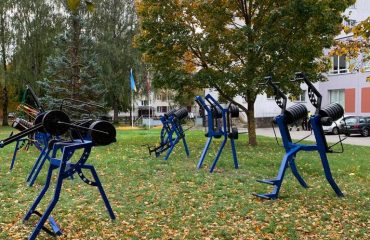
Case study: an adapted-exercise circuit for a care home - indoor and compact outdoor
Un circuit gym-santé en EHPAD associe postes intérieurs à résistance nulle et agrès extérieurs compacts, dans le cadre du décret n° 2023-234 sur l'activité physique adaptée. L'implantation à proximité immédiate du bâtiment conditionne l'usage réel par les résidents. Cette étude de cas détaille la configuration retenue, en intérieur comme en extérieur.
Can a care home run a genuine adapted-exercise circuit for 80 residents in under 50 m2 of usable space? Yes — by splitting it into a 30 m2 indoor activity room and a compact outdoor trail on a 20 m2 footprint. This anonymised case study retraces that project from audit to commissioning: equipment choices for three resident profiles, the standards to document, and how the investment was funded. Adapted physical activity is no longer an optional animation in residential aged care: public health guidance across Europe now classifies it as a validated non-drug therapy for older adults losing autonomy, particularly for falls prevention.
Why adapted exercise equipment has become a care-home priority
- Clinical evidence. Structured balance and mobility programmes are associated with a documented reduction in fall risk of around 23 %, rising to roughly 28 % when muscle strengthening is added.
- Resident wellbeing. Depression affects around 30 % of older people living in institutions, and more than half of residents report sleep disturbance. Supervised adapted exercise acts simultaneously on falls prevention, cognitive maintenance and mood — with no side effects.
- Funding and inspection. Prevention budgets held by local authorities and health bodies increasingly treat exercise equipment as an eligible health investment, and inspectors expect documented equipment conformity.
The specification: three resident profiles, one circuit
Geriatric guidance distinguishes three profiles, each with distinct exercise objectives. A well-designed circuit lets all three coexist without permanent nursing supervision:
- Robust residents — objective: maintain health and autonomy. Equipment: gentle cardio (recumbent bike, walking), light strengthening, coordination work. Semi-autonomous use after initial assessment by the exercise professional.
- Frail or pre-frail residents — objective: stabilise or reverse decline. Equipment: specific balance work, lower-limb strengthening for falls prevention, ergonomic grips. Always supervised, individually or in small groups.
- Dependent residents — objective: slow functional decline. Equipment: full wheelchair accessibility, machines usable from a seated or wheelchair position, passive and assisted-active movement. Supervision by care staff plus the exercise professional.
The difficulty is making the three profiles share the same equipment. A circuit designed only for robust residents excludes the majority; equipment reserved for dependent residents frustrates the autonomous. The answer lies in machines with very wide adjustment ranges, ergonomic grips, and an intelligent indoor/outdoor split.
The layout: hybrid indoor + compact outdoor
Zone 1 — Indoor activity room (30 m2)
The therapeutic core, used year-round on supervised time slots:
- One or two recumbent bikes — the reference cardio machine in aged care: ergonomic backrest, low step-through access, seat and distance adjustment, very low starting resistance.
- A multifunction strengthening unit or two adjustable benches with light progressive dumbbells (0.5 to 5 kg).
- A soft-mat area with tatami mats for floor exercises, proprioception work and safe transfers.
- Optionally a Pilates reformer or high chair if the care plan includes spinal stabiliser work.
- Wall mirror, grab bars and perimeter rails for safety and visual feedback.
Zone 2 — Compact outdoor trail (20 m2 footprint)
The outdoor leg is not an accessory: natural light exposure regulates the circadian rhythm — disturbed in more than one resident in two — and stimulates vitamin D production. It also creates a social focal point for family visits. On a corner of garden or terrace:
- A senior-specific fitness trail: shoulder-mobility arm station, sit-to-stand leg station, balance beam, parallel bars.
- Stainless steel is the right material wherever the site is permanently exposed: near-zero maintenance over 15-20 years, which matches the investment cycle of a care home.
- All modules compliant with EN 16630 (fixed outdoor fitness equipment), with controlled fall heights and impact-attenuating surfacing assessed to EN 1177.
Optional zone 3 — Aquatic
Where the facility has (or plans) a pool, aquabikes add a major therapeutic dimension: buoyancy relieves the joints while preserving cardiovascular benefit — valuable for residents with osteoarthritis.
The three standards to document
| Standard | Scope | Document to archive |
|---|---|---|
| EN ISO 20957-1:2024 | Stationary indoor training equipment (bikes, benches, machines) — class S for professional supervised use | Manufacturer conformity certificate, data sheet stating the usage class |
| EN 16630 | Permanently installed outdoor fitness equipment (senior stations, fitness trails) | Third-party test report, product conformity certificate |
| EN 1177 | Impact-attenuating surfacing around equipment, critical fall height | Surfacing certificate, installation conformity statement |
Light In Fitness supplies these documents systematically at delivery with a signed installation report — a single archivable file that stands up to any inspection or insurance claim.
Budget and funding
A hybrid circuit as described sits in a range of 25,000 to 60,000 EUR excluding VAT depending on the equipment level, the outdoor surfacing and the choice of galvanised versus stainless steel. It is rarely funded from a single budget line. Channels typically combined:
- Local-authority prevention funds dedicated to preserving the autonomy of older people, often via calls for projects.
- The facility’s care or dependency budget — adapted exercise equipment squarely qualifies as prevention of loss of autonomy.
- The operator’s own funds, depreciated over 10-15 years.
- Charitable foundations and corporate sponsorship for non-profit operators.
- Multi-year contracts with regional health bodies where the project is written into the facility’s care objectives.
| Key figure | Value |
|---|---|
| Fall-risk reduction, balance + mobility programme | -23 % |
| Fall-risk reduction with added strengthening | -28 % |
| Older people in institutions affected by depression | ~30 % |
| Expected service life of the equipment with preventive maintenance | 15-20 years |
Six structural decisions to take away
- Involve the coordinating physician from the design stage — without medical buy-in, the equipment stays under-used.
- Secure a qualified adapted-physical-activity professional. Equipment without qualified supervision loses most of its clinical value.
- Think indoor AND outdoor. Daylight, vitamin D, circadian regulation and sociability cannot be produced by an indoor room alone — and vice versa.
- Choose stainless steel outdoors where exposure is continuous: the initial premium is repaid by near-zero maintenance over the 15-20 year cycle.
- Document conformity at delivery (EN ISO 20957-1, EN 16630, EN 1177) in one archived technical file.
- Measure clinical impact over 12 months — falls, cognitive scores, geriatric depression scales — to justify the investment to the board and funders.
Frequently asked questions
What is the minimum floor area for a care home activity room?
A functional room starts at 25-30 m2 of usable space with versatile equipment: recumbent bike, adjustable bench, soft-mat area. For a facility of 80 to 120 residents, aim for 40-60 m2 indoors plus an outdoor trail on a 20-40 m2 footprint.
Do residents need professional supervision to use the equipment?
For residents losing autonomy, supervision by a qualified adapted-exercise professional is the rule, in coordination with the facility’s physician. Robust residents can use simple equipment semi-autonomously after an initial assessment. Unsupervised equipment remains possible but loses most of its clinical value.
Which standards apply to exercise equipment in care homes?
EN ISO 20957-1:2024 for indoor stationary equipment (class S for professional use), EN 16630 for fixed outdoor fitness equipment and EN 1177 for the impact-attenuating surfacing around it. Conformity certificates should be archived in the facility’s technical file.
Why include an outdoor section at all?
Because it delivers benefits an indoor room cannot: daylight exposure that supports circadian rhythm and vitamin D, plus a social setting residents share with visiting families. Even a modest outdoor budget multiplies the clinical impact of the overall circuit.
Planning an adapted-exercise project for your facility?
Light In Fitness supports care homes, assisted-living residences and rehabilitation units end to end: space audit, 3D plan matched to your resident profiles, full standards file, delivery, installation and staff training. See our dedicated care home equipment page and our guide to adapting strength equipment for older residents, then request a free audit and detailed quotation.
Réalisations documentées
- Cage street workout ultime, Carcassonne – armée française
- Cage street workout ultime, Tahiti – armée française, Polynésie
- Cage SP Max, centre EPIDE de Combrée – établissement public d’insertion
- Cage SP Max, lycée Saint-Bénigne de Dijon – établissement scolaire
Sources et références
- NF EN 16630 – modules fixes d’entraînement physique de plein air : exigences de sécurité et méthodes d’essai (AFNOR)
- Code du sport, article L322-2 – garanties d’hygiène et de sécurité des établissements d’activités physiques et sportives (Légifrance)
- Code du sport, articles R322-4 à R322-43 – garanties d’hygiène et de sécurité applicables aux établissements d’activités physiques et sportives (Légifrance)