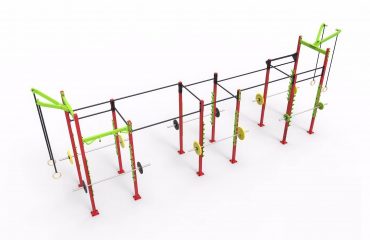
Case Study: Deploying a Fitness Trail Network Across 12 Municipalities
Un parcours santé intercommunal permet de mutualiser l'étude, la commande et la pose sur plusieurs communes, avec un effet direct sur le prix unitaire. La dotation d'équipement des territoires ruraux peut financer une part de l'investissement, sous conditions de dépôt et de calendrier. Cette étude de cas détaille le déploiement sur douze communes.
When an inter-municipal body decides to equip several municipalities with outdoor fitness trails at once, the project changes nature: it is no longer a few stations in a park but a coherent equipment network across a territory, with a multi-source funding plan, a single tender specification, pooled logistics and centralised maintenance. This anonymised case study covers a project we supported across 12 rural municipalities of 500 to 5,000 residents: 12 trails deployed in 18 months, public funding covering around 55 percent of the total excluding VAT, and a five-year pooled maintenance contract.
The case in figures
| Indicator | Value |
|---|---|
| Municipalities equipped under one contract | 12 |
| Combined public funding rate | ~55% of cost excl. VAT |
| Total deployment, study to last installation | 18 months |
| Expected service life (stainless steel, maintained) | 15–20+ years |
Why the inter-municipal logic changes everything
A standalone fitness trail costs 15,000–40,000 EUR excluding VAT. If each municipality tenders alone, twelve municipalities run twelve procedures, twelve deliveries and twelve negotiations — and usually end up with twelve heterogeneous results in material, aesthetics and compliance. Pooling transforms four parameters:
- Negotiating power: a single contract of 180,000–350,000 EUR excluding VAT secures unit prices, delivery, installation and maintenance terms unreachable municipality by municipality.
- Territorial coherence: one equipment range, one signage system, one compliance level across the territory — a visible sporting identity rather than an accumulation of isolated projects.
- An optimised funding plan: one application carried by the joint body can mobilise a larger envelope than a series of small municipal files, and combine several public funding schemes.
- Pooled maintenance: one preventive contract covering all 12 sites with planned technician rounds, instead of twelve ad-hoc interventions.
The modular specification
The tender was structured in modular lots so each municipality received a trail matched to its available space on a common technical base.
| Configuration | Footprint | Stations | Typical municipality |
|---|---|---|---|
| A — Compact | 30–50 m2 | 3–4 | Under 1,000 residents; village square or small public garden |
| B — Standard | 60–100 m2 | 5–7 | 1,000–3,000 residents; municipal park, sports-ground surrounds |
| C — Extended | 120–200 m2 | 8–12 plus linear trail | The territory’s central town or leisure zone |
All three configurations shared one technical base: equipment compliant with EN 16630, EN 1177 impact surfacing around every station with fall height, the regulatory information panel (minimum user height 1.40 m, usage instructions, emergency contact), and unified network signage. The procurement mechanics behind such a specification are detailed in our guide to outdoor fitness public procurement.
The material arbitration: galvanised vs stainless
| Criterion | Powder-coated hot-dip galvanised steel | Stainless steel 304/316 |
|---|---|---|
| Unit budget per station | 1,500–3,500 EUR excl. VAT | 3,000–6,000 EUR excl. VAT |
| Service life without recoating | 10–15 years (repainting every 4–5 years) | 20–30 years, near-zero surface maintenance |
| 15-year maintenance cost | High: 3–4 recoats = 15–25% of initial price | Very low: annual cleaning only |
| 20-year whole-life cost | ~120–140% of initial price | ~105–110% of initial price |
The joint body chose stainless steel for the central-town Configuration C site (high visibility and footfall) and galvanised steel for the A and B configurations — a compromise that optimises the global whole-life cost while protecting the image of the territory’s flagship site. For the material choice in depth, see timber vs galvanised steel for outdoor fitness.
The 18-month timeline
- Months 1–2 — Decision and funding file: council deliberation, budget estimate with a 3D plan per municipality, funding application lodged. The non-negotiable condition of most schemes: no purchase order signed before the application is lodged.
- Months 3–5 — Funding award and tender: grant notification, specification drafting with technical assistance, publication, four-week consultation, bid analysis, award.
- Months 6–9 — Manufacture and site preparation: production (6–10 weeks for galvanised, 8–12 for stainless) while municipalities prepared groundworks, anchor slabs and impact surfacing in parallel.
- Months 10–15 — Installation in waves: deployment in waves of 3–4 municipalities — anchoring, surfacing, signage — each wave mobilising the technical team 3–5 working days, with a joint acceptance report signed with each municipality’s technical officer.
- Months 16–18 — Final acceptance and maintenance activation: global acceptance report, full compliance file handed over (EN 16630 and EN 1177 certificates, data sheets, installation photos), five-year pooled preventive maintenance activated, funder acknowledgement panels installed.
The funding plan
Indicative breakdown on a 250,000 EUR (excluding VAT) network — scheme names and rates vary by country and year, but the structure is typical of European public funding for community sport infrastructure:
| Source | Rate | On 250,000 EUR excl. VAT |
|---|---|---|
| National rural investment scheme | 30% | 75,000 EUR |
| National public-facilities investment scheme | 25% | 62,500 EUR |
| Regional grant (where a scheme is active) | 10% | 25,000 EUR |
| Joint body self-funding | 35% | 87,500 EUR |
The 87,500 EUR residual was shared between the twelve municipalities pro rata to their configuration — between 4,000 and 15,000 EUR each. The schemes and eligibility rules are detailed in our guide to funding a sports facility.
The six structuring decisions to replicate
- Carry the project at inter-municipal level, not municipality by municipality: one contract, better terms, coherent standards, pooled maintenance.
- Design three modular configurations so each municipality fits without multiplying references or complicating the specification.
- Arbitrate galvanised vs stainless per site, not globally: stainless on high-visibility sites, galvanised on secondary ones.
- Lodge the funding application before any order — the eligibility condition of almost every scheme. Plan the decision and the filing 3–6 months before the intended tender launch.
- Include surfacing and signage in the contract: the two items most often forgotten and then bought in emergency, off budget.
- Contract maintenance from day one: a five-year pooled preventive contract with an annual documented inspection per site keeps the network compliant and insurable.
Frequently asked questions
What does a 12-site fitness trail network cost?
This case sat in the 180,000–350,000 EUR excluding VAT bracket depending on final configurations and materials — roughly 15,000–30,000 EUR per site turnkey, with joint procurement pushing unit costs to the lower end. All figures are project estimates.
How much public funding can such a project attract?
This project combined schemes to reach about 55 percent of eligible costs. Rates of 30–60 percent are common across European public funding for community sport infrastructure, but every scheme has its own eligibility windows and rules — verify before building the budget.
How long does an inter-municipal deployment take?
Eighteen months here, from first deliberation to last acceptance report — and the funding instruction, not the manufacturing, is the critical path. Single-site projects typically run 9–12 months.
Who owns and maintains the trails afterwards?
In this model the joint body carried the contract and the pooled five-year maintenance agreement, with each municipality owning its site. The alternative — each municipality maintaining its own — recreates precisely the heterogeneity the joint project avoided.
Can the same approach work for street workout or playground networks?
Yes — the modular-lot, joint-procurement structure transfers directly, with EN 16630 replaced or complemented by EN 1176/1177 where children’s equipment is involved.
Planning a multi-site outdoor project?
Light In Fitness supports joint bodies and municipalities end to end: site audits, 3D plans per site, specification assistance, manufacture in galvanised and stainless steel, waved installation and pooled maintenance. Send us your territory’s outline and we will return a network proposal and budget within 24 working hours. Request your free quote.
Réalisations documentées
- Cage street workout ultime, Carcassonne – armée française
- Cage street workout ultime, Tahiti – armée française, Polynésie
- Cage SP Max, centre EPIDE de Combrée – établissement public d’insertion
- Cage SP Max, lycée Saint-Bénigne de Dijon – établissement scolaire
Sources et références
- NF EN 16630 – modules fixes d’entraînement physique de plein air : exigences de sécurité et méthodes d’essai (AFNOR)
- Code du sport, article L322-2 – garanties d’hygiène et de sécurité des établissements d’activités physiques et sportives (Légifrance)
- Décret n° 96-1136 du 18 décembre 1996 – prescriptions de sécurité relatives aux aires collectives de jeux (Légifrance)
- NF EN 1176-1 – Équipements et sols d’aires de jeux, partie 1 : exigences de sécurité et méthodes d’essai générales (AFNOR)