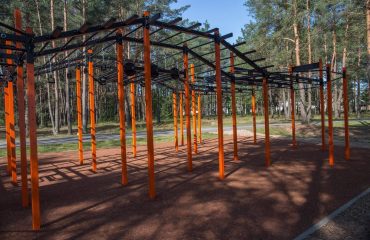
EN 16630 Outdoor Fitness Equipment for Municipalities, Employers and Resorts
La norme EN 16630 encadre les équipements de fitness en accès libre installés en plein air, pour les utilisateurs de plus de 1 400 millimètres. Elle s'applique aux stations de street workout, parcours santé, agrès cardio outdoor et aires seniors. Light In Fitness fabrique ces équipements pour collectivités, entreprises et campings, étude d'implantation et pose comprises.
Outdoor fitness equipment certified to EN 16630 serves three distinct buyers — municipalities building free-access public areas, employers adding workplace wellbeing infrastructure, and campsites or resorts differentiating their amenity offer — with the same technical foundation: hot-dip galvanised steel stations, type-tested safety geometry, protective zones and a documented maintenance regime. Light In Fitness manufactures and distributes complete EN 16630 ranges with installation and maintenance across Europe, from single stations at around 600 EUR excluding VAT to full multi-zone parks.
Why outdoor fitness has become a strategic investment
- Public health delivery: free-access equipment reaches populations that gyms never touch — which is why national sport agencies and health programmes across Europe co-fund it heavily.
- Territorial attractiveness: parks with fitness areas rank among the most-used municipal sports investments per euro, with usage spread across ages when senior and accessible stations are included.
- Employer wellbeing: outdoor stations on company grounds cost a fraction of an indoor gym, need no supervision and no changing-room investment.
- Hospitality differentiation: for campsites and resorts, a certified zone is a bookable, photographable amenity with first-season payback in occupancy terms.
EN 16630 for decision-makers
The standard covers permanently installed, free-access outdoor fitness equipment for users above 1.40 m. Concretely it imposes: entrapment-free openings, limited free-fall heights with matching impact surfacing, clear protective zones per station, corrosion-resistant materials, permanent marking and user-information signage, and a maintenance-and-inspection regime documented by the operator. It is distinct from the playground standard — shared sites must separate the zones (see EN 16630 vs EN 1176). Demand accredited type-test reports per station model at offer stage.
Our four outdoor ranges
| Range | Audience | Verified price anchors (EUR excl. VAT) | Typical deployment |
|---|---|---|---|
| Street workout structures | Teens and adults, calisthenics | TRAINER dips station: 636 · TRAINER 12-station park: 5,454 | Urban parks, campuses, campsites |
| Self-powered cardio stations | All adults | TRAINER Steel4Fit elliptical: 2,196 | Trails, employer sites, resorts |
| Multi-station fitness sets | Mixed-age public areas | TRAINER Set 7 (5 stations): 8,974.80 | Municipal areas, large sites |
| Senior and accessible stations | Older and reduced-mobility users | Accessible Tai Chi and wall-bar stations: 1,500–1,865 | Care settings, inclusive public areas |
All TRAINER and Steel4Fit ranges are hot-dip galvanised steel with powder-coat finish; for coastal sites we supply dedicated stainless steel 316L equipment. Range depth per audience: councils, employers, senior areas and campsites and holiday villages.
Installation: from study to handover
- Siting study and 3D plan — orientation, drainage, access, protective-zone mapping;
- Groundworks and foundations — concrete footings per station loads (2–3 days);
- Station installation and surfacing — rubber tiles 40 mm+ (60–90 EUR excluding VAT per m²) or wet-pour EPDM (90–130 EUR per m²) where fall heights require certified attenuation;
- Handover — conformity file: certificates, as-built plan, maintenance schedule, inspection log template.
Anticipate: machine access for groundworks, 28-day concrete cure before use, and signage positioning. Typical calendar from order to opening: 6–10 weeks.
Maintenance and warranties
- Inspection regime under EN 16630: routine visual checks (weekly-to-monthly), operational inspections (1–3 months), documented annual main inspection.
- Maintenance contracts: from 490 EUR excluding VAT per year for a standard area — operational plus annual inspection with conformity report.
- Warranties to demand: 10 years on galvanised structures, 2–3 years on moving parts, spare-parts availability over 10 years.
- Service life: 15–20 years for hot-dip galvanised stations under maintenance — the whole-life cost per user-hour is among the lowest of any sports investment.
Funding the project
Across European jurisdictions, outdoor fitness areas attract public co-funding — national sport agency programmes, regional health-promotion schemes, rural development funds and urban regeneration budgets — with cumulative support commonly reaching 40–70% of eligible costs for municipal projects. Employers typically treat stations as depreciable wellbeing infrastructure; hospitality operators fold them into tourism-modernisation grant applications. We supply the technical annexes (certificates, maintenance plan, visuals) that applications require.
Frequently asked questions
How much does an outdoor fitness area cost?
A compact 4–6 station area with surfacing and installation: 15,000–25,000 EUR excluding VAT. A full multi-zone park with street workout, cardio and accessible stations: 30,000–60,000 EUR. Single employer or campsite configurations start under 10,000 EUR.
How long does outdoor fitness equipment last?
Fifteen to twenty years for hot-dip galvanised steel with routine maintenance; stainless steel 316L matches that in coastal exposure. Surfacing typically renews once within the equipment’s life.
Who can install the equipment — and who inspects it afterwards?
Installation must follow the manufacturer’s foundations and torque specifications — we install with our own teams and hand over a conformity file. Afterwards the operator keeps the inspection log; the annual main inspection can be contracted back to us or to any competent third party.
Is outdoor fitness equipment safe for unsupervised public use?
That is precisely what EN 16630 certifies: entrapment-free geometry, controlled fall heights, marked usage guidance. The operator’s residual duties are surfacing upkeep and the documented inspection regime.
Receive your complete outdoor project file
Send us your site type — municipal, workplace or hospitality — surface and audience: Light In Fitness returns a configured proposal with 3D visuals, certified documentation, installation planning and financing guidance within 24 working hours.
Réalisations documentées
- Cage street workout ultime, Carcassonne – armée française
- Cage street workout ultime, Tahiti – armée française, Polynésie
- Cage SP Max, centre EPIDE de Combrée – établissement public d’insertion
- Cage SP Max, lycée Saint-Bénigne de Dijon – établissement scolaire
Sources et références
- NF EN 16630 – modules fixes d’entraînement physique de plein air : exigences de sécurité et méthodes d’essai (AFNOR)
- Code du sport, article L322-2 – garanties d’hygiène et de sécurité des établissements d’activités physiques et sportives (Légifrance)
- Code de la commande publique – texte intégral en vigueur (Légifrance)
- Direction des affaires juridiques, ministère de l’Économie – réglementation de la commande publique et fiches techniques
À lire aussi sur le même thème
- Est-ce que l’airsoft est un sport ? Analyse complète en 2026
- Studio cycling bikes: Bodytone MT6 and MT10 compared with the Keiser M3i
- Custom steel and stainless sports structures: how a manufacturing quotation is built
- AI that recognises the machine and coaches the member: what it means for equipment buyers