Studio cycling bikes: Bodytone MT6 and MT10 compared with the Keiser M3i
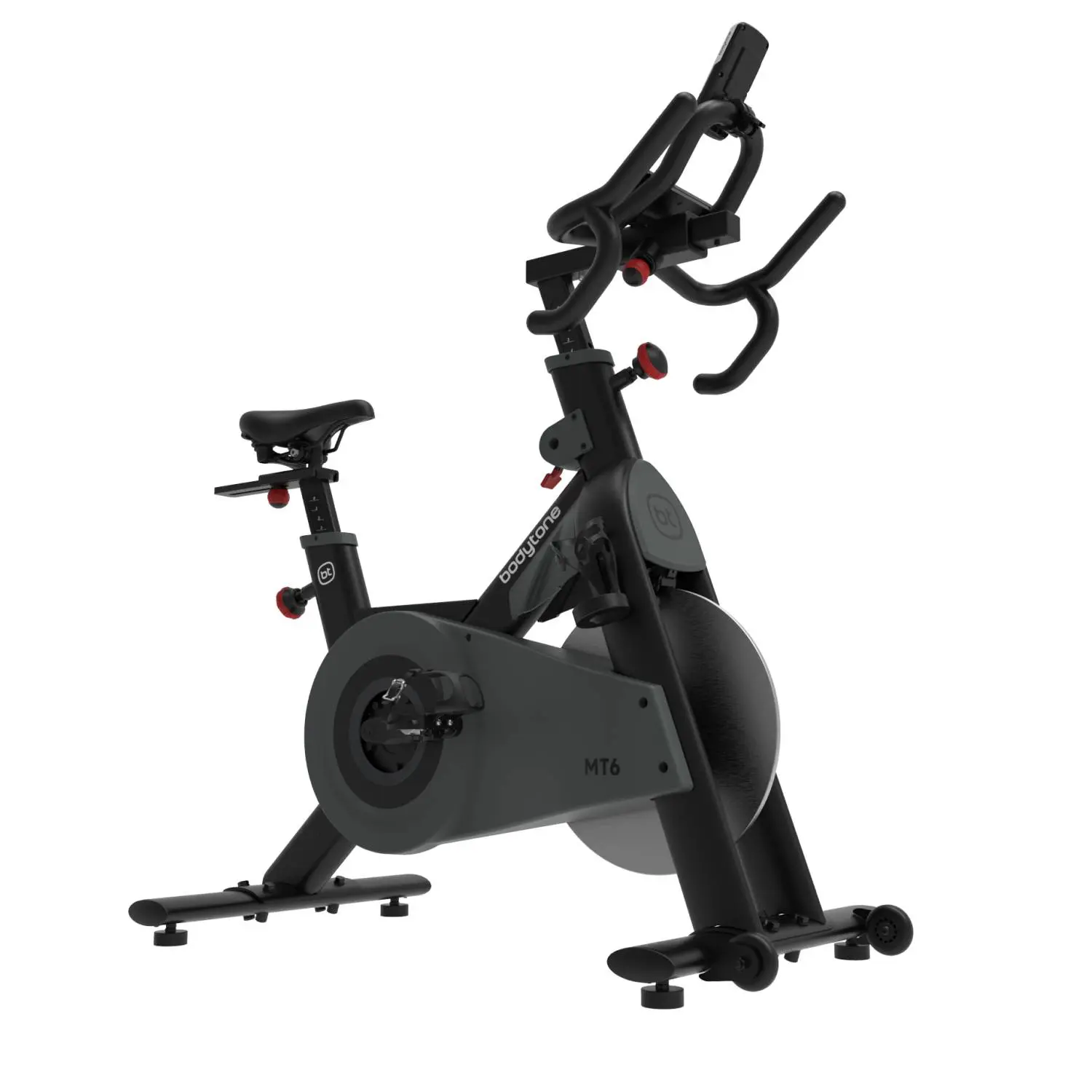
For a 15 to 25-bike studio, the honest comparison between the Keiser M3i and the Bodytone indoor cycling range supplied by Light In Fitness comes down to three published variables: acquisition cost per bike, the wear parts that drive maintenance, and how many participants can ride without cycling shoes. The Bodytone MT6 is listed at 1,425.40 EUR excluding VAT and the watt-measuring MT10 at 2,731.80 EUR excluding VAT; the Keiser M3i is sold in Europe through a reseller network, so the only sound comparison is a written quotation for your quantity. Below is the scoring grid to apply before you commit a whole studio.
What both bikes have in common — and why that matters
The Keiser M3i earned its position by putting frictionless magnetic resistance into group cycling: 24 resistance levels, a claimed 38.5 kg unit weight that one instructor can reposition, Bluetooth power broadcast, manufactured in the United States. Those are Keiser’s own published characteristics and they are not in dispute.
The Bodytone MT6 and MT10 share the same underlying architecture: neodymium magnetic braking with no contact pad, Poly-V belt transmission with no chain to lubricate, and a welded steel tube frame. Both families therefore avoid the two classic studio failure points — felt brake pads and chain wear. Once that is established, the comparison stops being technical and becomes commercial.
Both must be declared to EN ISO 20957-1:2024 class S for professional and commercial use. Class H is domestic; do not accept it in a staffed studio, whatever the sales tier is called. “Semi-professional” is not a class under the standard.
Comparison table: the criteria that decide a studio order
| Criterion | Bodytone MT6 / MT10 (Light In Fitness) | Keiser M3i |
|---|---|---|
| Published price | MT6: 1,425.40 EUR excluding VAT. MT10 (watt measurement): 2,731.80 EUR excluding VAT | Sold through resellers; obtain a written quotation for your quantity |
| Resistance | Magnetic, neodymium magnets, non-contact | Magnetic, 24 levels, non-contact (manufacturer specification) |
| Transmission | Poly-V belt, near-silent, no lubrication | Belt drive (manufacturer specification) |
| Power measurement | MT10: on-board watt measurement, cadence and heart rate | Power display with Bluetooth broadcast (manufacturer specification) |
| Pedals | Dual-sided SPD: cleat one side, toe cage the other | Per configuration ordered |
| Ergonomics | 213 mm Q-factor, EVA saddle with 17 vertical positions, four-grip hypoallergenic handlebar | Published by the manufacturer |
| Connectivity | Optional M20X console (209.00 EUR excluding VAT): Bluetooth to Zwift, Bkool, Kinomap, MyBodytone | Keiser app ecosystem, Bluetooth |
| Warranty | 3 years, EN ISO 20957-1 compliance, European after-sales support | Manufacturer warranty via the reseller |
| Manufacturing | Bodytone, Spain — European supply chain and spare parts | United States |
Every statement about Keiser above is either published by Keiser itself or a statement that the figure is not published. Light In Fitness does not publish failure statistics for equipment it does not service.
Total cost per studio: the calculation to run before you choose
A studio is never one bike. Model the whole room, over the realistic seven-year replacement horizon, and include the items a bike quotation usually leaves out.
| Line | 15-bike studio | 25-bike studio |
|---|---|---|
| MT6 at 1,425.40 EUR excluding VAT | 21,381.00 EUR excluding VAT | 35,635.00 EUR excluding VAT |
| Hybrid layout: 3 x MT10 front row + MT6 behind | 25,020.60 EUR excluding VAT | 39,274.60 EUR excluding VAT |
| Floor area required at 3 to 4 m2 per bike | 45 to 60 m2 | 75 to 100 m2 |
| Technical flooring, sound and lighting | Budget separately — quote in the same package | Budget separately — quote in the same package |
These are project estimates built from published unit prices; carriage, installation and any flooring works are quoted separately. Whatever brand you compare, run the same arithmetic on a written quotation rather than on a headline unit price.
The maintenance question: which parts wear
Studio bikes are consumed by three things: sweat corrosion, brake wear and drive wear. Score any bike against this list before signing:
- Braking: non-contact magnetic braking removes the felt pad entirely. Friction bikes need pad replacement several times a year in a busy room.
- Drive: a Poly-V belt needs no lubrication and no tensioning schedule; a chain does.
- Corrosion protection: ask for TPR or equivalent sweat guards over the frame junctions and the resistance mechanism. Sweat, not mileage, kills studio bikes.
- Adjustment hardware: saddle and handlebar posts are handled dozens of times a day. Count the vertical positions (17 on the MT6) and check that adjustment needs no tools.
- Spare parts geography: a European-manufactured bike shortens the parts lead time. Ask for the published lead time in the quotation, not verbally.
Light In Fitness publishes a fault rate of 4.1% at 24 months, excluding consumables, from its own after-sales records on the MT6. That figure describes equipment Light In Fitness services itself; it is not a comparative claim about any other brand.
Access: the pedal decision that fills the 6 pm class
In a general-public studio, a large share of participants arrive in trainers rather than cycling shoes. Dual-sided SPD pedals — cleat on one face, toe cage on the other — remove that barrier without imposing shoe hire. Combine that with a 213 mm Q-factor for a natural knee track and a saddle that adjusts in seconds, and the class fills on comfort rather than on kit.
The same logic drives the hybrid layout many operators now use: two to four watt-measuring bikes in the front row for data-driven members, and MT6 units behind for the rest of the room. It tests appetite for connected cycling without capitalising the whole studio at premium unit cost.
Which configuration for which venue
- Dedicated cycling studio, 8 to 30 bikes — hybrid layout: MT10 front row, MT6 behind. Published unit prices, single quotation covering bikes, flooring and accessories.
- Fitness club, hotel or corporate gym — MT6 at 1,425.40 EUR excluding VAT: near-silent magnetic, dual-sided pedals, minimal maintenance, 3-year warranty.
- Performance-oriented studio with a cyclist membership — MT10 at 2,731.80 EUR excluding VAT for on-board watt measurement across the front rows.
- Venue committed to a specific premium brand — a brand decision is legitimate. Budget it against a written quotation for your quantity, including warranty scope, spare-part lead times and the cost of servicing US-manufactured units in Europe.
If you are specifying a full cardio floor rather than a cycling room alone, the same scoring logic applies to running machines: see our comparison of commercial treadmills and Technogym club ranges.
Frequently asked questions
How much does a professional studio bike cost?
Light In Fitness publishes the Bodytone MT6 at 1,425.40 EUR excluding VAT and the watt-measuring MT10 at 2,731.80 EUR excluding VAT. Premium studio brands such as Keiser are generally sold through resellers without a published European list price, so ask for a written quotation covering your exact quantity, warranty scope and delivery.
Is a magnetic bike really better than a friction bike for a studio?
For commercial use, yes on maintenance grounds. Non-contact magnetic braking has no friction pad to replace, produces no dust and no noise, and holds calibration. Friction pads in a busy studio are a recurring consumable and a recurring service call.
Do participants need cycling shoes?
Not with dual-sided SPD pedals, which take a cleated shoe on one face and a standard trainer in the toe cage on the other. In a general-public studio this is a direct driver of class occupancy, because no participant is turned away over footwear.
How much floor area does a cycling studio need?
Allow 3 to 4 m2 per bike including circulation: roughly 45 to 60 m2 for 15 bikes and 75 to 100 m2 for 25 bikes, ideally in a theatre layout so the instructor has sight of every participant. Add the technical flooring specification to the same package.
Which apps work with Bodytone indoor bikes?
The optional M20X wireless console (209.00 EUR excluding VAT) connects over Bluetooth to Zwift, Bkool, Kinomap and the free MyBodytone app, and pairs with standard Bluetooth heart-rate straps.
Specifying a cycling studio? Send us the room dimensions, the ceiling height and your target class size. Light In Fitness returns a costed layout — bikes, technical flooring, sound and lighting, delivery and installation, with all prices excluding VAT — within 24 working hours. More than 2,500 customers equipped across Europe since 2013.
Related guides: air bikes and air rowers and rubber sports flooring.
Sources et références
- NF EN ISO 20957-1 – équipement d’entraînement fixe, partie 1 : exigences générales de sécurité et méthodes d’essai (AFNOR)
- AFNOR Normalisation – dossier thématique sur les appareils d’entraînement fixes et leurs classes d’usage
À lire aussi sur le même thème
- Custom steel and stainless sports structures: how a manufacturing quotation is built
- AI that recognises the machine and coaches the member: what it means for equipment buyers
- Athlete skin: protecting the barrier between sweat, showers and friction
- Bulgarian split squat: technique, muscles worked and equipment specification