Bulgarian split squat: technique, muscles worked and equipment specification
La fente bulgare, pied arrière surélevé sur un banc, impose un travail de stabilité et corrige les déséquilibres gauche-droite que le squat bilatéral masque. Le pied avant se place à 60-80 cm du banc, la descente reste verticale. C'est l'un des exercices unilatéraux les plus efficaces pour les quadriceps et les fessiers.
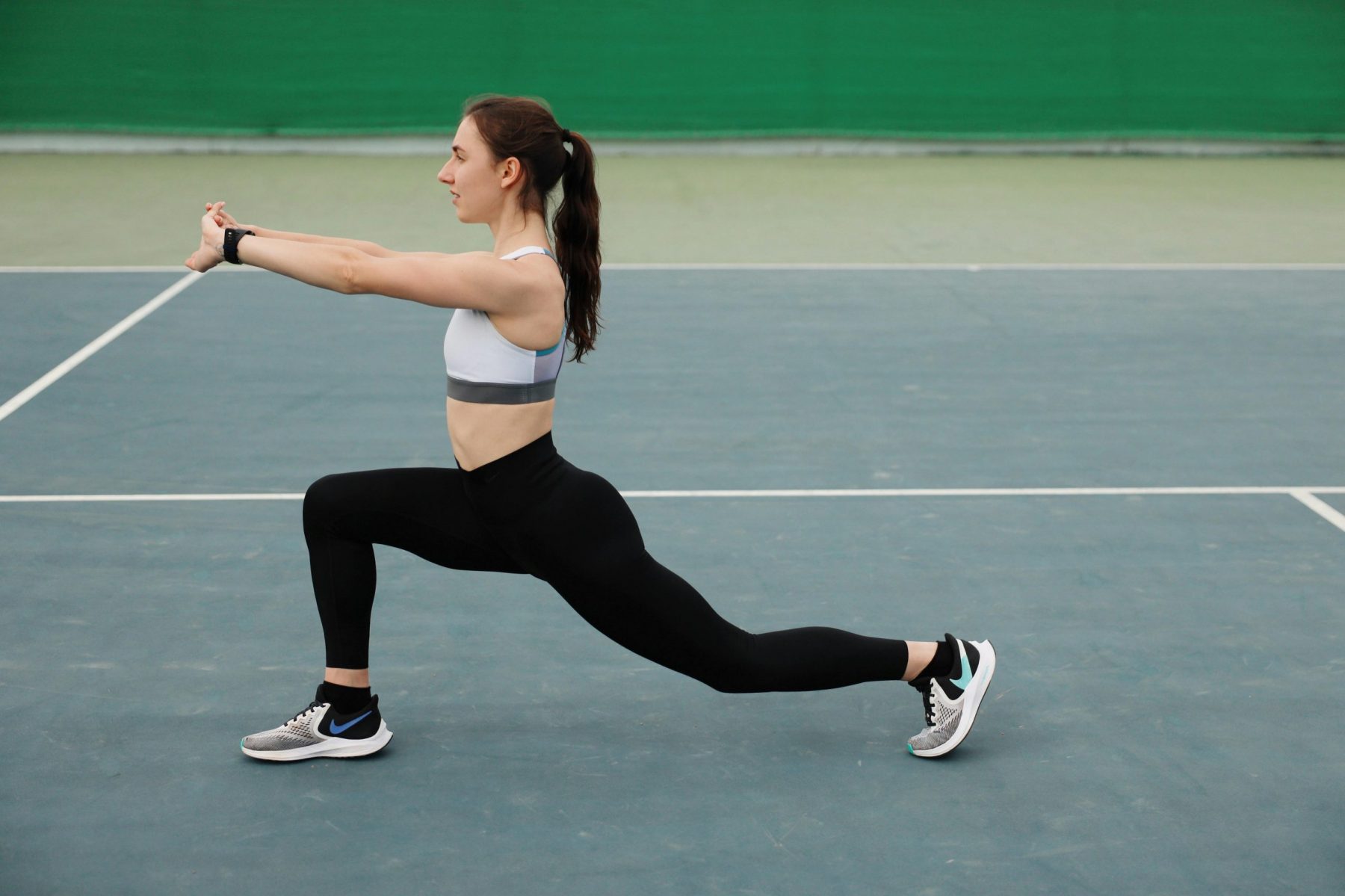
The Bulgarian split squat is the highest-yield unilateral leg exercise on a commercial floor, and it needs almost nothing to run: a stable bench at 40 to 45 cm, a pair of dumbbells, and about 2 m by 1.2 m of clear space. Three to four sets of 8 to 12 repetitions per leg, twice a week, is the standard prescription. It exposes the left-right strength asymmetry that a bilateral back squat hides, which in untrained populations commonly sits between 10 and 15 per cent.
How to perform a Bulgarian split squat
Place the rear foot on a bench at knee height. Set the front foot 60 to 80 cm forward of the bench, depending on leg length. Descend vertically until the rear knee is a few centimetres from the floor, keeping the weight over the mid-foot and heel of the front leg. Drive back up through the front heel. The rear leg is a kickstand, not a contributor: pushing off the back foot converts the movement into a shallow lunge and removes most of its value.
Torso angle is the tuning dial. A more upright trunk biases the quadriceps. A forward lean of 15 to 30 degrees at the hip loads the gluteus maximus and adductor magnus through a longer range. Neither is more correct; they are different prescriptions.
The two variables that change the exercise
| Variable | Setting | Effect |
|---|---|---|
| Bench height | 40 to 45 cm (knee height) | Reference setting. Balanced stretch and stability. |
| Bench height | Above 50 cm | Increases hip flexor stretch on the rear leg, degrades balance, raises the risk of a lumbar compensation. |
| Bench height | 20 to 30 cm | Regression for new or deconditioned members. Closer to a static split squat. |
| Front foot distance | Under 50 cm | Knee travels well past the toes; shear load on the patellofemoral joint rises. |
| Front foot distance | 60 to 80 cm | Reference. Shin close to vertical at the bottom. |
| Front foot distance | Over 90 cm | Becomes a hip flexor stretch; the rear leg cannot reach the floor without hyperextension. |
Which implement: dumbbells, barbell, Smith machine or landmine
For a commercial operator, the choice is mostly a throughput and supervision decision rather than a biomechanical one.
| Implement | Suits | Load ceiling | Equipment cost excluding VAT |
|---|---|---|---|
| Dumbbells | All populations, unsupervised floors | Grip-limited, roughly 2 x 40 kg | From 85.80 EUR per 10 kg pair to 238 EUR per 30 kg pair |
| Back-racked barbell | Experienced lifters under coaching | High, balance-limited | 195 EUR for a 220 cm 20 kg bar, plus plates |
| Smith machine | Heavy unilateral work, rehabilitation, hypertrophy blocks | Highest; balance removed | 1,695 to 4,950 EUR depending on model |
| Landmine or safety squat bar | Members with shoulder or wrist restrictions | Moderate | Attachment cost only if a rig is already in place |
Dumbbells remain the default for open-floor use: they are self-limiting, they need no spotter, and a member can bail simply by putting them down. The Smith machine earns its place when a coached athlete wants to load the pattern beyond what grip allows, or when a rehabilitation protocol requires a fixed bar path.
The four errors that cost most
- Pushing off the rear foot. The single most common fault. Cue the athlete to keep the rear knee soft and the rear toes lightly loaded only.
- Front foot too close. Produces knee discomfort that members attribute to the exercise rather than to the setup.
- Bouncing at the bottom. Removes the tension the exercise exists to create. A one-second pause at the bottom fixes it and is a useful regression.
- Bench too high. A standard flat bench at 40 to 45 cm is correct. A plyometric box at 60 cm is not, and this substitution is what most gym-floor knee complaints trace back to.
Programming for different populations
| Objective | Sets x reps per leg | Load | Frequency |
|---|---|---|---|
| Movement quality, new member | 2 x 8, bodyweight | None or 2 x 4 kg | 2 per week |
| Hypertrophy | 3 to 4 x 8 to 12 | 2 x 12 to 25 kg | 2 per week |
| Strength and asymmetry correction | 4 x 5 to 6 | 2 x 25 to 40 kg or Smith machine | 2 per week, weaker side first |
| Return to sport after knee injury | 3 x 10 to 15, tempo controlled | Bodyweight progressing to light dumbbells | 3 per week under supervision |
The standard rule for correcting asymmetry is to train the weaker limb first and cap the stronger limb at the repetitions the weaker one achieved. Eight to twelve weeks of that pattern typically narrows a 15 per cent gap to under 5 per cent.
What this means for equipment specification
The Bulgarian split squat is popular precisely because it is cheap to provision, but three specification points decide whether it works on your floor.
- Bench stability. A bench used as a rear-foot support takes an eccentric, off-axis load that a domestic bench is not built for. Specify benches to EN ISO 20957-1:2024 class S, the professional and commercial use class, with a frame section of at least 50 x 50 mm and a footprint wide enough to resist tipping. Class H benches are designed for domestic use and will loosen within months on a busy floor. Our commercial weight bench buying guide covers frame, upholstery and load-rating criteria in detail.
- Dumbbell granularity. Unilateral training needs small increments. A rack that jumps 5 kg between pairs above 20 kg forces members to stall. Specify 2.5 kg increments to 30 kg where the budget allows.
- Footprint and circulation. Allow 2 m by 1.2 m per station including the bench, and keep the working axis parallel to the main circulation route rather than across it. See our notes on strength floor layout for clearance rules.
- Non-slip surface. A 15 to 20 mm rubber tile from 22 EUR per square metre excluding VAT is sufficient in this zone; there is no impact load to absorb.
Frequently asked questions
Is the Bulgarian split squat better than the back squat?
It does not replace the back squat, it complements it. The back squat is the superior tool for absolute lower-body strength and axial loading. The Bulgarian split squat exposes and corrects left-right imbalances, loads the hip stabilisers far more, and reaches useful training stimulus at a fraction of the spinal load, which is why it survives in programmes for older or back-sensitive members.
What bench height should be used?
Knee height, which is 40 to 45 cm for most adults and corresponds to a standard commercial flat bench. Going higher increases the stretch on the rear hip flexor and makes balance the limiting factor rather than the working leg, which defeats the purpose.
How many repetitions to make progress?
Three to four sets of 8 to 12 repetitions per leg, twice a week, adding load progressively. If the objective is strength rather than hypertrophy, drop to sets of 5 to 6 with a heavier dumbbell or on a Smith machine.
Does it hurt the knee?
Correctly set up, it is generally better tolerated by sensitive knees than a deep bilateral squat, because the shin stays close to vertical and the load per repetition is lower. Knee complaints almost always trace back to a front foot placed too close to the bench, or a bench that is too high.
How many benches does a gym need for unilateral work?
As a planning figure, one bench per 60 to 80 m2 of free-weight floor, on top of the benches allocated to pressing stations. Benches used for split squats are occupied for long sets and should not be taken from the pressing area.
Specifying a free-weight zone? Light In Fitness has equipped gyms, clubs, hotels and public facilities across Europe and export markets since 2013. Tell us your floor area, membership profile and budget, and we will return a costed layout covering benches, dumbbell racking, Smith machines and flooring. Request a quote or explore our professional weight benches.