Ab wheel: technique, progression and commercial specification
La roue abdominale met le grand droit et le transverse sous tension croissante, avec une exigence de contrôle que peu d'exercices égalent. L'exécution se fait à genoux, bassin en rétroversion et lombaires neutres, en descendant aussi loin que le gainage le permet sans creuser le bas du dos. La progression passe par l'amplitude avant de passer par la position debout.
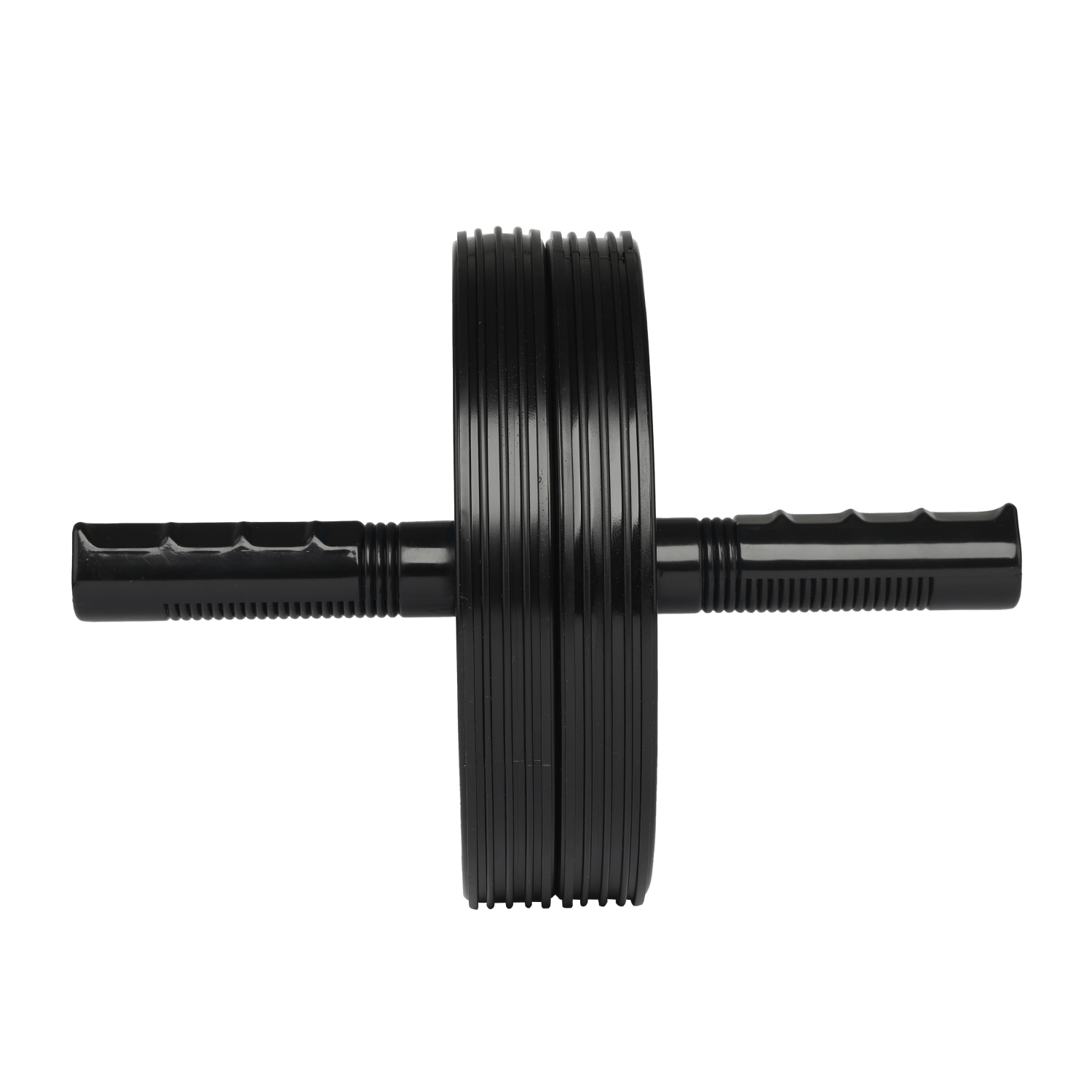
The ab wheel is the cheapest piece of equipment in a commercial gym that produces a measurable training effect: around 19 EUR excluding VAT per unit, against 1,900 to 3,700 EUR excluding VAT for a selectorised abdominal crunch machine. Three sets of 8 to 12 controlled roll-outs, two to three times a week, is the complete prescription. The catch is that it is unforgiving of poor technique, which is why the specification and the coaching around it matter more than the product itself.
Why the roll-out works
Most abdominal exercises shorten the trunk. The roll-out does the opposite: it loads the rectus abdominis and the transversus abdominis in an anti-extension pattern, resisting the lumbar extension that gravity and the lever arm are trying to produce. The demand rises continuously as the wheel travels forward, so the exercise self-scales by range rather than by added load.
Electromyography studies consistently place the standing roll-out at or near the top of abdominal activation rankings, above crunches and above most machine-based flexion work. It also loads the latissimus dorsi, the serratus anterior and the hip flexors, which is why it transfers to overhead and pressing strength in a way that a crunch machine does not.
Technique: the non-negotiables
- Kneel on a mat, hands on the handles, wheel directly under the shoulders.
- Set the pelvis in posterior tilt and brace. The lumbar spine must be neutral before the wheel moves.
- Roll forward slowly, extending the hips and shoulders together. Two to three seconds out.
- Stop at the point where the pelvis starts to tip forward or the lower back starts to arch. That point, not the floor, is the end of the range.
- Return by contracting the abdominals and pulling the pelvis back under, not by pulling with the arms.
The single diagnostic: if the lower back arches, the range is too long for the current level of control. This is not a cue to push through. It is a cue to shorten the range or add a stop.
Progression, in five stages
| Stage | Position | Range | Typical prescription |
|---|---|---|---|
| 1 | Kneeling, facing a wall | Wheel stops at the wall; move the start point back 5 cm per week | 3 x 8 |
| 2 | Kneeling, free | Partial, stopping before the pelvis tips | 3 x 8 to 10 |
| 3 | Kneeling, free | Full range, chest close to the floor | 3 x 10 to 12 |
| 4 | Standing, facing a wall | Short range, progressively lengthened | 3 x 5 to 8 |
| 5 | Standing, free | Full standing roll-out and return | 3 x 3 to 5 |
Stage 5 realistically takes months of consistent practice, and most members will never need it. Stages 2 and 3 already deliver the great majority of the training effect. Coaches who market the standing roll-out as the goal tend to produce members who arch their way through stage 3.
Choosing an ab wheel for commercial use
Domestic ab wheels fail on a class floor within a season. Four specification points separate a commercial unit:
- Wheel width and count. A wide single wheel, or a twin-wheel design, resists lateral wobble. That matters most for beginners, whose failure mode is a sideways deviation rather than a forward one. Twin-wheel is the default for unsupervised club use.
- Bearing quality. A sealed bearing keeps the roll smooth and prevents the jerky travel that causes members to lose control mid-range.
- Tread material. Rubber or TPE tread that grips a rubber floor. A hard plastic wheel skids on a polished surface and is unusable on a mat.
- Handle grip. Non-slip, at least 25 mm diameter, ideally with a knurled or textured sleeve. Sweat is the main variable in a class setting.
A professional-grade unit sits at around 19 EUR excluding VAT. At that price, the correct provisioning decision for a club is one wheel per two class participants, not a shared pair, so that a coach can programme it as a station rather than a demonstration.
Where it fits against machine-based core work
| Option | Pattern trained | Cost excluding VAT | Footprint | Best for |
|---|---|---|---|---|
| Ab wheel | Anti-extension, dynamic | From 19 EUR | 1.5 x 1 m, shared | Class programming, functional floors, personal training |
| Selectorised crunch machine | Loaded trunk flexion, guided | From 1,892 EUR | 1.4 x 1.2 m fixed | Unsupervised floors, deconditioned or older members, progressive load tracking |
| Rotary torso machine | Loaded rotation | From around 3,600 EUR | 1.5 x 1.3 m fixed | Clubs with a full circuit and space to spare |
| Hanging leg raise station | Anti-extension plus hip flexion | From 1,175 EUR as part of a power tower | 1.2 x 1.4 m fixed | Bodyweight-oriented floors |
The honest reading for an operator is that the ab wheel does not replace a crunch machine on an unsupervised floor. A machine gives a guided path, a load the member can track, and a seat, and those things drive usage among the deconditioned members who most need core work. The ab wheel dominates on cost per station in a coached environment. Most clubs need both, and our professional gym accessories guide sets out how to balance accessory and machine spend.
Floor and mats
The roll-out is performed on the knees, so the surface matters. A 20 mm rubber tile is too hard for a set of twelve; specify a rolled mat or an individual exercise mat of 10 to 15 mm in the core and mobility corner. This is the same provisioning as a stretching zone, and it is usually the same physical area: see our notes on stretching and mobility zone design. The wheel itself needs a smooth, clean, low-pile surface to travel on, so avoid deep artificial turf strips for this exercise.
Coaching the roll-out in a class setting
The ab wheel is easy to buy and easy to programme badly. In a group setting, three coaching decisions determine whether it produces a training effect or a wave of lower back complaints.
- Set the range with a physical stop, not a verbal cue. A wall, a bench leg or a foam block placed at the current end of range removes the judgement call from the athlete mid-set, which is exactly when judgement fails.
- Prescribe tempo, not repetitions. Two to three seconds out and two seconds back makes the exercise self-limiting. Untimed repetitions become a fall and a pull.
- Screen for the arch before loading volume. A single roll-out watched from the side tells a coach everything. If the lumbar spine extends at any point, the athlete belongs at the wall progression regardless of how strong they look elsewhere.
For a facility, the associated equipment items are cheap and frequently forgotten: a kneeling mat per station, a wall or bench stop that is not in a circulation route, and enough wheels that the exercise can be run as a station rather than demonstrated once. Inspect the wheel bearing and tread quarterly; a seized bearing produces exactly the jerky travel that causes a loss of control.
Frequently asked questions
Is the ab wheel bad for your back?
Not when the pelvis stays in posterior tilt and the range is matched to the athlete’s level of control. The arched lower back is the warning sign, and it means the range is too long, not that the exercise is unsuitable. Members with existing lumbar pathology should start at the wall-stop progression under supervision.
How often should you use an ab wheel?
Two to three sessions a week is sufficient. Deep trunk musculature recovers quickly, but the eccentric demand of the roll-out is high for beginners and produces meaningful soreness in the first two weeks, so start at two sessions and add a third once that settles.
Does the ab wheel burn belly fat?
No. It strengthens and thickens the abdominal wall, which changes how the midsection looks when body fat is already low. Fat loss is a function of energy balance and total activity, not of the exercise selected for the abdominal muscles.
Single or double wheel?
Double, or a single wide wheel, for commercial and unsupervised use, because lateral stability is the limiting factor for beginners. A narrow single wheel adds a frontal-plane stability demand that is appropriate only for advanced users.
How many ab wheels should a club buy?
One per two class participants as a minimum, so 6 to 8 for a standard 16-person class. At around 19 EUR excluding VAT each, the constraint is storage and not budget, and a wall bracket or a small crate solves that.
Planning a core, stretching or functional area? Light In Fitness supplies gyms, clubs, hotels and public facilities across Europe and export markets, from single accessories to complete fitted floors, with layout studies and installation. Send us your floor plan and class profile and we will return a costed specification. Request a quote or browse our functional training accessories.
À lire aussi sur le même thème
- Lifting straps: when to use them, which type and how to wrap them
- Gym equipment names in English and French: the international buyer glossary
- Solid Grow, Gold Line, Forza ou Forza FH : quelle gamme guidée
- Box jumps: technique, heights and how to choose a plyometric box
- Sled push and farmer walk: the guide to pushing and carrying work