Box jumps: technique, heights and how to choose a plyometric box
Le box jump développe la puissance des membres inférieurs et la coordination, à condition de redescendre en marchant et non en sautant en arrière. La réception se fait en douceur, genoux alignés et pieds entiers sur la plateforme. La hauteur de la plyo box se choisit sur la qualité de réception, jamais sur le record du pratiquant.
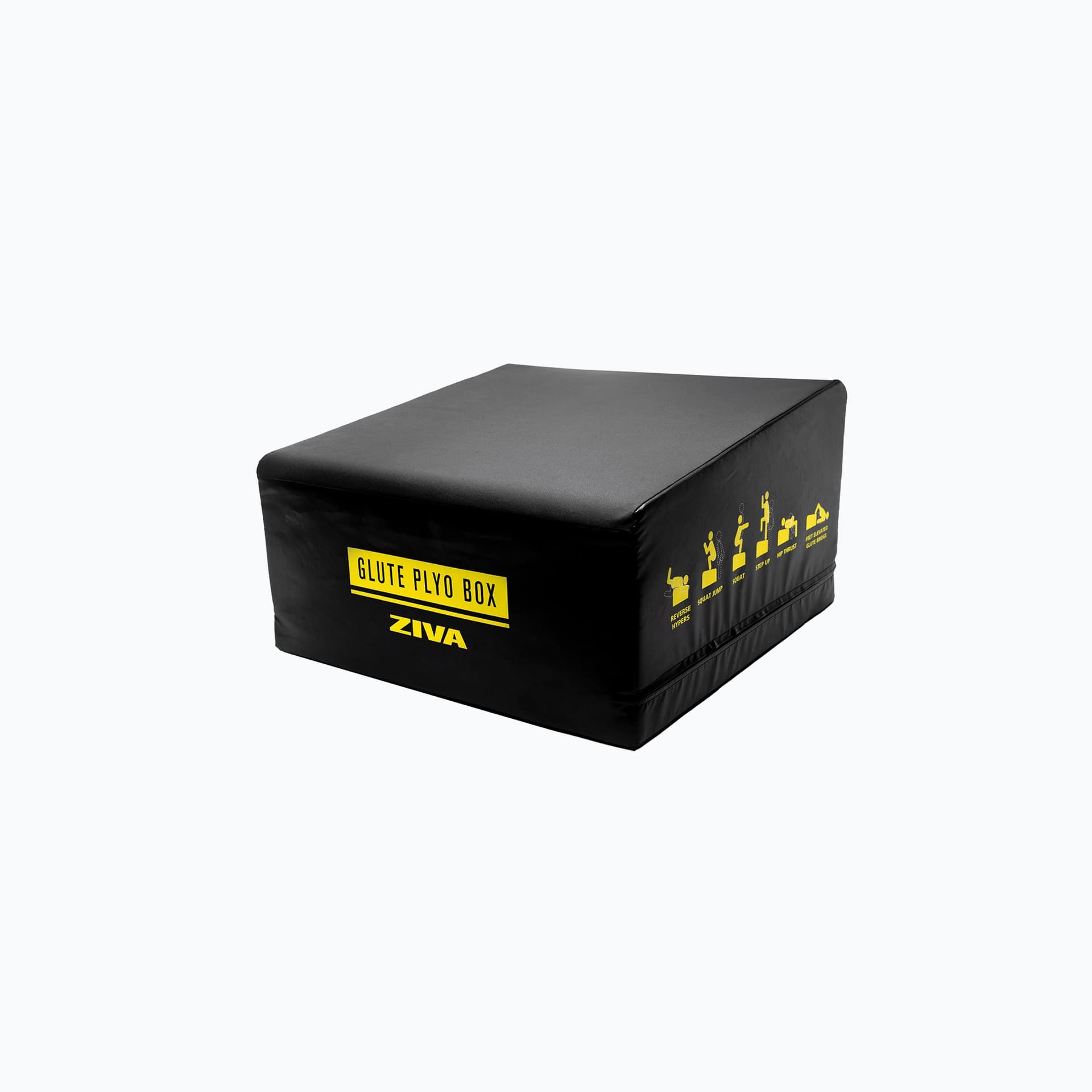
The reference box jump height is 50 cm for a beginner, 60 cm for a regular trainee and 75 cm or more for explosive athletes, and the correct box for a commercial class floor is high-density foam, not plywood. A three-position wooden box costs from 273 EUR excluding VAT and a foam equivalent from 398 EUR excluding VAT. That 125 EUR difference buys out the single most common injury on a functional training floor: a shin torn open on a plywood edge.
Box jump technique in six points
- Stand facing the box, feet at hip width, roughly 15 to 30 cm from the front face.
- Load the arms back and hinge at the hip and knee in one countermovement. Do not pause at the bottom.
- Extend explosively through hip, knee and ankle, driving the arms up.
- Land softly with the whole foot on the platform, knees tracking over the toes, hips absorbing the landing.
- Stand fully upright on the box. The repetition is not complete at the landing; it is complete at hip extension on top.
- Step down. Never jump down. The descent, not the jump, causes most box jump injuries.
The rebound descent stacks an eccentric load onto an already fatigued Achilles tendon at the end of a high-repetition set. Achilles ruptures in commercial gyms are overwhelmingly associated with rebounding box jumps under fatigue, and the fix costs nothing: programme step-downs and coach them.
Choosing the height
| Population | Height | Typical set | Note |
|---|---|---|---|
| Complete beginner, older member | 40 cm | 3 x 5, full reset between reps | Or step-ups only until landing mechanics are sound |
| General fitness member | 50 cm | 4 x 5 to 8 | The default reference for class programming |
| Regular cross training athlete | 60 cm | Conditioning sets of 10 to 20 | Standard competition height |
| Explosive or competitive athlete | 75 cm and above | 3 to 5 x 3, full recovery | Power work, not conditioning |
The height test is simple and it is not about courage. If the knees come up towards the chest on landing, the box is too tall and the athlete is compensating with hip flexion rather than producing more power. A box jump measures vertical power output, not hip mobility. Reducing the box by one setting almost always improves the quality of the movement and the training effect.
Wood, foam or steel: the specification decision
| Type | Best for | Advantages | Limitations | Price excluding VAT |
|---|---|---|---|---|
| Three-position plywood box | Coached cross training floors, competition preparation | Three heights in one unit, stable, low cost, stackable | Hard edges, real laceration risk under fatigue | From 273 EUR |
| High-density foam box | Group classes, mixed-ability memberships, hotels, schools | No laceration risk, quieter, safe for unsupervised use | Compresses over time, higher unit cost, bulkier storage | From 398 EUR; compact models from 225 EUR |
| Stackable steel platform | Performance and strength and conditioning floors | Very high load rating, precise incremental heights, long service life | Heaviest, unforgiving surface, highest cost | – |
| Galvanised or stainless outdoor box | Street workout parks, military training areas, schools | Weather resistant, vandal resistant, anti-slip deck | Fixed height per unit, requires foundations | 499 to 859 EUR by height |
For a commercial club running group classes, high-density foam is the correct default. The plywood box belongs on a coached floor where every athlete is supervised. Outdoor installations use fixed-height galvanised or stainless steel boxes, or a multi-height plyometric podium, which for a public site runs to around 3,999 EUR excluding VAT for a complete multi-level platform.
The three-position box: what the numbers mean
A standard commercial plywood box measures 50 x 60 x 75 cm, giving three usable heights from a single unit by rotating it. That is why it dominates cross training boxes: one purchase covers the beginner, intermediate and advanced heights, and a stack of eight boxes serves a full class in about 1.5 m2 of storage. Check three things before ordering: birch or poplar plywood of at least 18 mm, fully radiused edges, and a rated static load of at least 250 kg so the box can also be used as a step-up, dip and elevated push-up platform.
Floor, spacing and ceiling height
- Flooring. A 20 mm rubber tile is the minimum under a jump zone, and 25 to 30 mm where the box is used for depth jumps or drop landings. Thin tiles under a box zone compress locally around the box feet and telegraph the pattern into the surface within a season.
- Station spacing. Allow 2 m by 2 m per box, with 1 m of clear space behind each athlete for a missed repetition. This is the dimension that class programming most often ignores.
- Ceiling height. A 75 cm box plus a 1.85 m athlete plus arm extension needs 2.9 m of clear height as an absolute minimum, and 3.2 m is the comfortable figure for a floor that also programmes overhead work.
Where the box zone shares a floor with barbell work, specify the higher thickness across the whole area rather than creating a step between zones. Our rubber gym flooring range covers the thickness and density bands.
Standards and duty of care
Plyometric boxes used in a supervised commercial environment fall under EN ISO 20957-1:2024 class S, the professional and commercial use class, which sets the stability, load and edge-geometry requirements. Class H is domestic and inappropriate for a paying floor. Where jump platforms are installed outdoors in free public access, EN 16630 applies to the equipment and, wherever a free height of fall is created, EN 1177 governs the impact-attenuating surface beneath it. Our outdoor parkour and cross training parks section covers the surfacing implications for public installations.
Programming box jumps without generating injuries
The injury risk on a plyometric station is almost entirely a programming problem rather than an equipment problem. Three rules cover it.
- Cap the repetitions per set. Plyometric work is a power stimulus. Beyond about eight consecutive jumps, landing quality falls and the exercise becomes conditioning performed on a hard edge. Where a conditioning effect is wanted, use step-ups or a lower box.
- Do not programme jumps at the end of a fatiguing session. Ankle and knee stiffness regulation degrades with fatigue, and that is the mechanism behind most missed landings.
- Separate the height from the ego. Post the recommended heights by ability at the station. Members left to choose in a class setting reliably select a box one setting too tall.
Two additional operational points matter for a club. Foam boxes compress over time and a set that has lost 3 to 4 cm of height no longer matches the labelling, so re-measure annually and relabel. And boxes stored in a stack are a manual handling item: a plywood box at 50 x 60 x 75 cm weighs 25 to 35 kg, which is a two-person lift under most workplace guidance.
Frequently asked questions
What box height should a beginner start with?
Fifty centimetres suits most adults, and 40 cm is appropriate for complete beginners and older members. Landing quality decides progression, not the number on the box. If the knees rise towards the chest on landing, drop a height.
Should you jump onto the box or step up?
Both belong in a programme, and they train different qualities. Loaded step-ups develop unilateral strength and are appropriate at any age or condition. Jumps develop rate of force development and power. For members over 55, or in an unsupervised environment, step-ups are the safer default and lose very little.
Why should you not jump down from the box?
Jumping down adds a high eccentric load to an Achilles tendon and a calf complex that are already fatigued from the concentric work, at exactly the moment concentration is lowest. Stepping down removes the mechanism entirely and costs a few seconds per set.
Wooden or foam plyo box for a commercial gym?
Foam for group classes and any floor with mixed abilities or limited supervision; the additional 125 EUR excluding VAT per box removes the laceration risk that generates most incident reports. Plywood for coached cross training floors and competition preparation, where three heights in one stackable unit is worth more.
How many boxes does a class floor need?
One per athlete for jump-based conditioning, so 12 to 16 for a standard class, plus two or three spares at alternative heights. Because a three-position box gives three heights in one unit, a fleet of identical boxes covers the whole ability range without extra purchasing.
Equipping a plyometric or functional zone? Light In Fitness supplies gyms, cross training boxes, schools, defence facilities and public authorities across Europe and export markets, with layout studies, flooring specification and installation. Send us your class size, ceiling height and floor plan and we will return a costed specification. Request a quote or browse our cross training box equipment.