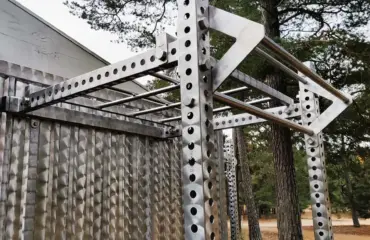
Anchoring a rig or outdoor structure: chemical anchors, mechanical fixings and foundations
Le scellement chimique par injection de résine est la référence pour fixer une cage, un rig ou une structure de street workout soumise à des charges dynamiques. Il répartit la charge sur toute la profondeur du perçage, sans contrainte d'expansion sur le béton, là où la cheville mécanique crée une poussée latérale. Le choix dépend du support, de son épaisseur et de l'usage attendu.
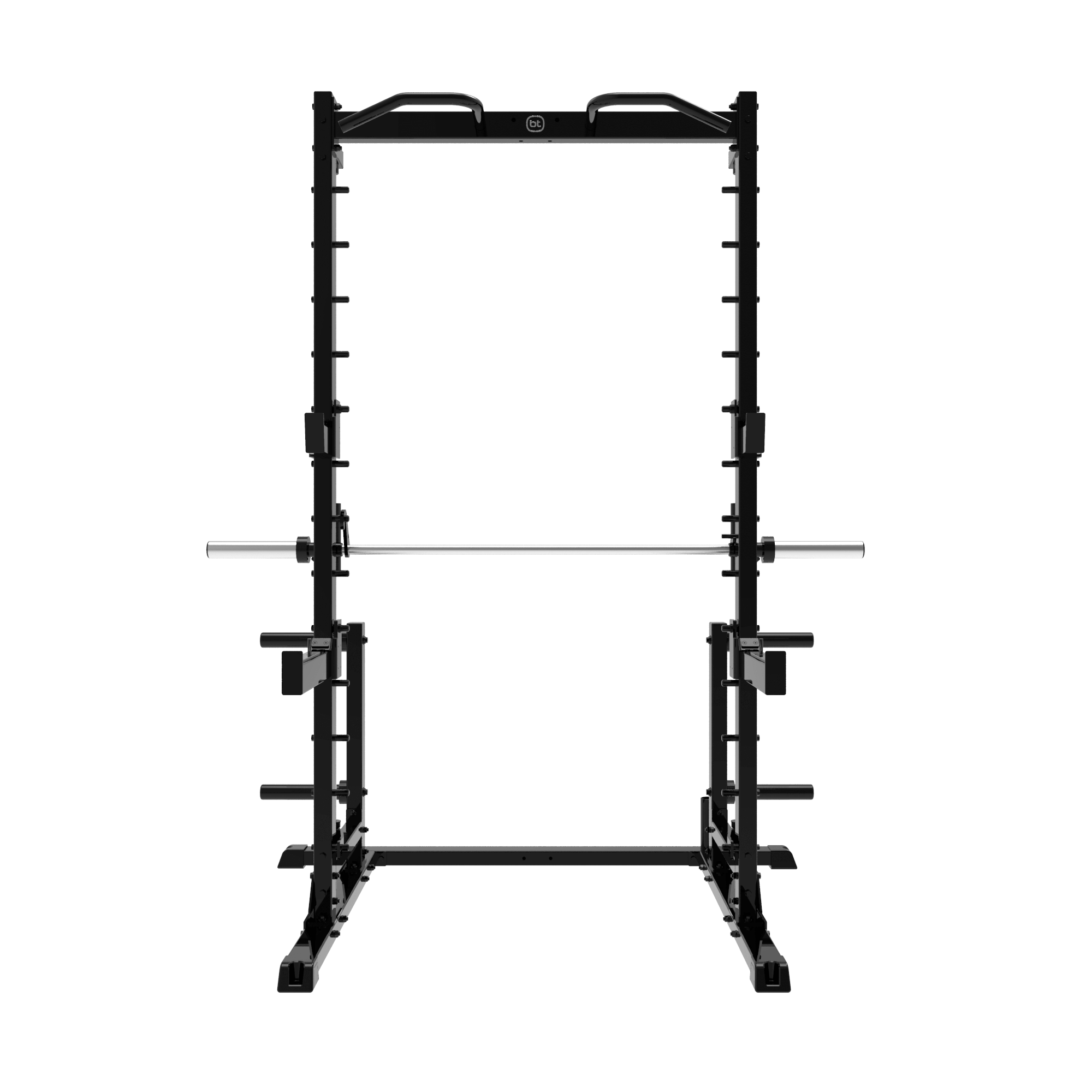
Anchoring a cross training rig, a street workout structure or a wall-mounted frame is a structural design task, not an installation detail. The short answer for most projects: chemical (bonded) anchors into sound concrete of at least 100 mm thickness, embedment of 80 to 110 mm depending on stud diameter, and a cure time of anywhere between 45 minutes and 24 hours depending on resin chemistry and substrate temperature. Mechanical expansion anchors are faster but tolerate dynamic and cyclic loading far less well, which is exactly the loading a pull-up bar or a punch bag produces.
Why the load case is the starting point
Training structures do not apply static loads. A kipping pull-up, a muscle-up, a bar drop into a rig-mounted catcher or a 40 kg punch bag under a combination all generate cyclic, off-axis, impulsive loads. Fixings that are perfectly adequate for a static shelf bracket loosen progressively under that regime.
Three quantities should be established before any fixing is specified:
- Tension (pull-out) load at each fixing point, including dynamic amplification.
- Shear load, which dominates on wall-mounted frames and on baseplates resisting a horizontal push.
- The moment generated by the structure geometry, which is what converts a modest user load into a large pull-out force at the rear baseplate bolts of a tall, narrow frame.
The manufacturer’s installation manual should state these values per fixing point. If it does not, that is a supplier question to resolve before the order, not after delivery.
Chemical anchors: the reference for dynamic loads
A bonded anchor transfers load through resin along the full depth of the hole rather than through radial expansion pressure. That has four practical consequences:
- No expansion stress in the concrete, so the anchor can be placed closer to a slab edge or another anchor without splitting the substrate.
- Better performance in cracked concrete, provided the resin holds an assessment covering cracked concrete use.
- Higher and more predictable resistance to cyclic loading, which is the decisive property for training structures.
- Tolerance of hollow and perforated substrates when used with a sleeve, which mechanical anchors do not offer at all.
Specify a resin holding a European Technical Assessment (ETA) covering the intended use, and check that the assessment explicitly includes seismic or fatigue categories if the project requires them. Design in Europe is carried out to EN 1992-4, the Eurocode covering the design of fastenings for use in concrete; outside Europe, ACI 318 Chapter 17 is the equivalent reference. Anchors specified without reference to either are being specified by habit.
Cure time is a real project constraint
| Substrate temperature | Typical gel time | Typical full cure before loading |
|---|---|---|
| Above 20 degrees C | 4 to 6 minutes | 45 minutes to 2 hours |
| 10 to 20 degrees C | 10 to 15 minutes | 2 to 6 hours |
| 0 to 10 degrees C | 25 to 45 minutes | 8 to 24 hours |
| Below 0 degrees C | Winter-grade resin only | 24 hours or more; many resins are not approved at all |
These are indicative ranges. Always work from the resin manufacturer’s data sheet for the specific product and the measured substrate temperature, not the air temperature. Winter installation on an outdoor site is the single most common cause of under-strength anchors, because the concrete is colder than the day feels.
Hole preparation decides the result
Bonded anchor performance is governed by hole cleanliness more than by any other installation variable. Drill dust left in the hole can reduce pull-out capacity by more than half. The sequence is blow, brush, blow, repeated, with a brush of the correct diameter, or a hollow drill bit with dust extraction, which removes the step entirely and is worth specifying on any project with more than a few dozen fixings.
Mechanical anchors: where they are still appropriate
Through-bolts, wedge anchors and drop-in anchors install immediately with no cure time, which matters on a tight programme. They are appropriate for:
- Sound, uncracked concrete of at least 100 mm thickness, and preferably more.
- Predominantly static loads: equipment that is bolted down to prevent movement rather than to resist repeated pull-out.
- Positions well away from slab edges and from other anchors, because expansion pressure needs surrounding concrete to react against.
They are the wrong choice near an edge, in a thin or cracked slab, in hollow block, in a screed topping, or anywhere the structure will be loaded dynamically. A wedge anchor in a 60 mm screed over insulation is not a fixing; it is a decoration.
Substrate by substrate
| Substrate | Recommended fixing | Key check |
|---|---|---|
| Structural concrete slab, 150 mm or more | Chemical anchor, threaded stud, grade 8.8 or stainless | Verify slab thickness and reinforcement position before drilling |
| Concrete slab, 100 to 150 mm | Chemical anchor with reduced embedment per the ETA | Edge distance and anchor spacing; consider a spreader plate |
| Screed over insulation | None. Break out to the structural slab, or use a ballasted freestanding structure | Establish the build-up before pricing the installation |
| Hollow block or perforated brick | Chemical anchor with mesh sleeve | Reduced design values; a specific ETA for the substrate is required |
| Timber floor or joisted structure | Through-bolted with back plates, subject to a structural assessment | Many rigs simply cannot be fixed to timber; a new concrete pad may be required |
| Ground, outdoor installation | Cast-in bolts or chemically anchored studs into a designed concrete foundation block | Block dimensions from the manufacturer drawing, matched to ground bearing capacity |
Outdoor structures: foundations and baseplates
Outdoor street workout structures, ninja frames and obstacle courses are anchored onto designed concrete foundation blocks, dimensioned according to EN 16630 for permanently installed outdoor fitness equipment, or EN 1176 where the installation is a play area and EN 16899 for obstacle and ninja-type equipment. The manufacturer supplies a foundation drawing giving block dimensions, concrete grade and reinforcement; the site is responsible for verifying ground bearing capacity and drainage.
Three details separate installations that last from installations that do not:
- Galvanised or stainless baseplates and studs. A galvanised structure on plain steel studs corrodes at the joint within a few winters. Within 3 km of a coastline, or where de-icing salt is used, specify grade 316 stainless throughout.
- Foundation top level below finished surface. The concrete block should sit below the impact-attenuating surface so no hard edge is exposed within the free fall zone.
- Drainage and post protection. Standing water at the baseplate is what actually kills outdoor structures.
Our outdoor gym installation guide covers the site sequence, and our street workout structures section shows the configurations these foundations support.
Testing and records
For public and commercial installations, proof testing of a sample of anchors is normal practice and is often required by the client or the insurer. A typical regime is to test 5 to 10 per cent of anchors to a defined proof load, with a pass criterion of no measurable displacement, and to record the results with the resin batch numbers, the substrate temperature and the installer’s details. Those records, together with a documented periodic inspection schedule, are what an operator needs when a claim is made. Our rig anchoring and maintenance guide sets out the inspection intervals to hold records against.
Frequently asked questions
How long does a chemical anchor take to cure?
Between 45 minutes and 24 hours depending on the resin chemistry and, critically, the substrate temperature rather than the air temperature. Always work from the manufacturer’s data sheet for the specific product, and never load an anchor before the stated full cure time; a partly cured anchor may feel solid and still fail well below its design value.
Can a rig be fixed to a timber floor?
Only after a structural assessment. Through-bolting with load-spreading back plates under the joists is the usual approach, and many rigs cannot be fixed to timber at all because the pull-out and moment values exceed what the floor structure can carry. The alternatives are a new concrete pad or a ballasted freestanding configuration.
What drilling depth does a cross training rig need?
Typically 80 to 110 mm depending on stud diameter, into concrete of at least 100 mm thickness. The controlling figure is the embedment depth stated in the manufacturer installation manual and in the anchor’s European Technical Assessment, and it varies by product; do not transfer a value from one project to another.
Chemical or mechanical anchors for a punch bag frame?
Chemical, without qualification. A punch bag applies a repeated, swinging, off-axis load, which is the load case mechanical expansion anchors handle worst. Bonded anchors also allow fixing nearer to slab edges, which is often unavoidable in the corner positions where bag frames end up.
Who is responsible for the anchoring design?
The equipment manufacturer provides the fixing loads, the baseplate details and the foundation drawing. The client or their engineer confirms that the existing structure or the ground can accept those loads. Where a supplier installs, that responsibility should be set out explicitly in the contract, because it is the interface where disputes arise.
Planning an installation? Light In Fitness manufactures steel and stainless steel training structures and supplies indoor rigs across Europe and export markets, with fixing loads, foundation drawings, anchoring specification and installation included in every project. Send us the substrate details and the site conditions and we will return a costed proposal. Request a quote.
Réalisations documentées
- Cage street workout ultime, Carcassonne – armée française
- Cage street workout ultime, Tahiti – armée française, Polynésie
- Cage SP Max, centre EPIDE de Combrée – établissement public d’insertion
- Cage SP Max, lycée Saint-Bénigne de Dijon – établissement scolaire
Sources et références
- NF EN 16630 – modules fixes d’entraînement physique de plein air : exigences de sécurité et méthodes d’essai (AFNOR)
- Code du sport, article L322-2 – garanties d’hygiène et de sécurité des établissements d’activités physiques et sportives (Légifrance)
À lire aussi sur le même thème
- Cross-training rigs: compare import and manufacturer quotes
- Medicine ball, wall ball ou slam ball : laquelle choisir
- CrossFit Training: Principles, Benefits and Box Equipment
- Rangement du matériel d’une salle de sport : solutions par zone et budget
- Outdoor Fitness Equipment on Military Bases: A Strategic Tool for MWR and Sports Directors