Outdoor gym installation: groundworks, surfacing and handover
Une aire de fitness en accès libre répond à une demande de pratique gratuite et sans contrainte d'horaire, dans les parcs, esplanades, campus et bases de loisirs. Elle relève de la norme EN 16630 et suppose un sol amortissant conforme sous les agrès concernés. Le projet se pilote sur l'implantation, le matériau et le plan de maintenance, avant le catalogue.
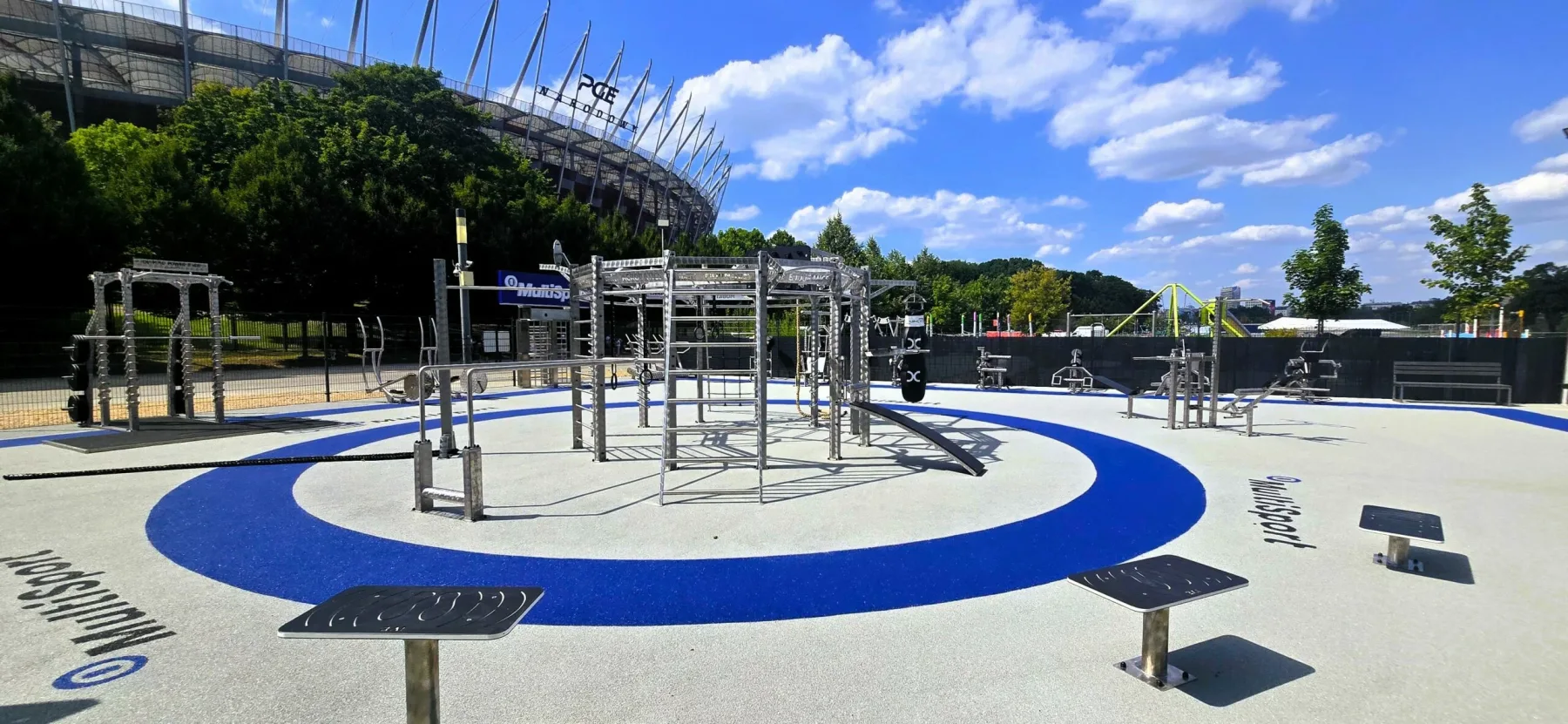
On an outdoor fitness area, the groundworks and the surfacing decide the service life of the installation, and they regularly account for 25 to 40 percent of the total budget once excavation is included. The equipment is the visible part of the project and the easy part to specify. What fails at three years is almost always drainage, a poorly compacted sub base or foundations that did not follow the manufacturer’s instructions. This guide covers the installation sequence, the surfacing decision and the specification clauses that protect the client.
Which standard actually applies? EN 16630, EN 1176 or free access
Most specifications get this point wrong, yet it drives everything else in the project: the surfacing, the clearance zones, the signage and the operator’s liability.
| Type of equipment | Reference standard | Intended users |
|---|---|---|
| Outdoor fitness, street workout, calisthenics, adult trim trails | EN 16630 — permanently installed outdoor fitness equipment | Teenagers and adults, unsupervised free access |
| Children’s playgrounds | EN 1176 and EN 1177 | Children under 14 |
| Parkour modules | EN 16899 | Free sports practice |
| Pump tracks and skateparks | EN 14974 | Bikes, scooters, skateboards, rollers |
| Structural strength of outdoor frames (complementary US reference) | ASTM F3101 | Often required on demanding tenders |
In France, market surveillance authorities (DGCCRF) specifically check that equipment intended for older users — outdoor training modules and free-access fitness areas — cannot be mistaken for playground equipment. If your project places a children’s playground next to a fitness plateau, you need two physically separate zones, two sets of signage and two standards applied separately.
EN 16630 covers design, materials, entrapment risks, structural integrity and clearance zones for free-access fitness equipment. Its threshold for mandatory impact-attenuating surfacing is higher than on a playground — so applying EN 1177 rules by default to a zone that is not governed by them needlessly inflates the surfacing budget. Have the applicable thresholds confirmed by your supplier against the current version of the standard.
To turn all of this into contract clauses, see our guide to public procurement and EN 16630 and the broader guide for public-sector sports equipment purchasing.
The six stages of an outdoor fitness project
Define the users first. Identify who the site is really for, whether young people, families, older adults or trained athletes, along with the available area, the capital budget and the objective, whether public health, attractiveness or social cohesion. An area designed for everyone without arbitration is rarely used by anyone.
Choose the location second. Favour a visible, walkable and well served position: a park, a riverside path or an esplanade. Check the bearing capacity of the ground, buried services, the feasibility of lighting and the solar orientation, since a stainless bar in full sun becomes hot in summer.
Design the scheme third, with a site survey, a layout, the equipment selection and a detailed costing. A three dimensional layout is also a useful document for a funding application or a committee presentation.
Write the specification fourth. On a public contract, the technical specification determines the quality of what you receive, and the clauses that matter are listed further down this page.
Install fifth. Delivery and assembly by specialist teams, with foundations, that is concrete blocks, depth and section, strictly following the manufacturer’s instructions. This is the item where savings are paid back most expensively. Site access and lifting equipment must be arranged in advance.
Hand over sixth. Exercise panels, safety instructions, the contact details of the operator, and optionally codes linking to instructional videos. Good signage increases real use and reduces misuse. Collect the as built file, the handover report and open the maintenance record on day one.
Choosing the outdoor surface
The surface has to do four things at once: attenuate impact where equipment creates a fall risk, drain, resist frost and ultraviolet exposure, and stay maintainable.
| Solution | Usual thickness or depth | Where to use it | Point to watch |
|---|---|---|---|
| Outdoor rubber tiles | 30 to 50 mm depending on fall height | The standard under rigs, bars and outdoor machines | Substrate flatness, joint integrity, perimeter anchoring |
| Rubber pavers | Per reference | Circulation routes, paths, links between modules | Less attenuating, so keep them outside fall zones |
| Graded wood chips | 30 cm, or 40 cm in intensive use | Fitness trails in wooded settings, economical alternative | Regular regrading, material displacement, hygiene monitoring |
| Wet pour rubber | According to the required critical fall height | Urban sites with heavy use and design requirements | Installation quality is decisive, localised repairs stay visible |
| Artificial turf | According to use | Sprint lanes, sled work, cross training areas | Does not replace attenuating surfacing under a tall structure |
Where attenuating surfacing is required, it is the critical fall height of the surface, determined by the head injury criterion test to EN 1177, that must be at least equal to the free fall height of the equipment. Thickness alone is never the proof: two surfaces of identical depth can attenuate very differently.
The three technical points that decide ten year durability
None of these appear on a product data sheet, and all three are settled during groundworks.
Drainage. Standing water under the surface is the primary cause of degradation on any outdoor installation. Falls, a perimeter drain and a free draining sub base are handled at excavation stage and cannot be retrofitted.
Bearing capacity of the sub base. A surface laid on poorly compacted fill separates within one or two winters, and the joints then open irreversibly.
Edge restraint. A kerb or edge anchor stops the surface from creeping under frost cycles and foot traffic. On tiled surfaces it is what keeps the joints closed over time.
Specification clauses that protect the client
A generic specification produces offers that cannot be compared and, frequently, awards the contract to the cheapest and most fragile bid. The clauses below make the difference.
| Clause | What to write |
|---|---|
| Standard | EN 16630 cited explicitly for outdoor fitness equipment, with a conformity certificate from a third party body rather than a self declaration |
| Materials | Hot dip galvanised then powder coated steel, or stainless steel 304 as a minimum and 316L on coastal sites; state the minimum wall thickness of load bearing tubes and main posts |
| Finish | UV resistant epoxy coating with a non fading warranty expressed in years |
| User load | Maximum load per station, stated in kilograms |
| Temperature | Operating temperature range and maximum surface temperature of accessible parts under direct sun |
| Surfacing | Type, thickness, required critical fall height, laying method and treatment of drainage |
| Groundworks | Who carries out the excavation and the concrete foundations, and over what area. This is the number one source of variations. |
| Spare parts | A commitment on availability over a defined period, and the replenishment lead time |
| Handover file | As built drawings, technical data sheets, declarations of conformity and a blank maintenance record supplied at handover |
| Warranties | Completion warranty and manufacturer warranties, stated separately and quantified in years |
Sizing the area and budgeting the full scope
| Format | Area | Typical composition | Typical client |
|---|---|---|---|
| Small area, 2 to 4 modules | 50 to 100 m² | Compact rig or outdoor machines, wall bars, tiled surfacing under the use zones | Small municipalities, school grounds, residential schemes, campsites |
| Medium area, 4 to 8 modules | 100 to 300 m² | Street workout rig, outdoor machines, wall bars, benches, full rubber tile surfacing | Mid sized municipalities, neighbourhood parks, campuses |
| Large park, 8 to 20 or more modules | 300 to 1 000 m² and above | Full street workout park, parkour or ninja section, outdoor machines, complete surfacing | Large municipalities, leisure parks, groups of authorities |
The same number of modules can vary by a factor of three depending on the surface, the excavation and site access, which is why a fixed price grid is misleading. What is stable is the list of items to cost, and the ones most often forgotten are the ones that produce variations later: excavation, drainage and kerbs; concrete foundations; transport and lifting equipment; signage and exercise panels; associated street furniture such as benches, bins and lighting; and the handover file itself.
Frequently asked questions
Which standard applies to outdoor fitness equipment?
EN 16630 covers permanently installed outdoor fitness equipment. It is a different standard from EN 1176, which covers children’s playgrounds, and from EN 16899 for parkour equipment. A site that mixes uses needs distinct zones with their own signage.
Is attenuating surfacing always required?
It depends on the free fall height of each piece of equipment. Where it is required, the surface must have a critical fall height at least equal to the free fall height, established by test rather than by thickness.
Who should carry out the foundations?
Whoever is named in the specification, which is precisely why the clause must exist. Foundation depth and section follow the manufacturer’s instructions without adaptation, and the scope of the excavation should be defined before tenders are issued.
What material should be used on a coastal site?
Stainless steel takes over from galvanised steel in salt spray environments, with 316L specified for direct coastal exposure. The grade has to genuinely match the exposure rather than simply appear in the offer.
How long does an installation take on site?
It depends on the groundworks rather than on the equipment. Excavation, foundations, curing time and surfacing installation dominate the programme, and site access for lifting equipment should be confirmed before the delivery date is fixed.
Plan your outdoor fitness installation with Light In Fitness
Light In Fitness has supplied outdoor sports and fitness equipment from Tours, France since 2013, working to EN 16630, EN 1176 and EN 1177, with 316L stainless steel available for coastal projects and more than 2 000 references in the catalogue. We survey the site, produce the layout, cost the full scope including groundworks and supply the handover documentation.
See our outdoor gym equipment and street workout rigs, or request a quote and receive a costed proposal within 24 working hours.
Réalisations documentées
- Cage street workout ultime, Carcassonne – armée française
- Cage street workout ultime, Tahiti – armée française, Polynésie
- Cage SP Max, centre EPIDE de Combrée – établissement public d’insertion
- Cage SP Max, lycée Saint-Bénigne de Dijon – établissement scolaire
Sources et références
- Décret n° 96-1136 du 18 décembre 1996 – prescriptions de sécurité relatives aux aires collectives de jeux (Légifrance)
- NF EN 1176-1 – Équipements et sols d’aires de jeux, partie 1 : exigences de sécurité et méthodes d’essai générales (AFNOR)
- NF EN 1177 – revêtements de surface amortissants : détermination de la hauteur de chute critique (AFNOR)
- NF EN 16630 – modules fixes d’entraînement physique de plein air : exigences de sécurité et méthodes d’essai (AFNOR)