How to Choose Free Weights: Dumbbells, Kettlebells and Plates
Dumbbells, kettlebells and plates look like the simplest purchase in a gym project, and they are the one most often got wrong. Buy too narrow a range and half your members cannot train; buy too wide a range and you have paid for weights that sit untouched. This guide sets out how to build a free-weight area for a commercial facility: which families do what, how to size the range, and what has to be budgeted alongside the weights themselves.
What free weights bring to a facility
Free weights cover the movement patterns that guided machines cannot reproduce. Because nothing stabilises the load for the user, the trunk, the shoulder girdle and the small stabilising muscles work on every repetition. That is what makes a free-weight area the part of the gym that experienced members come for, and it is why a strength offer without one is judged incomplete however good the machines are.
They are also the most flexible equipment in the building. A single rack of dumbbells serves a beginner’s shoulder rehabilitation and an advanced member’s pressing session on the same afternoon, from chest and back through arms, trunk, legs and glutes. Per square metre and per euro, nothing else in a gym covers as many exercises.
Matching the range to your users
The starting point is not a catalogue but your membership. A club with a large beginner intake needs depth in the light and middle weights, where most sets actually happen. A strength-focused gym or a cross-training box needs the heavy end and duplicated pairs, because two people will want the same weight at the same time.
Three practical rules make the decision easier. Cover the light and middle range continuously, because those are the weights in constant use. Duplicate the most requested pairs rather than extending the top end. And keep the increments close together in the light range, where a jump of several kilos is a jump a beginner cannot make.
Choosing between the three families
Dumbbells
Dumbbells are the backbone of an upper-body offer: pressing, rowing, curls, lateral work and unilateral exercises that reveal and correct left-right imbalances. They also serve trunk and lower-body work, and they load bodyweight exercises when a member holds one during a plank or a lunge.
For a facility, fixed dumbbells in a full rack are almost always the right answer rather than adjustable sets: they are faster between sets, they survive being dropped and they cannot be reassembled incorrectly by a member. Our professional dumbbell range covers the usual commercial specifications.
Kettlebells
Kettlebells suit dynamic, functional movements: swings, cleans, presses and carries. The offset centre of gravity is what distinguishes them from a dumbbell and what makes them the tool of choice for ballistic work and for conditioning circuits.
Choose weights that let a user complete a full set with correct technique, which in practice means a wider spread of light and middle weights than most buyers expect. Competition kettlebells keep the same dimensions across every weight, which is why coached groups prefer them: the technique does not change as the load goes up. See the kettlebells range.
Plates
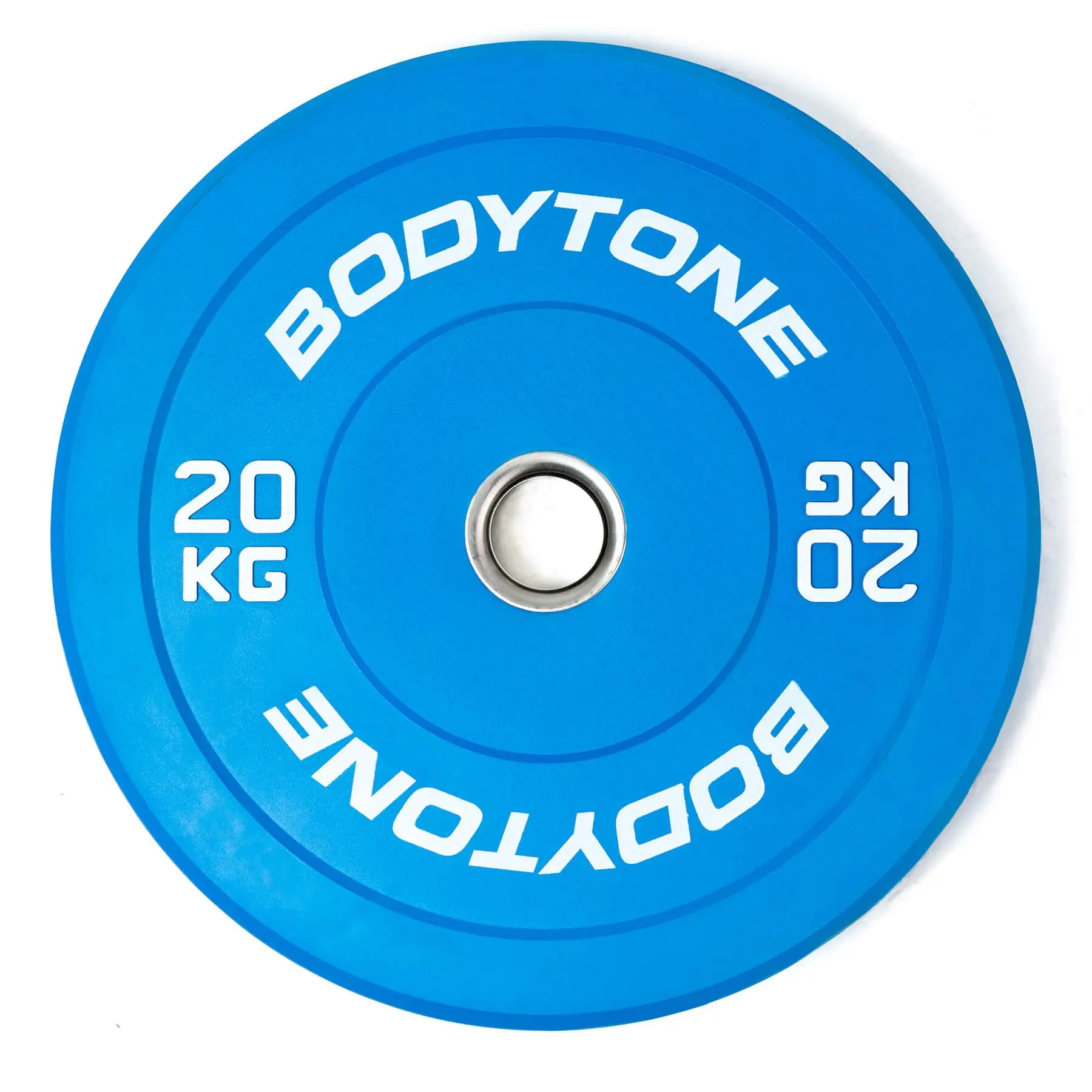
Plates load a barbell for the compound lifts: squats, deadlifts, presses and pulls. Two points decide the specification. First, the plates must match the bar: Olympic plates fit Olympic bar sleeves and standard plates do not, so the bars and the plates are specified together rather than separately. Second, cast iron and rubber-coated plates suit loaded lifts that are set down under control, while bumper plates are what you need wherever a loaded bar may be dropped from height, as in weightlifting and cross-training.
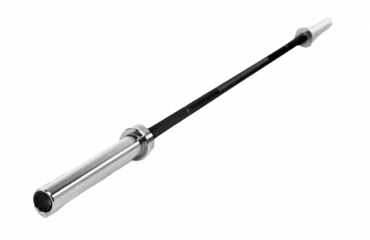
Bars are part of the same decision: shaft finish, knurling and the intended use of the platform all matter. See Olympic barbells.
Sets, repetitions and how they shape the range
The training your members actually do determines which weights get used. As a general guide, heavier loads for around six to eight repetitions are used for mass and strength work, while lighter loads for around twelve to fifteen repetitions are used for muscular endurance and toning sessions. A facility whose classes and coaching lean towards the higher repetition ranges will burn through the light and middle weights and barely touch the top of the rack, and the purchase should reflect that.
What has to be budgeted alongside the weights
- Storage. Dumbbell racks, kettlebell stands and plate trees are not accessories. Unracked weights are the main cause of injuries and of damaged floors in a free-weight area, and organised storage is what keeps the zone usable at peak times.
- Flooring. Heavy-duty rubber flooring protects the slab, the weights and the acoustics of the building. Lifting areas need a specification suited to dropped loads.
- Benches and racks. An adjustable bench and a rack turn a set of weights into a complete training area, and they are what allows a member to train heavy safely.
- Circulation. Free-weight zones need more floor area per user than machine areas. Plan the space around the racks, not just the racks.
Safety in a supervised area
A warm-up before loaded work, correct technique before added load, and a spotter or safety bars for heavy pressing are the three habits worth reinforcing with members and instructors. On the operator side, inspect handles, welds and coatings periodically, replace damaged plates rather than keeping them in circulation, and make racking weights after use a house rule rather than a request.
Frequently asked questions
Fixed or adjustable dumbbells for a gym? Fixed, in a rack. Adjustable sets are slower between sets and can be misassembled by users, which makes them unsuitable for an unsupervised commercial floor.
Will any plate fit any bar? No. Olympic plates fit Olympic bar sleeves and standard plates do not. Specify bars and plates together to avoid a delivery that cannot be used.
Bumper plates or cast iron? Bumper plates wherever a loaded bar may be dropped, such as weightlifting and cross-training platforms. Cast iron or rubber-coated plates for controlled lifts on a conventional floor.
How many kettlebells does a class need? Enough for the largest class you run, in the light and middle weights that most participants will use, plus a few heavier pieces. Sizing that is part of the quotation.
Specifying your free-weight area
Tell us the size of the zone, the profile of your members and the classes you run, and our team will return a complete free-weight specification: weight ranges and quantities, storage, benches, racks and flooring, drawn on your own plan and costed. Request a quote and we will build the list with you.