How to Choose Rubber Flooring Density for Shock Absorption

Choosing the right density of rubber flooring matters more than most buyers expect. Density influences durability and abrasion resistance, but it also influences how much impact the floor absorbs, how it sounds, and how it feels underfoot. Get it wrong and you either buy a floor that wears out early or one that transmits every dropped weight into the structure below.
This guide explains what density actually means for a rubber floor, how it interacts with thickness, and how the specification changes between a gym, a sports surface and a play area.
What density means
In rubber flooring, density refers to the mass per unit volume of the material, usually expressed in kilograms per cubic metre.
As a general rule, the higher the density, the more resistant the surface is to impact and abrasion. But density is not a free good. A denser floor is firmer, so it is less forgiving underfoot and, past a certain point, it stops absorbing impact and starts transmitting it. The right answer is always a compromise between resistance and absorption, and the compromise point depends entirely on what happens on top of the floor.
Density and thickness work together
Density on its own tells you very little. It is the combination of density and thickness that determines behaviour, and the two are traded against each other.
A thicker floor generally absorbs impact better, but the composition matters as much as the dimension. Tiles and rolls behave differently: a roll can be thinner and still cushion well because it is more flexible over its length, while a tile is often specified thicker, which also makes it the better answer where impact noise into the rooms below is the problem.
This is why comparing two products on density alone is misleading. Compare them on what they are specified to do.
Different applications, different densities
Three typical cases, and they call for three different specifications.
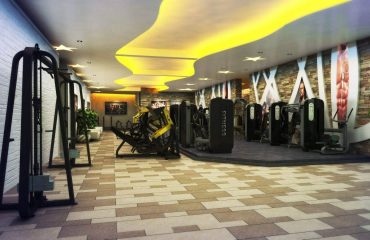
Gym and strength floors. Here the floor has to absorb dropped load, protect the slab, cut noise and survive being dragged across by racks and benches. A dense rubber surface is the answer, and in a weightlifting area a purpose-specified tile is worth the extra cost because that is the one place where the floor takes repeated, concentrated impact. See the rubber gym flooring tile range and the rubber flooring roll range.
Sports surfaces. A sports floor has to absorb impact and return energy, which is a different requirement from simply damping it. Here the surface is usually specified with an underlay rather than by increasing density alone, because the underlay does the absorbing while the surface handles wear and grip.
Children’s play areas. This is the case where density is the wrong question entirely. Impact-attenuating surfacing under play equipment is governed by EN 1177, and what matters is the tested critical fall height of the system, not its density or its thickness taken in isolation. The equipment itself falls under EN 1176-1. Specify the surfacing against the free height of fall of the equipment and ask for the test documentation. See the playground surfacing range.
Acoustic and thermal performance
Density also affects insulation. In rooms where impact noise into the space below is a concern, and in a gym above occupied rooms it always is, the combination of density and thickness is what determines how much of a dropped weight the neighbours hear.
Where the acoustic requirement is significant, an acoustic underlay under the finished surface usually does more than a denser surface layer would, and it does it without making the floor uncomfortable to train on. See the acoustic underlay range.
Maintenance and service life
Density affects how easy the floor is to keep. Denser surfaces are less porous and generally simpler to clean, which matters in a facility cleaned several times a day.
Whichever format you choose, tiles, rolls or mats, specify against abrasion resistance and ease of cleaning as well as absorption. A floor that performs perfectly and cannot be cleaned economically is a floor you will replace early.
Frequently asked questions
Is a denser rubber floor always better?
No. Higher density improves resistance to impact and abrasion, but it also makes the floor firmer and past a point it transmits impact instead of absorbing it. The right density depends on the use.
Tiles or rolls?
Rolls suit large continuous areas and give fewer joints. Tiles suit areas that need to be lifted, replaced or reconfigured, and are usually the answer where impact noise has to be controlled.
Which standard applies to playground surfacing?
EN 1177 governs the impact-attenuating surfacing and its tested critical fall height; EN 1176-1 governs the play equipment itself. They are separate standards and neither substitutes for the other.
Does the floor go in before or after the equipment?
Before. Fitting flooring around installed equipment costs more, looks worse and leaves joints exactly where load is heaviest.
Specifying your floor
The specification follows from the use, the substrate and what is underneath the room. Tell us the surface area, what happens on it and what is below it, and we will come back with a flooring specification and a costed proposal: request a quote.
Light In Fitness has supplied professional and public sites since 2013, from gym floors to sports surfaces and play areas.
Réalisations documentées
- Dalles et sols sportifs : livraisons documentées – plusieurs chantiers
- Sol sportif extérieur, square Georges-Vallerey – Taverny (95)
À lire aussi sur le même thème
- Rubber flooring for shops, hotels and restaurants: comfort, safety, design and compliance
- Bodytone Equipment for Rehabilitation and Physiotherapy: Choosing, Setting Up, Using and Maintaining
- Comment choisir sa protéine en poudre selon son objectif ?
- How to Choose an Effective Fat Burner: What Operators Should Know