Olympic barbell colours and specifications: building a coded barbell fleet
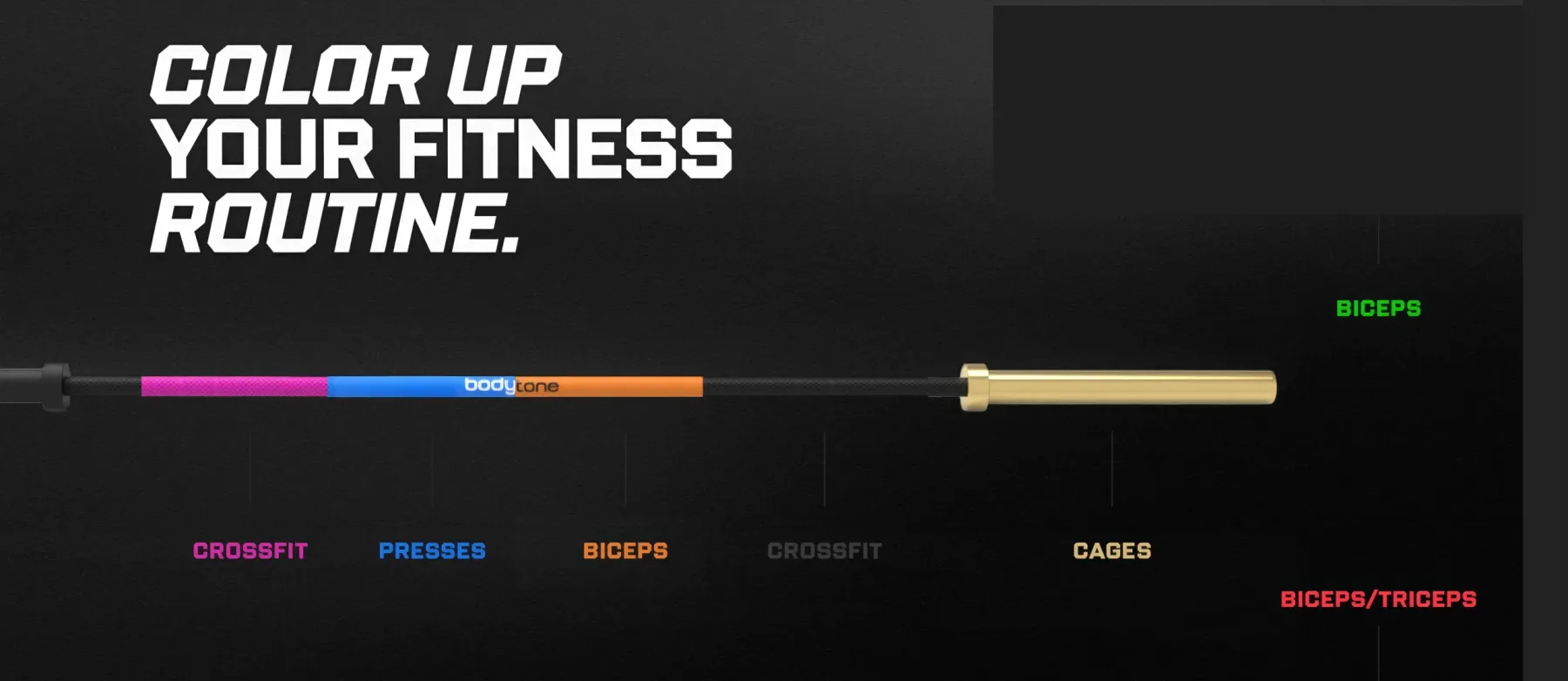
Colour on an Olympic barbell is not decoration when a facility runs a shared floor: it is the fastest way for staff and members to identify weight, length and intended use at a glance. The COLORS-BARS range from Light In Fitness by Bodytone applies that logic across eight models, from a 10 kg teaching bar to a 25 kg hex bar, all forged in 42CrMo steel. This guide sets out the specifications, the coatings, the applicable standards and how to combine models into a coherent fleet.
What makes an Olympic bar more than a steel tube
All COLORS-BARS models are forged in high resistance 42CrMo steel rated to 190,000 PSI tensile strength, the same industrial grade used in precision mechanics and aerospace. In practice that rating is what allows a bar to absorb repeated drops without permanent deformation and to return to its original shape rather than taking a set. CNC precision welding governs the balance between sleeves and shaft, which is what a lifter feels as stability at the moment the bar is racked.
Rotation comes from 4 to 10 NK or HK bearings depending on the model, or from copper bushings on the weightlifting specification. More bearings suit explosive movement with minimal friction; bushings give the controlled, progressive rotation weightlifters expect under the clean and the snatch. Neither is universally better, and the choice should follow the training programme rather than the specification sheet.
Coatings and what each one is for
| Coating | Property | Model |
|---|---|---|
| Black hard chrome | Robustness and abrasion resistance | DARK CORE |
| Blue QPQ finish | High corrosion resistance | CLOUD NINE |
| Gold finish | Premium appearance, individually treated | GOLDEN BOY |
| Hard chrome | Surface hardness and finish life | LIME SET |
All coatings are REACH compliant, meaning free of restricted heavy metals, which matters for facilities with procurement rules on substances of concern. Coating choice affects grip feel as well as corrosion resistance, so where a fleet mixes finishes, expect coaches to develop preferences by movement.
The eight models compared
| Model | Weight | Length | Grip diameter | Bearings | Primary use |
|---|---|---|---|---|---|
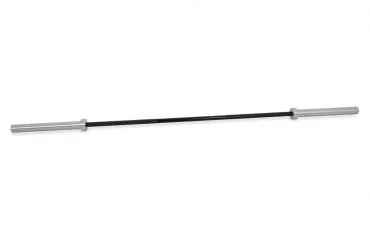
| DARK CORE, black | 20 kg | 2,200 mm | 28 mm | 10 NK | CrossFit, HIIT, functional training, competition |
| PINK SIN, pink | 15 kg | 2,000 mm | 25 mm | 8 NK | CrossFit and functional training at reduced joint load |
| CLOUD NINE, dark blue | 20 kg | 2,200 mm | 28 mm | 8, copper bushings | Weightlifting, competition |
| GOLDEN BOY, black and gold | 20 kg | 2,200 mm | 28 mm | 8 NK | Strength, weightlifting, technical work |
| SUN SET, orange | 12 kg | 1,500 mm | 25 mm | 4 HK | Technique, introduction, mobility |
| RED POW, red | 10 kg | 1,200 mm | 28 mm | Not applicable | Teaching, youth athletes, rehabilitation |
| LIME SET, green | 13.5 kg | 960 mm | 28 mm | Not applicable | Biceps and triceps isolation, curl bar geometry |
| BLACK HEX, black | 25 kg | 1,500 mm | 28 mm | Not applicable | Deadlift, shrugs, rehabilitation, injury prevention |
Sleeve diameter is 50 mm across the Olympic models, so all standard bumper and cast plates fit. The RED POW has 820 mm between sleeves and 175 mm of loadable length, sized for younger and smaller users while keeping a 28 mm Olympic grip so progression to a full bar needs no relearning of the hand position. The BLACK HEX has 610 mm between handles and 267 mm of loadable length; its hexagonal geometry keeps the centre of gravity in line with the lifter, reducing lumbar loading, which is why strength and conditioning coaches and sports physiotherapists use it as a deadlift substitute.
Choosing weight and length by population
A 20 kg bar at 2,200 mm is the reference for adult training across CrossFit, weightlifting and strength work. A 15 kg bar at 2,000 mm with a 25 mm grip suits lifters who need a smaller hand diameter and lower joint load without giving up Olympic geometry. A 12 kg technique bar at 1,500 mm is the right tool for teaching movement patterns and mobility work, and it prevents the common error of starting beginners on a bar they cannot control. A 10 kg bar at 1,200 mm covers school sport, youth athletes and rehabilitation.
The DARK CORE is specified to withstand repeated drops from 2 m without deformation, which is the criterion that matters most on a functional floor where bars are dropped from overhead many times a day. On a weightlifting platform, rotation quality under the second pull matters more than drop tolerance, which is why the CLOUD NINE uses copper bushings rather than a high bearing count.
Standards and testing
| Reference | What it covers |
|---|---|
| EN ISO 20957-2 | European standard for stationary strength training equipment: safety requirements and test methods |
| EN ISO 20957-9 | Mechanical strength and durability, long duration testing |
| CE marking | European conformity, user safety |
| REACH | Absence of restricted substances in coatings |
| Drop testing | 1,500 cycles at 220 cm, verifying deformation and rotation |
Each bar leaves the factory with an individual quality inspection. For a facility open to the public, ask for the conformity documentation at quotation stage: it is far easier to obtain before delivery than after an insurer or an inspector asks for it.
Building a coherent barbell fleet
A functional training floor working with mixed ability groups is usually best served by four complementary specifications rather than by multiples of one bar. A 20 kg bar for the main adult population, a 15 kg bar for smaller hands and lower joint load, a curl bar for arm isolation, and a hex bar for loaded carries, deadlifts and return to training work. Colour then does real operational work: coaches call a bar by colour across a noisy room, members return bars to the right rack, and stock checks take seconds.
Add a 12 kg technique bar for every group class that includes new lifters, and a 10 kg bar if the facility trains youth athletes or runs rehabilitation sessions. These are the two models most often omitted from a first order and most often added within the first year.
Frequently asked questions
What does the 190,000 PSI rating mean in practice?
It is the tensile strength of the 42CrMo steel used for the shaft. A higher rating means the bar resists permanent bending under load and returns to its original shape after flexing. On a floor where bars are dropped from overhead daily, it is the single specification most closely linked to service life.
Bearings or bushings for weightlifting?
Bushings, typically copper, give the controlled rotation weightlifters expect under the clean, snatch and jerk, and that is the CLOUD NINE specification. Higher bearing counts, up to 10 on the DARK CORE, suit explosive functional work where minimal friction and fast spin matter more.
What grip diameter should be specified?
28 mm is the standard Olympic grip and the reference for adult training. A 25 mm grip suits smaller hands and reduces the grip strength demand, which is why it appears on the 15 kg and 12 kg models. Keeping a 28 mm grip on the 10 kg teaching bar means young athletes learn the hand position they will use later.
Which bar suits rehabilitation and return to training work?
The hex bar, at 25 kg with 610 mm between handles, because the load line passes through the lifter rather than in front, reducing lumbar loading during deadlift patterns. Pair it with the 10 kg or 12 kg bars for technique work at very low load.
What lead times and warranties apply?
Light In Fitness returns quotations within 24 working hours and ships stock items in 5 to 10 working days, with warranties from 2 to 5 years depending on the range. Delivery covers France, Belgium, Switzerland and Luxembourg, with export quoted per project.
Specify your barbell fleet
Tell us your class formats, member profile and platform count, and we will return a bar mix with weights, lengths and coatings matched to each training zone. Request a quote within 24 working hours, or browse our Olympic barbells and CrossFit rigs.
Sources et références
- Code du sport, articles R322-4 à R322-43 – garanties d’hygiène et de sécurité applicables aux établissements d’activités physiques et sportives (Légifrance)