Reducing noise and vibration in a deadlift area with rubber tiles
La réduction du bruit en zone de soulevé de terre passe par une épaisseur de dalle importante, une désolidarisation du support et une plateforme dédiée. C'est la transmission solidienne, non le bruit aérien, qui génère les plaintes de voisinage. Un empilage dalle plus sous-couche est plus efficace qu'une dalle unique de même épaisseur totale.
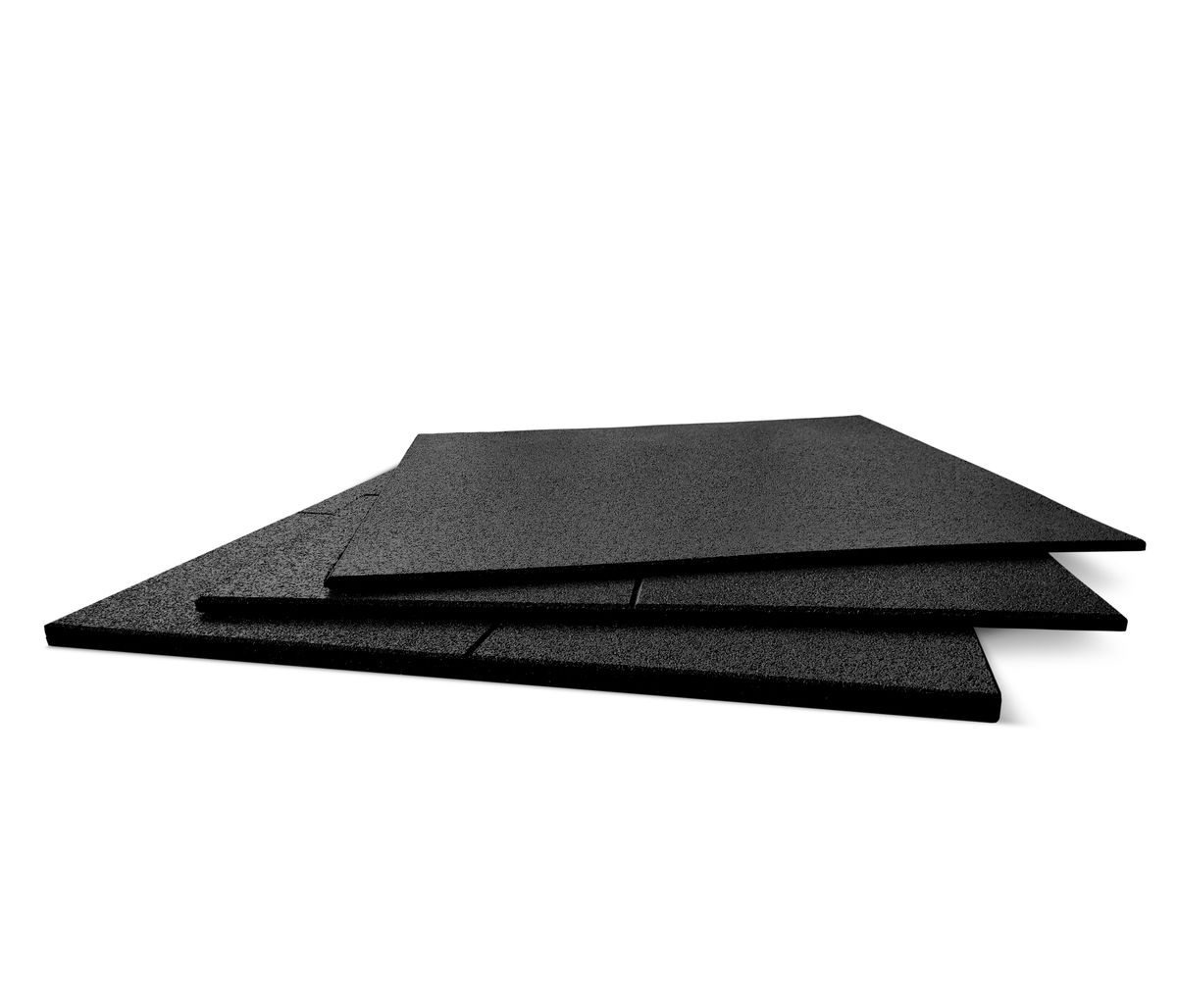
Cutting noise in a deadlift zone comes down to tile thickness, decoupling from the structure and a dedicated platform. It is structure-borne transmission, not airborne noise, that generates neighbour complaints. A tile plus underlay build-up outperforms a single tile of the same total thickness, and that single fact settles most of the specification.
This guide is for anyone specifying flooring for a free weight area, a lifting platform or a functional zone in a commercial venue: which thickness, which fire class, and when an underlay stops being optional.
Why rubber tiles in the first place
Rubber tiles are built to absorb impact and to cut impact noise: a bar coming down, dumbbells, kettlebells, heavy machines being moved. Their dense, resilient structure acts as a mechanical buffer, so less vibration reaches the slab and less energy resonates in the room.
They also protect what sits underneath. Concrete slabs, tiled floors and timber floors all suffer under repeated drops, and the tile is the cheapest sacrificial layer in the building. The variable that decides how well any of this works is thickness, chosen against the load, the frequency of drops, what sits below or beside the room, and the nature of the substrate.
Impact noise and structural vibration are two different problems
Noise in a weight room comes from two sources, and they are not solved by the same measure.
- Impact noise. The bar hitting the floor, dumbbells set down, plates moved across the room. This is what people in the room hear.
- Structural vibration. Waves travelling through the slab and the walls, sometimes reaching the floor below or the adjoining premises. This is what people outside the room complain about.
Tiles alone already remove a great deal of impact noise. Structural transmission is a different matter: the effective answer is to decouple the surface from the slab, by combining tiles with an acoustic underlay. In a multi-storey building, a venue with occupied rooms below, or a site with sensitive neighbours, that combination is not an upgrade, it is the baseline.
What to check on a tile specification
Thickness and density
Thickness drives shock absorption, the reduction of vibration transmission, protection of both the substrate and the equipment, and comfort in the room through lower reverberation. Density matters alongside it: two tiles of the same thickness and different densities do not behave the same under a dropped barbell.
Slip resistance
A tile has to stay stable, particularly in a heavy loading zone where lifters change stance under load.
Wear and compression resistance
This is the line that separates a commercial specification from a light one: high footfall, repeated loading and repeated impacts over years rather than months.
Fire classification
Venues open to the public, municipal facilities and many commercial buildings require a floor covering with a suitable reaction-to-fire classification. The relevant classes for these ranges are Cfl-s1, Dfl-s1 and Efl. The smoke index is part of the classification and must never be dropped or added when a class is quoted, so a specification asking for Cfl-s1 is not satisfied by a tile classified Efl. Check what the national building regulations applicable to your project require before you compare prices, because the class is often what decides the product.
Which thickness for a deadlift or free weight area
The following is a workable starting point, to be adjusted to the project and the budget.
| Use | Recommended | Objective |
|---|---|---|
| Multi-purpose room, moderate loads | 20 to 25 mm | Protection, comfort, reduced noise |
| Serious free weight area, intensive use | 25 to 40 mm | Stronger cushioning, less vibration |
| Heavy deadlift, frequent drops | 40 to 50 mm | Maximum absorption and protection |
| Upper floor, occupied rooms below, sensitive neighbours | Tiles plus underlay | Decoupling, limiting transmission |
Read the bottom row as a rule rather than an option. Once there is an occupied space underneath, adding thickness alone reaches its limit quickly, whereas decoupling keeps working.
Selecting by case
- Public venue with fire requirements. A 20 mm tile classified Cfl-s1, or a 20 mm tile classified Bfl-s1 where the specification is stricter.
- Solid all-rounder. A 25 mm Efl tile in the 100 by 100 cm format.
- Deadlift and weightlifting. A 40 mm Dfl-s1 tile, or a 50 mm SBR Efl tile where cushioning matters more than anything else. See the weightlifting rubber tiles range.
- Fire-classified projects. Start from the fire-rated rubber tiles and work back to thickness, not the other way round.
One note on adjacent standards, because they are regularly confused on specifications: impact-attenuating surfacing for children’s playgrounds is covered by EN 1177 and the play equipment itself by EN 1176-1. Neither applies to an indoor weight room floor, and neither substitutes for a reaction-to-fire class.
Installation and maintenance
Laying: the points that make the difference
- Prepare a clean, flat, dry substrate. Acoustic performance and tile life both depend on it more than on the tile itself.
- Take care with alignment and joints, so that micro-movements do not open gaps under load.
- In heavily loaded zones, add an underlay to reinforce the anti-vibration effect.
- On very large areas, a continuous solution in roll form can be the better answer, with fewer joints to maintain.
Maintenance
Regular cleaning is enough: vacuuming plus gentle washing. Expect questions in the first weeks after installation about odour and off-gassing; ventilation and appropriate cleaning are the practical answer, and the intensity depends on the formulation and the laying conditions.
What you gain beyond quiet
- Substrate protection. Fewer cracks, fewer marks, less damage to repair at the end of a lease.
- Thermal comfort. A surface that feels far less cold than a hard floor.
- Less reverberation. A calmer room, which coaches notice before members do.
- Safety. Better footing and fewer slips, depending on the surface finish chosen.
Frequently asked questions
What is the minimum thickness to reduce noise in a weight room?
In general 20 to 25 mm already improves acoustic comfort noticeably. For heavy deadlifting, aim at 40 to 50 mm instead.
Are tiles enough on an upper floor?
Often not, once there is an occupied space below. The reliable build-up is tiles plus underlay, because the problem there is structure-borne transmission rather than airborne noise.
What should a public-access venue choose?
Start from the reaction-to-fire class required by the building, then choose thickness within the products that hold that class. Doing it in the reverse order usually means re-specifying.
Do rubber tiles smell?
It can happen, depending on the formulation and the laying conditions. Ventilation during and after installation, plus appropriate cleaning, is the standard response.
Tiles or rolls?
Tiles are modular: easy to repair, easy to lay zone by zone, easy to extend later. Rolls suit large continuous areas and offer fewer joints. Most projects use tiles in the lifting zones and rolls in the open areas.
Specifying your floor
The efficient way to get a correct quotation is to start from the surface area, the loads, the substrate and the constraints: which floor level, what sits below, and what the building requires in terms of fire classification. From those four inputs the thickness, the underlay and the quantities follow. Request a quotation with your area, your load profile and your floor level, and the configuration can be built around them.
Réalisations documentées
- Dalles et sols sportifs : livraisons documentées – plusieurs chantiers
- Sol sportif extérieur, square Georges-Vallerey – Taverny (95)
Sources et références
- Arrêté du 19 avril 2011 – étiquetage des produits de construction ou de revêtement de mur ou de sol sur leurs émissions de polluants volatils (Légifrance)
- Ministère de la Transition écologique – étiquetage des produits de construction : classes d’émission A+ à C
À lire aussi sur le même thème
- Entraînement avec kettlebells – pourquoi s’entraîner avec des kettlebells est-il intéressant ?
- Strength Equipment: How to Choose Your Barbells and Dumbbells
- ZIVA pour les zones poids libres & entraînement fonctionnel : construire une zone belle, robuste et Instagram‑friendly
- Haltères et Poids Libres 2026 : Guide Complet pour Musculation