Dumbbell sets for gyms: how many pairs, what weights, which rack
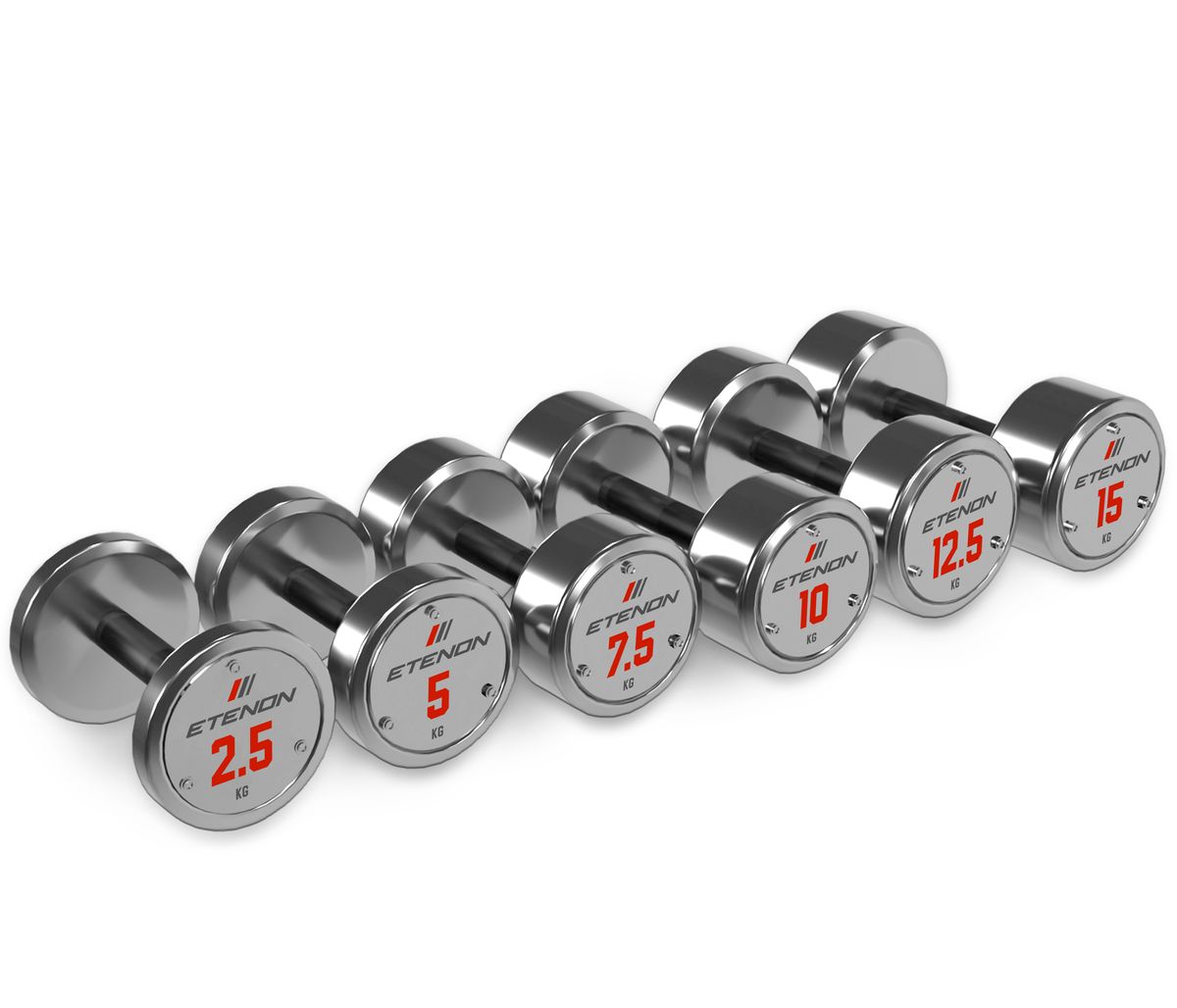
A dumbbell fleet is specified by weight range and pair count, not by total budget. A continuous range of 2.5 to 30 kg in 2.5 kg increments already covers the vast majority of commercial gym use. A small facility (hotel, workplace, studio) needs 8 to 10 pairs from 2 to 20 kg; a local club 12 to 14 pairs from 2.5 to 30 kg; a full service club 18 to 22 pairs from 2.5 to 50 kg, usually doubled on the light end. The most underestimated line is the rack: without properly sized storage, a dumbbell fleet degrades within a year. The forgotten constraint is floor loading, because a full range concentrates around a tonne of iron on a few square metres.
Range before quantity
The question we are asked is almost always the wrong way round: I need a set of dumbbells, what have you got? The right question is what the smallest and the largest dumbbell you must offer are. The pair count then follows mechanically, because the increment is a constant of the trade.
The bottom of the range determines your ability to convert beginners, female members, older users and people returning to activity. A gym starting at 5 kg effectively excludes part of its membership from shoulder and arm work. It is the most frequent error and the cheapest to correct, because the light weights are the least expensive in the set.
The top of the range determines your credibility with experienced members. Above 40 kg, use becomes marginal in a general commercial gym, but its absence is noticed immediately by the very members who generate your word of mouth.
The classic trap is the range gap. Many gyms buy a 5 to 30 kg set then top up piecemeal. The result is two finishes, two grip shapes, two suppliers and a rack that no longer accepts half the fleet. It is cheaper to define the target range from the start, even if you acquire it in two stages on the same model.
Pair count by facility type
| Facility | Recommended range | Pairs | Duplicates to plan |
|---|---|---|---|
| Hotel, residence, workplace wellness space | 2 to 20 kg | 8 to 10 | None |
| Coaching studio, small facility | 2 to 25 kg | 10 to 12 | Light weights if classes are run |
| Local fitness club | 2.5 to 30 kg | 12 to 14 | 2 to 5 kg doubled |
| Full service club | 2.5 to 50 kg | 18 to 22 | 5 to 15 kg doubled, sometimes tripled |
| CrossFit box | 5 to 35 kg | 10 to 14 | Systematic across the working range |
| Care home, rehabilitation, public facility | 1 to 10 kg | 6 to 10 | Doubled from 1 to 4 kg |
On increments, sector practice is stable: 2.5 kg steps up to 30 kg, then 5 kg above. Dropping to 1 kg steps is only worthwhile on the light end in rehabilitation and older-adult work. Moving to 5 kg steps from 20 kg, by contrast, creates a progression jump that members feel, particularly on arm isolation movements.
Round, hexagonal, rubber or urethane
| Type | Main advantage | Limitation in collective use | Best context |
|---|---|---|---|
| Hexagonal rubber | Does not roll, sits flat on the floor, controlled cost | Coating more vulnerable to repeated impact on bare concrete | Commercial gyms, boxes, multi-purpose facilities |
| Round rubber or urethane | Wrist rotation comfort, holds its appearance over time | Rolls if set down carelessly | Premium clubs, visible dumbbell zones |
| Round chrome or steel | Finish, compact on light weights | Noisy, marks the floor, slippery when hands are wet | Light ranges, hotels, design-led spaces |
| Adjustable dumbbells | Minimum footprint | Mechanism under load, adjustment time between sets | Small areas, individual use, rarely right in a club |
For intensive collective use our default recommendation is hexagonal rubber on the working weights, completed by a finer light range. As a reference on complete sets, the ZIVA XP urethane professional set of 20 pairs from 2.5 to 50 kg is 6,950 EUR excluding VAT.
The rack decides how long the fleet lasts
A dumbbell fleet without sized storage always degrades the same way: the most-used weights stay on the floor, members roll them with a foot, the coating chips, and the zone becomes an obstacle course nobody tidies. Four sizing rules apply.
Size the rack on the target fleet, not the initial one. If you plan to extend the range within 24 months, buy the rack for the final range. Prefer two tiers to three where the audience includes beginners and older members, because the bottom tier of a three-tier rack forces a full squat under load, which is both an injury factor and a reason the weights go unused. Plan the real run length: as an order of magnitude, allow around 2 m of rack for ten pairs on two tiers, confirmed against the data sheet of the rack you select. And keep 1.50 m of clear space in front, which is what a member needs to lift a heavy pair and turn without hitting anyone. Our Bodytone FR95 accessory storage rack is 689 EUR excluding VAT.
Floor loading, which nobody calculates
A continuous set from 2.5 to 25 kg in 2.5 kg steps is 10 pairs and weighs 275 kg of iron, rack excluded. It is worth being precise about the larger set, because the figure circulates loosely. A 20 pair set running from 2.5 to 50 kg in constant 2.5 kg increments weighs 1,050 kg, so it does exceed a tonne. Applying the standard increment rule instead, 2.5 kg steps to 30 kg then 5 kg steps, gives 16 pairs and 730 kg. Both are correct; they are different sets. Check which one your quotation describes.
Concentrated on a few square metres, either mass is a genuine question on an upper floor or a timber structure. The load path must be validated before the layout is fixed, not after delivery.
Flooring and benches
The dumbbell zone is where the floor works hardest: dropped weights, repeated setting down, rack skidding. An undersized covering hollows under the rack feet and tears at the drop points. In practice this zone belongs to the impact flooring family: thick rubber tiles at the drop points, or rubber roll on continuous surfaces with moderate impact. See our tile density guide.
Dumbbells and benches are sized together. A fleet without enough benches creates an invisible queue, because members occupy a bench while working standing so as not to lose it. Conversely, benches without a coherent dumbbell range sit unused. Two layout principles: keep the rack within 2 m of the benches, beyond which members carry weights across the room and set them down outside the zone; and set the bench-to-pair ratio against your peak attendance. Our weight bench buying guide covers the second point.
The errors that cost most
| Error | Observed consequence | Correction |
|---|---|---|
| Set bought without a rack | Weights on the floor, damaged covering, disordered zone within a year | Order the rack at the same time, sized on the target fleet |
| Range starting at 5 kg | Beginners and older members excluded from arm and shoulder work | Complete the 1 to 5 kg range, the cheapest part of the set |
| Top-up bought on a different model | Mismatched grips and finishes, rack no longer suitable | Lock the reference on the first order |
| Floor loading not checked | Floor deflection on an upper storey, operating dispute | Validate the load path before layout |
| Domestic-grade dumbbells in commercial use | Coating flakes, heads work loose | Professional references with a coating rated for repeated impact |
Frequently asked questions
How many pairs for a 100 m2 gym?
Twelve to fourteen pairs from 2.5 to 30 kg is the working answer for a local club at that size, with 2 to 5 kg doubled. The constraint is rarely budget: it is the 2 m of rack run and the 1.50 m of clear frontage, which together take roughly 5 m2 out of the layout.
Hexagonal or round?
Hexagonal for working weights in intensive collective use, because they do not roll and cost less. Round urethane where the zone is visible and the positioning is premium, since the finish holds better over years and wrist rotation is more comfortable. Mixing the two across one range is what creates the grip inconsistency members notice.
Are adjustable dumbbells ever right in a club?
Rarely. They save floor space but introduce an adjustment mechanism under load and a delay between sets, which is unacceptable at peak times. They make sense in a very small workplace or hotel space where the alternative is no dumbbells at all.
Should the light weights be doubled?
Yes, from a local club upwards. The 2 to 5 kg pairs are used simultaneously in classes, by beginners and in rehabilitation work, and they are the cheapest pairs in the set. Doubling them costs little and removes the most visible queue in the zone.
Get the set, the rack and the floor quoted together
Light In Fitness has been a manufacturer and B2B distributor of professional fitness equipment since 2013, based in Tours, France, with more than 2,500 customers equipped. We price the dumbbell fleet with its rack and its flooring in one quotation, and validate the floor loading before the layout is fixed. Stock items ship in 5 to 10 working days across France, Belgium, Switzerland and Luxembourg, with export priced per project. Browse the professional dumbbells and gym storage ranges, then request a quote. We reply within 24 working hours.
Réalisations documentées
- Dalles et sols sportifs : livraisons documentées – plusieurs chantiers
- Sol sportif extérieur, square Georges-Vallerey – Taverny (95)
- Functional Rig inox – installations sur trois continents
- iGreenMill, tapis de course extérieur – installations sur trois continents
Sources et références
- Code du sport, articles R322-4 à R322-43 – garanties d’hygiène et de sécurité applicables aux établissements d’activités physiques et sportives (Légifrance)