Dumbbells, kettlebells and professional free weights: the complete buying guide
L'haltère hexagonal caoutchouté est devenu le standard des salles de sport : il ne roule pas, protège le sol et encaisse la repose répétée. Les poids libres, haltères, kettlebells, barres et disques, restent le socle de tout plateau professionnel, avant les machines. Le choix du revêtement, caoutchouc, uréthane ou fonte brute, se fait sur le niveau sonore, l'odeur et la durée de vie attendue.
A complete commercial free-weight zone, 20 pairs of dumbbells from 2.5 to 50 kg, a kettlebell ladder from 4 to 32 kg, four barbells and a bumper set, lands between 9,000 and 16,000 EUR excluding VAT depending on coating grade, before flooring and racking. The decisions that move that number most are the dumbbell coating (rubber hex versus urethane), whether kettlebells are cast iron or competition steel, and how much of the plate inventory needs to be drop-rated. This guide sets out the thresholds for each.
Dumbbells: hex rubber, round urethane or adjustable
Three formats cover the commercial market, and the choice is driven by traffic, budget and the image of the club.
| Format | Suits | Service life on a busy floor | Indicative price excluding VAT |
|---|---|---|---|
| Rubber-coated hexagonal | Fitness clubs, cross training boxes, hotels, public facilities | 8 to 12 years | 85.80 EUR per 10 kg pair, 171.70 EUR per 20 kg pair, 238 EUR per 30 kg pair |
| Round urethane | Premium clubs, brand-sensitive environments, high-traffic floors | 12 to 20 years | 6,950 EUR for a 20-pair set from 2.5 to 50 kg |
| Adjustable | Studios, personal training rooms, hotel gyms under 40 m2 | 5 to 8 years, mechanism-limited | Compact sets from around 1,179 EUR for six pairs |
Hexagonal rubber is the default commercial choice for three reasons: the dumbbell does not roll when set down, the rubber protects the floor from the inevitable drop, and the flat faces make renumbering and stock-taking straightforward. Urethane costs more per kilogram but does not degrade under ultraviolet light, does not develop the characteristic rubber smell in a poorly ventilated room, and holds its finish long enough to justify the premium in a club that refreshes its floor every fifteen years rather than every eight.
The specification detail that gets overlooked is increment granularity. A rack that runs 2.5 kg increments to 30 kg and 5 kg thereafter serves a mixed membership. A rack that jumps 5 kg from 10 kg upwards strands smaller and newer members, who then stop using the zone. Our dumbbell set specification guide covers rack sizing and increment planning by club type.
Kettlebells: cast iron, competition steel or adjustable
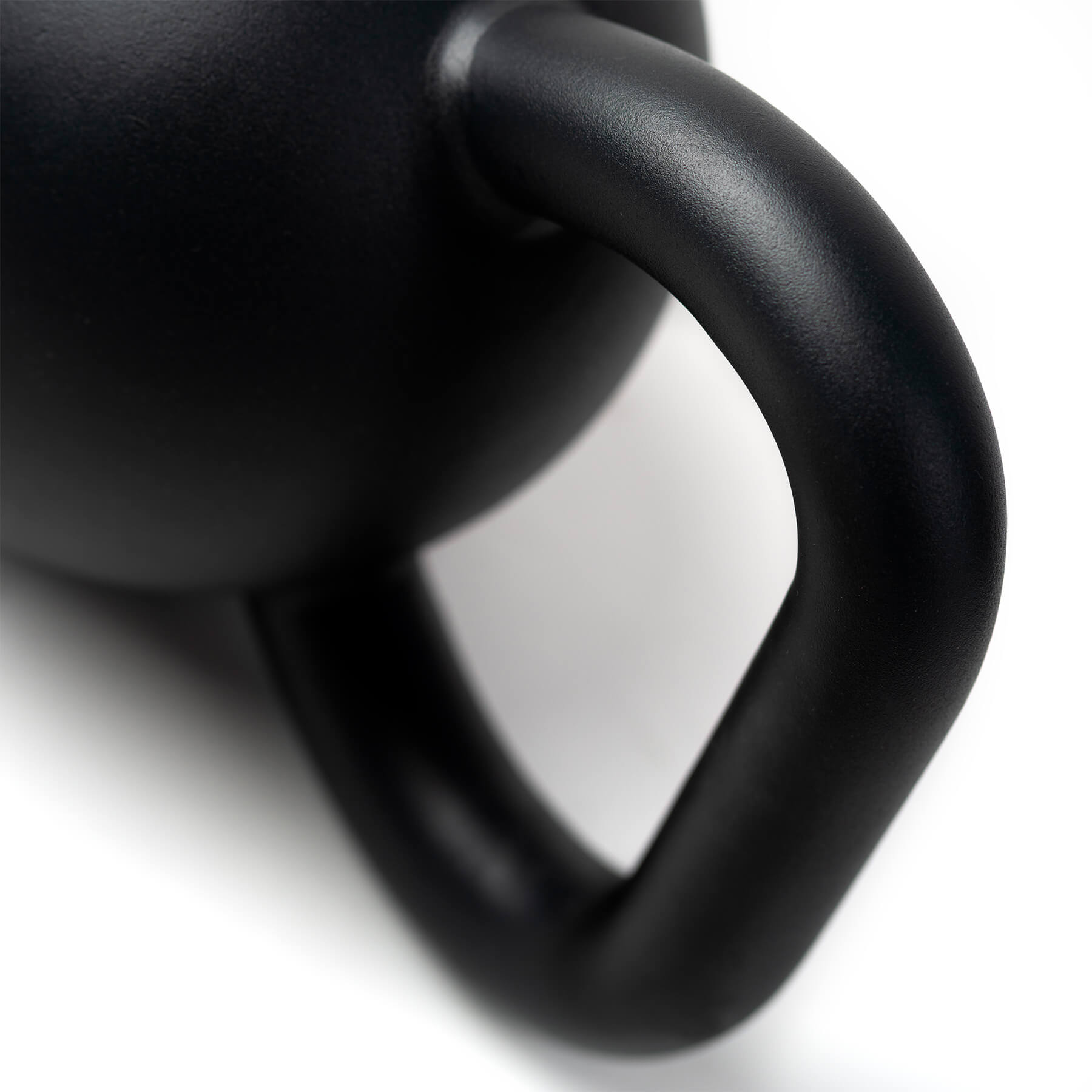
The functional difference is dimensional consistency. A cast iron kettlebell grows physically as the weight increases: the 32 kg bell is noticeably larger than the 16 kg bell, so the rack position and the bell path change as an athlete progresses. A competition steel kettlebell keeps the same external dimensions and the same 35 mm handle diameter at every weight, so technique stays constant.
| Type | Dimensions | Best for | Price excluding VAT |
|---|---|---|---|
| Coated cast iron | Vary with weight | General conditioning, classes, mixed-ability memberships | 29.50 EUR at 4 kg, 59 EUR at 8 kg, 119 EUR at 16 kg, 179 EUR at 24 kg, 239 EUR at 32 kg |
| Competition steel | Constant at every weight, 35 mm handle | Girevoy sport, competitive boxes, coaching-led studios | 55 EUR at 4 kg, 105 EUR at 16 kg, 130 EUR at 20 kg |
| Adjustable | Constant shell, variable core | Very small studios and mobile trainers | Storage saving offsets a higher unit price |
For a commercial floor, the practical answer is usually a cast iron ladder from 4 to 32 kg in 4 kg steps, with a small competition steel subset at 16, 20 and 24 kg for the coached snatch and jerk work. Full professional kettlebell ranges are available in both.
Barbells: the three criteria that matter
A commercial barbell is judged on load rating, sleeve rotation and knurling.
- Rated load. At least 680 kg for a cross training environment. Tensile strength of 190,000 PSI or higher indicates a bar that will not take a permanent set after repeated drops.
- Sleeve rotation. Needle bearings for weightlifting, where the bar must spin fast under the athlete during a snatch or clean. Bronze bushings for general strength training and powerlifting, where slower, more controlled rotation and lower cost are preferable.
- Knurling. Dual knurl marks (IWF and IPF) on a general-purpose bar so it can serve both disciplines. A centre knurl helps back squats and hinders cleans, so most mixed-use floors specify without it.
Commercial chrome bars start at 144 EUR excluding VAT for a 150 cm model and 195 EUR excluding VAT for the standard 220 cm 20 kg reference. Coloured cerakote and specialist bars run from 157 EUR excluding VAT for a 10 kg training bar up to 398.50 EUR excluding VAT for premium finishes. A hexagonal trap bar, worth having on any floor that programmes loaded carries or deadlift variations for beginners, sits at 275 EUR excluding VAT. See the full Olympic barbell range.
Plates: bumper, polyurethane or cast iron
The rule is simple. If the bar can touch the floor from height, the plate must be a solid rubber bumper. If the plate loads a machine or a bar that is always racked, a coated cast iron or polyurethane plate is cheaper and takes less storage volume.
| Plate type | Use | 5 kg | 10 kg | 15 kg | 20 kg | 25 kg |
|---|---|---|---|---|---|---|
| Standard solid rubber bumper | Cross training, general drop use | 63 EUR | 93 EUR | 118 EUR | 147 EUR | 166 EUR |
| IWF-specification competition bumper | Competition platforms, tighter tolerance, low bounce | 115 EUR | 194.50 EUR | 238 EUR | 292 EUR | 342.50 EUR |
| Polyurethane Olympic disc | Plate-loaded machines, racked barbell work | 34.10 EUR | 68.20 EUR | 102.30 EUR | 136.40 EUR | – |
All prices excluding VAT, per plate. Buy competition-grade bumpers only for the platforms used in competition preparation; on class floors the standard grade is the correct specification and roughly half the cost.
Flooring under a free-weight zone
Free weights are the reason gym floors fail. Three thickness bands cover almost every case:
- 15 to 20 mm under dumbbell racks, benches and general resistance work. From 22 EUR per square metre excluding VAT.
- 25 to 30 mm under kettlebell zones and light barbell work, where implements are set down rather than dropped. From 32 EUR per square metre excluding VAT.
- 40 mm and above in any zone where a loaded barbell is released from hip or shoulder height. Rooms above an occupied floor should go to 50 or 60 mm, or add a bonded acoustic underlay.
Getting this wrong is expensive twice: once when the tiles compress and split, and again when the room has to be emptied to replace them.
Storage and racking
Storage is a safety item, not an aesthetic one. Loose plates and dumbbells on a class floor are the most common cause of minor injury claims in commercial gyms. Budget a three-tier dumbbell rack per 10 pairs, a vertical bumper tree at around 499 EUR excluding VAT per unit, and a wall-mounted or A-frame barbell holder per four bars. Storage typically adds 8 to 12 per cent to the free-weight equipment budget and reduces plate loss materially in its first year.
Standards and compliance
Free weights and their storage for supervised or paid-access use fall under EN ISO 20957-1:2024, class S, the professional and commercial use class. Class H denotes domestic equipment and should not appear on a commercial floor; class I covers inclusive professional equipment for supervised use by people with disabilities. Accuracy classes A, B and C describe the tolerance of any load indication, which is relevant when a club advertises calibrated plate weights. Where the free-weight zone is in a publicly accessible building, the reaction-to-fire classification of the flooring must also be checked against the applicable national building requirements.
Frequently asked questions
What dumbbell range does a commercial gym need?
A full rack usually runs from 2.5 to 50 kg in 2.5 kg increments, which is 20 pairs. Strength-oriented clubs extend to 60 or 70 kg. Hotel and corporate gyms typically stop at 30 kg and use the saved budget on increment granularity at the lower end, which is where their members actually train.
What is the difference between a cast iron and a competition kettlebell?
A cast iron kettlebell changes size as the weight increases, so the rack position and bell path shift as an athlete moves up. A competition steel kettlebell keeps identical external dimensions and a 35 mm handle at every weight, which keeps technique constant and is why it is mandatory in girevoy sport.
What flooring should be installed under a free-weight area?
Shock-absorbing rubber tiles of 25 to 40 mm across the general free-weight zone, rising to 40 mm or more wherever a loaded barbell is dropped. On upper floors, add a bonded acoustic underlay or move to 50 to 60 mm. Fifteen millimetre tiles are for cardio and machine areas only.
Do I need competition bumper plates?
Only for a platform used in competition preparation or for a certified competition. Competition plates hold a tighter weight tolerance and a lower bounce, and cost around twice a standard bumper. For class use, standard solid rubber bumpers with a steel insert are the correct specification.
How much floor area does a free-weight zone need?
Allow 25 to 35 per cent of a gym floor for free weights in a strength-oriented club, and plan 2.5 by 2.5 m per barbell station, 2 by 1.2 m per bench, and a 1.2 m circulation corridor in front of every dumbbell rack.
Equipping a free-weight zone? Light In Fitness has supplied fitness clubs, cross training boxes, hotels, care facilities and public authorities across Europe and export markets since 2013, with floor audits, rack and load sizing, delivery and installation. Send us your floor plan and membership profile and we will return a costed specification. Request a quote or browse our professional dumbbell ranges.
Réalisations documentées
- Dalles et sols sportifs : livraisons documentées – plusieurs chantiers
- Sol sportif extérieur, square Georges-Vallerey – Taverny (95)
À lire aussi sur le même thème
- Bulgarian split squat: technique, muscles worked and equipment specification
- Ab wheel: technique, progression and commercial specification
- Lifting straps: when to use them, which type and how to wrap them
- Power towers, pull-up bars and wall bars: the bodyweight equipment specification guide
- Battle ropes: exercises, specification and how to anchor them properly