Battle ropes: exercises, specification and how to anchor them properly
La battle rope développe la puissance des épaules, le gainage et la capacité cardiovasculaire avec un impact articulaire minimal. Les vagues alternées constituent le mouvement de base, genoux fléchis et buste gainé ; les vagues simultanées sollicitent davantage la chaîne antérieure. C'est un équipement peu encombrant, adapté aux espaces de cross training comme aux studios de coaching.
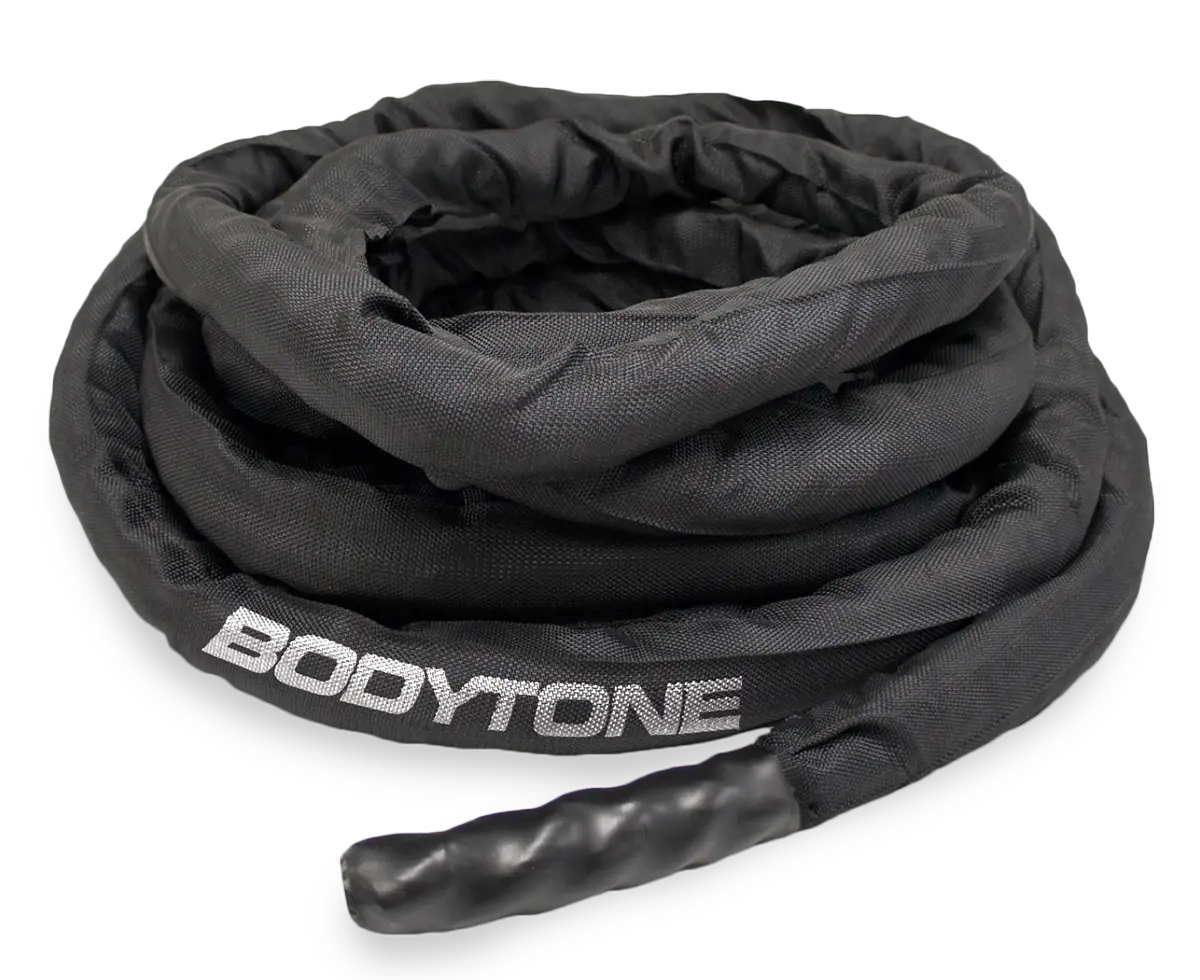
A battle rope station costs between 70 and 185 EUR excluding VAT, needs 4 to 5 m of clear length and about 2 m of width, and delivers a cardiovascular load comparable to sprinting with almost no joint impact. The two specification decisions that matter are the rope length, 12 to 15 m folded in half around the anchor, and the diameter, 38 mm for general use or 50 mm for grip and pure strength work. The third, and the one most operators get wrong, is the anchor.
Why battle ropes earn their floor space
A battle rope produces a high metabolic cost through the upper body without loading the spine or the knee. That combination is rare. It makes the rope useful in three very different settings: cross training conditioning, return-to-training programming for members with lower-limb restrictions, and small-group classes where a coach needs a station that scales to any fitness level simply by changing the interval.
Intervals of 20 to 30 seconds of work against 30 to 60 seconds of rest are the standard prescription. Eight to ten rounds is a complete conditioning block. Because the intensity is self-regulated by the athlete, one station serves a 20-year-old competitor and a 65-year-old member in the same class.
The four core movements
- Alternating waves. Knees soft, trunk braced, arms driving out of phase to produce fast, even undulations. This is the base movement and should be mastered before anything else.
- Simultaneous waves. Both arms in phase. Higher cardiovascular cost, more trunk demand, shorter sustainable duration.
- Slams. Rope lifted overhead and driven into the floor. Develops explosive power through the whole chain and is the loudest movement in the vocabulary, which matters in a mixed-use room.
- Outward and inward circles. Isolate the deltoids and load the shoulder in rotation. Useful for shoulder conditioning, and the movement most likely to expose a poor anchor.
Choosing the rope: three specifications
| Specification | Option | Effect | Recommended for |
|---|---|---|---|
| Length | 10 m folded (5 m per arm) | Faster wave, lower total load, smaller footprint | Studios, hotel gyms, corridors under 6 m |
| 15 m folded (7.5 m per arm) | Slower, heavier wave, higher metabolic cost | Cross training boxes, performance floors | |
| Diameter | 38 mm | General-purpose. Grip does not fail before the shoulders. | Mixed memberships, class use |
| 50 mm | Grip becomes a limiting factor; significantly heavier | Strength and combat sport preparation | |
| Sheath | Polyester sleeve | Protects the core, reduces fraying and fibre shedding indoors | Indoor floors, carpet-adjacent areas |
| Synthetic hemp, unsleeved | Abrasion-tolerant, weather-tolerant, sheds more | Outdoor training areas and military-style courses |
Indicative pricing: a 38 mm by 10 m rope sits at 70 EUR excluding VAT, and a 38 mm by 15 m rope at 185 EUR excluding VAT. The jump is not linear because rope mass rises with the square of the diameter and linearly with the length, and the 15 m rope is a materially heavier product.
The anchor is the part that fails
A rope in use applies a repeated, cyclic, off-axis pull. That is a fatigue load, not a static one, and it is the reason improvised anchors come loose. Four options, in ascending order of reliability:
- Rig upright. The simplest solution on a cross training floor. Pass the rope around a vertical member of an anchored rig and protect the rope with a sleeve at the contact point. Zero extra cost.
- Dedicated floor or wall anchor plate. Fixed with chemical anchors into structural concrete, never into plasterboard, hollow block or a screed topping. Specify the anchor to a working load of at least 5 kN and record the installation.
- Weighted anchor sled or plate stack. Movable, no fixing required. Suitable where the room is rented and drilling is not permitted; needs at least 40 kg of ballast for 38 mm rope work.
- Purpose-made rope anchor strap. Wraps a structural column and distributes load. Convenient for outdoor and temporary installations.
Whichever is chosen, inspect the anchor and the rope end at the same interval as the rest of the fixed equipment, and log it. Where the rope is anchored to a rig, that inspection is already part of the rig regime described in our rig anchoring and maintenance guide.
Floor, space and noise
Battle ropes are harder on the floor than they look. Slams concentrate impact on a narrow strip, and the constant abrasion of an unsleeved rope will polish and then tear a thin tile.
- Surface. Rubber tile of 20 mm minimum, 25 to 30 mm where slams are programmed. Artificial turf strips are a common and effective alternative because the pile takes the abrasion. See our rubber gym flooring range for thickness options.
- Footprint. Allow 4 to 5 m of length for a 10 m rope and 6 to 8 m for a 15 m rope, plus 2 m of width per station and a 1 m safety margin either side.
- Noise. Slams generate structure-borne noise that travels. In a first-floor studio or a hotel, position the rope station on the structural line of a wall rather than mid-span, and add an acoustic underlay.
Where the rope fits in a functional zone
A rope is rarely bought alone. In a 60 to 100 m2 functional area, the standard combination is two rope stations, a sled lane, a set of kettlebells, plyometric boxes and a wall ball target, all sharing the same shock-absorbing floor. That configuration supports circuit classes of 12 to 16 without queueing. Our professional gym accessories guide covers how to size the accessory inventory against class capacity.
Maintenance, inspection and service life
A battle rope is a consumable with a long life if two wear points are managed, and a short one if they are not.
- The anchor contact point. This is where the sheath abrades. Fit a protective sleeve or a length of hose at the fold and replace it as a cheap consumable. A rope that has worn through at the anchor cannot be repaired.
- The free ends. Heat-sealed or capped ends stop the core unravelling. Re-cap as soon as a cap splits rather than at the next service visit.
Add the rope and its anchor to the same documented inspection schedule as the fixed equipment: a visual check weekly and a recorded inspection monthly, looking at sheath integrity, anchor fixings and any deformation at the fold. On a rubber floor with a protected anchor, expect three to six years of commercial service. On bare concrete or an unprotected steel edge, expect considerably less.
One further operational point: ropes are stolen and mislaid more than any other accessory of their value, because they are portable and unbranded. Storing them on a dedicated wall hook rather than coiled on the floor solves the loss problem and the trip hazard at the same time.
Frequently asked questions
What length of battle rope should I choose?
Twelve to 15 m of total rope, folded in half around the anchor, giving 6 to 7.5 m of working length per arm. A 10 m rope produces a faster, lighter wave and suits rooms with less than 6 m of clear length, such as hotel and studio gyms.
Do battle ropes help with weight loss?
Used in short, high-intensity intervals they produce a calorie expenditure comparable to sprinting, while sparing the knees, hips and spine. That makes them one of the few high-intensity options available to members carrying a lower-limb restriction, which is where most of their value sits in a mixed membership.
How do you anchor a battle rope?
Around an anchored rig upright, through a plate fixed to structural concrete with chemical anchors, or around a weighted anchor of at least 40 kg where drilling is not possible. The load is cyclic, so the fixing must be specified for fatigue and inspected on the same schedule as the rest of the fixed equipment.
38 mm or 50 mm diameter?
Thirty-eight millimetres for general commercial use: it produces a demanding wave without grip failing before the shoulders do. Fifty millimetres is a specialist choice for combat sport and grip-focused strength programmes, and most members will not be able to sustain a useful interval with it.
How long does a battle rope last in a commercial gym?
Three to six years on a rubber floor with a protective sleeve at the anchor point, and considerably less on abrasive concrete or an unprotected steel edge. The two failure modes are sheath abrasion at the anchor and fraying at the free ends, both of which are prevented by cheap consumable protection.
Building a functional training zone? Light In Fitness has equipped gyms, cross training boxes, hotels and public facilities across Europe and export markets since 2013, with layout studies, flooring specification and installation. Tell us your room dimensions and class size and we will return a costed accessory and flooring specification. Request a quote or browse our functional training accessories.