Playground Inspections: What the Operator Must Do
Trois contrôles s'imposent dès la mise en service : l'inspection visuelle de routine (du quotidien au mensuel), l'inspection fonctionnelle (tous les 1 à 3 mois) et le contrôle annuel principal, ce dernier par une personne compétente et indépendante. Les décrets n° 94-699 et n° 96-1136 imposent au gestionnaire un plan d'entretien et un registre consultable. C'est le gestionnaire, et non le fabricant ou l'installateur, qui répond des contrôles après réception.
Three inspection regimes apply from the day a playground opens: routine visual inspection (daily to monthly), operational inspection (every one to three months) and the annual main inspection, the last of these carried out by a competent and independent person. The operator, not the manufacturer or the installer, is answerable for those inspections once the site has been handed over, and in most European jurisdictions must keep a maintenance plan and an inspection record available for the authorities.
Installing a playground does not end at handover. From the moment it opens, the operator, whether a municipality, a housing association, a campsite, a hotel or a school, becomes responsible for a regime of inspections and for keeping records. It is the part of the project most often discovered after the fact, even though it is what carries the liability.
Three levels of inspection
EN 1176-7, the guidance standard on installation, inspection and maintenance, distinguishes three complementary inspections to be organised from the day the playground is put into service.
| Inspection | Indicative frequency | By whom | Scope |
|---|---|---|---|
| Routine visual inspection | Daily to monthly depending on use | Technical staff or trained site keeper | Visible defects, missing parts, litter, damage and vandalism |
| Operational inspection | Every 1 to 3 months | Qualified technician | Stability, wear of moving parts, depth and displacement of the impact-absorbing surface |
| Annual main inspection | Yearly | Competent and independent person | Full structural and operational condition, compliance with EN 1176 |
Frequency follows real use: a heavily used site, or one exposed to vandalism, needs more frequent visits than the indicative minimum. For the annual inspection the standard calls for a competent and independent person, which rules out self-assessment by the same team that maintains the playground.
What the regulations require
A standard is voluntary until legislation refers to it, and the legal framework differs from one country to another. In most European jurisdictions the operator of a public-access playground has to draw up a maintenance plan and keep a file available for inspection by the competent authority. Check the national rules that apply where your playground is located before the site opens.
In practice that file contains the site layout plan, the documentation for each installed item and the record of inspections and interventions. The record is the sensitive point: its absence is a failing in itself, regardless of the actual condition of the equipment.
Who carries the liability
On a public site it is the operator of the playground who is answerable for the inspections, not the manufacturer or the installer once the works have been handed over. If an accident occurs, the operator can be held liable where it appears that the duties of supervision and maintenance were not met. Hence the importance of traceability: dated, signed and archived inspections are worth more than maintenance that was genuinely done but never documented.
What to require at delivery
The file is put together at handover, not six months later. Ask the supplier for:
- the EN 1176 declaration of conformity for each item of equipment;
- the site layout plan showing the free space zones and the free fall heights used;
- the assembly instructions and the manufacturer maintenance recommendations, which the annual inspection has to follow;
- the characteristics of the impact-absorbing surface installed and its EN 1177 conformity;
- the list of wear parts and their references, so replacements can be anticipated.
The surface is the item to watch first
The operational inspection covers, among other things, the depth and displacement of the impact-absorbing surface. On loose-fill surfaces the material migrates away from take-off and landing zones: a depth that complied on the day of installation can become insufficient within a season.
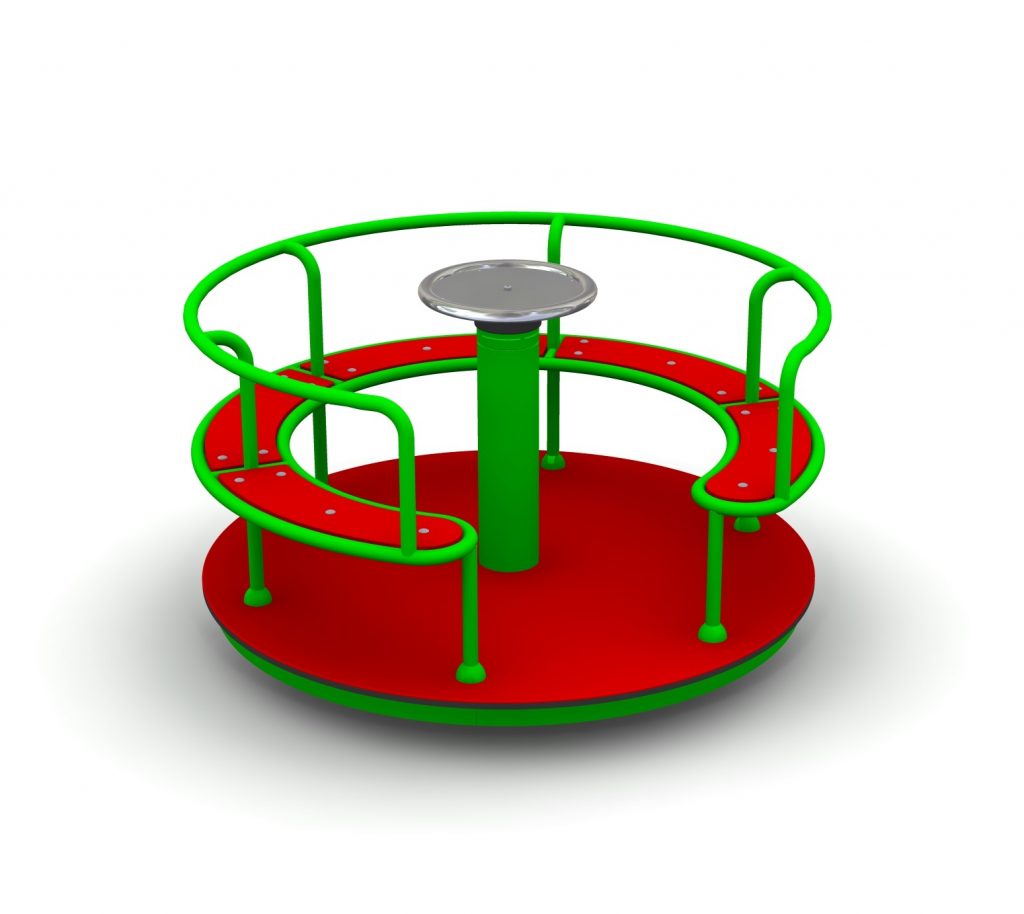
That is also why the free fall height chosen when the equipment is selected has lasting consequences. Equipment whose free fall height stays below 0.6 m does not require an EN 1177 impact-absorbing surface, which lightens the monitoring load as well: several playground roundabouts and spring riders fall into that category. Where a surface is required, see our playground surfacing range.
And for outdoor fitness
Outdoor fitness equipment falls under EN 16630, which is distinct from EN 1176 for playgrounds: the inspection regime and the expected documentation are not identical. Which standard applies to which item is a question to settle when the specification is written, not afterwards. On a mixed site the two regimes coexist side by side.
See the full range of playground equipment and outdoor gym equipment. For a new project or a compliance upgrade, request a quote: the layout plan and the declarations of conformity are supplied with the equipment.
This article sets out the general framework applicable at the date of publication. It does not replace the advice of an accredited inspection body or reading the legislation in force in your country.
Frequently asked questions
Are playground inspections compulsory?
In most European jurisdictions, yes: the operator must have a maintenance plan and keep a file available for the competent authority. EN 1176-7 sets out the three levels of inspection. Confirm the requirements applicable in your country.
How often?
Routine visual inspection daily to monthly depending on use, operational inspection every one to three months, main inspection once a year. A busy site or one exposed to vandalism needs more frequent visits.
Who can carry out the annual inspection?
A competent and independent person, in line with EN 1176-7 and in close accordance with the manufacturer instructions. Visual and operational inspections can be carried out by trained technical staff.
What should the record contain?
The site plan with the position of each item, the documentation for the installed equipment, and the dated trace of inspections and interventions. The absence of a record is a failing in itself.
Who is liable in the event of an accident?
The operator of the playground, not the manufacturer or the installer once the works have been handed over. Liability can be pursued if the duties of supervision and maintenance were not met.
Réalisations documentées
- Cage street workout ultime, Carcassonne – armée française
- Cage street workout ultime, Tahiti – armée française, Polynésie
- Cage SP Max, centre EPIDE de Combrée – établissement public d’insertion
- Cage SP Max, lycée Saint-Bénigne de Dijon – établissement scolaire
Sources et références
- Décret n° 96-1136 du 18 décembre 1996 – prescriptions de sécurité relatives aux aires collectives de jeux (Légifrance)
- NF EN 1176-1 – Équipements et sols d’aires de jeux, partie 1 : exigences de sécurité et méthodes d’essai générales (AFNOR)
- NF EN 1177 – revêtements de surface amortissants : détermination de la hauteur de chute critique (AFNOR)
- NF EN 16630 – modules fixes d’entraînement physique de plein air : exigences de sécurité et méthodes d’essai (AFNOR)